

Written by Nihatcan YanikCommissioned Content
Written by Nihatcan YanikCommissioned Content
The agentic economy: Why AI agents need a different kind of payment rail
CommissionedPublishedMar 23, 2026
Current blockchains lack the privacy and cost predictability needed to support the millions of daily transactions generated by AI models. But a Bitcoin-based payments layer is starting to address those limits.
Commissioned byUtexo
Disclaimer. This content is part of a paid partnership. The text below is a sponsored article that is not part of Cointelegraph.com editorial content. The material is written by our advertorial team and has undergone editorial review to ensure clarity and relevance, it may not reflect the views and opinions of Cointelegraph.com. Readers are encouraged to conduct their own research before taking any actions related to the company. Disclosure.

The next phase of the digital economy won’t be built by humans alone. Autonomous AI agents, which are software programs that execute tasks, negotiate services and manage workflows, are beginning to transact with one another. They can book travel, manage supply chains and consume APIs.
They also can already make payments in limited ways, but current rails are poorly suited to the volume, latency and unit economics that autonomous workflows require. A human might make a handful of payments in a day. An agent executing a complex workflow could trigger thousands of microtransactions per hour, per user it serves.
Multiply that across millions of concurrent agents, and the numbers become astronomical. Stripe’s 2025 annual letter put a fine point on it: the world may need blockchains that support “more than one million — or even one billion — transactions per second.”
But throughput alone misses the point. The real friction is structural. Most public blockchains were built for trading and decentralized finance (DeFi), not for the specific demands of machine-to-machine commerce.
Agents require cost predictability, instant finality and privacy. On networks where fees spike with congestion and every transaction is publicly broadcast, those requirements break.
Three things agents need (and blockchains don’t have)
Let’s consider what an agent actually requires to function autonomously.
Cost predictability: If a transaction fee exceeds the transaction value, the model collapses. An agent cannot pause mid-execution to check current gas prices or recalculate economics. Any fee structure with a minimum floor or market-driven volatility is mathematically incompatible with micropayments.
In early 2026, adjusted data showed AI agent payments volumes were significantly lower than initial hype suggested (around $1.6 million monthly). This is most likely because the infrastructure to support high-frequency, low-value transactions isn’t yet in place.
Privacy: When an agent makes thousands of purchases on a user’s behalf, every transaction becomes a data point. On a public ledger, that creates a surveillance record more granular than any human payment history has ever reached. Competitors could analyze flows. Individuals could have their preferences exposed.
Instant finality: Humans tolerate a two-second checkout. Agents operating in real-time pipelines cannot wait for block confirmations. Settlement must happen in milliseconds, or the workflow stalls.
These are not features that can be bolted onto existing chains. They require a different architecture entirely.
Settlement vs. execution: The lesson from Visa
The natural response to a scale problem is to design a faster system. Build a new blockchain with higher throughput. Optimize consensus. This is the instinct behind much of the infrastructure being proposed for agentic commerce today. But it misunderstands the problem.
Visa processes around 65,000 transactions per second at peak. It does not settle each transaction individually. It runs on pre-authorized credit lines and batched settlements. Fast execution occurs offchain; final settlement happens later, in bulk.
That layered architecture, separating execution from settlement, is the only model that has reached global scale. Bitcoin (BTC) and Lightning Network rebuilt the same logic as open, non-custodial infrastructure.
Payments execute offchain across millions of independent channels simultaneously. Settlement occurs onchain only when channels close. Capacity scales horizontally as the network grows.
For agentic commerce, this design offers a viable path forward.
The missing piece: Stablecoins with privacy and predictability
Lightning provided the execution layer. But until recently, it lacked one crucial component for agents: a stable asset. Volatility exposure is not acceptable for commerce, machine or human.
RGB, a client-side validation protocol, fills that gap. It enables stablecoins natively on Bitcoin and Lightning, with a trade-off familiar to the original Bitcoin design: transaction history is validated offchain while Bitcoin handles the anti-double-spend. RGB keeps contract state offchain rather than exposing balances and transaction history on a globally visible ledger.
In late 2025, Tether announced plans to bring Tether (USDT) to Bitcoin via RGB, describing it as “a powerful new pathway on Bitcoin.”
An execution layer for private USDT
Infrastructure exists. But infrastructure alone isn’t usable. Payment operators like wallets, exchanges and payment service providers need a way to integrate these rails without rebuilding their stack from scratch.
Bitcoin-native settlement network Utexo provides one such layer. Focused on enabling native USDT settlement on Bitcoin, the company recently raised a $7.5 million seed round co-led by Tether, Big Brain Holdings and Portal Ventures, with participation from Franklin Templeton.
Utexo has raised $7.5M from @tether, @BigBrainVC, and @PortalVentures to bring USDT natively on Bitcoin.
After more than a decade, USDT is finally coming home. pic.twitter.com/Y8vIh0zU4P— Utexo (@utexocom) March 6, 2026
Utexo unifies Bitcoin, Lightning and RGB into a single API. Partners integrate once and route USDT over Bitcoin and Lightning without managing node infrastructure, channel liquidity or the cryptographic complexity of RGB. The stack offers three unique properties:
- Configurable fees denominated in USDT that don’t fluctuate with network activity.
- Instant finality via Lightning, secured by Bitcoin.
- Transaction privacy through RGB’s client-side validation model.
Under this model, it becomes possible for the business to determine what payments cost its users, rather than the network. As wallets expand, USDT adoption on Bitcoin could scale with them.
Tether ❤️ Bitcoin https://t.co/JnTTenByfl— Paolo Ardoino 🤖 (@paoloardoino) March 7, 2026
Built for the agentic future
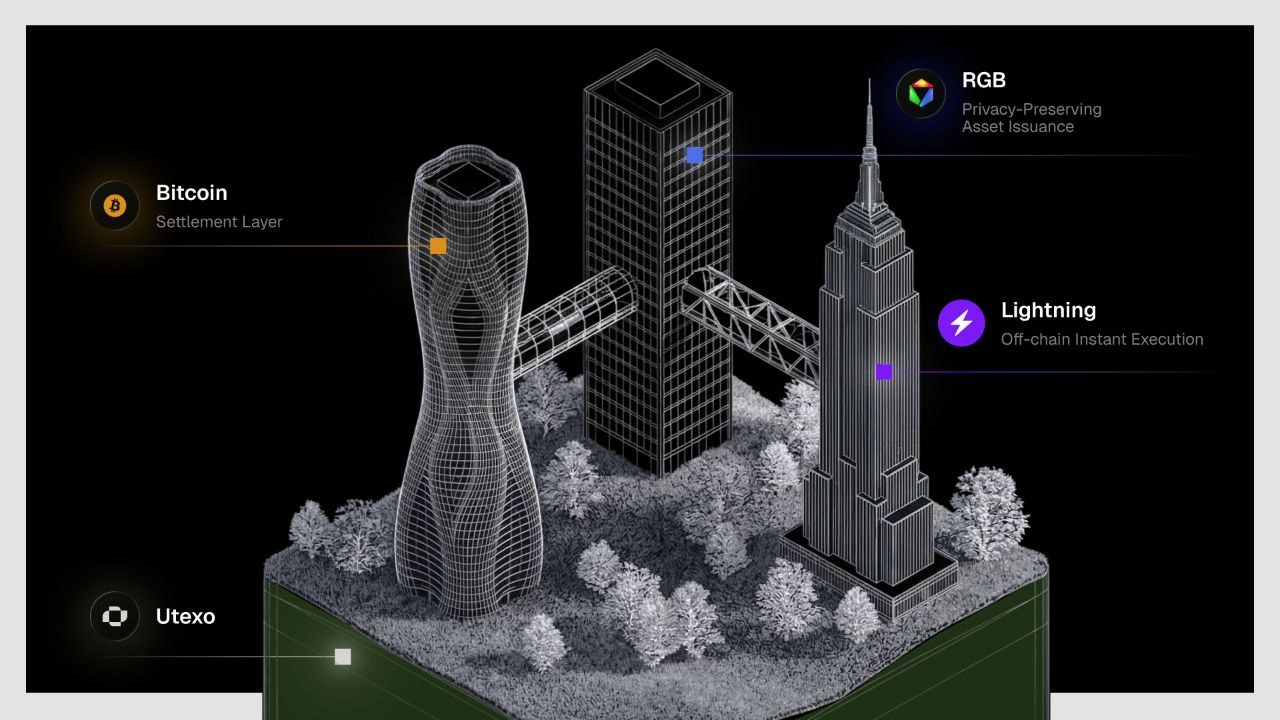
The account-to-account payments stack on Bitcoin includes several components: Bitcoin for finality, Lightning for execution, RGB for privacy and Utexo as a coordination layer aimed at making the combination usable.
This stack aligns with what the current agents require. When an agent requests a resource, the server can respond with a Lightning invoice instead of a login prompt. Payment and authentication could collapse into a single action. Fees are known in advance. Settlement is sub-second. And transaction details are not broadcast to the public ledger.
Source: Utexo
The agentic AI market is projected to grow from roughly $4.5 billion to nearly $100 billion by 2033. The builders deploying autonomous agents today are making infrastructure choices that will compound over the next decade. The payment layers they integrate with now may become default rails for applications built on top of them.
As autonomous agents become more embedded in daily economic activity, the payments infrastructure supporting them must evolve accordingly. By demonstrating how Bitcoin, Lightning and RGB can work together for private, machine-to-machine settlement, projects like Utexo point toward a path forward for the broader ecosystem.


Subscribe to daily byte-sized crypto news from Cointelegraph
This content is part of a paid partnership. The text below is a commissioned article that is not part of Cointelegraph editorial content. The material is written by our advertorial team and has undergone editorial review to ensure clarity and relevance, it may not reflect the views and opinions of Cointelegraph.com. Readers are encouraged to conduct their own research before taking any actions related to the company. Disclosure.
More on the subject