

Here’s what happened in crypto today
3 hours ago

 Written by Nate Kostarstaff writerEdited by Robert Lakinstaff editor
Bitfinex Securities will restart USDt-denominated bond issuances on Bitcoin’s Liquid Network, following four previous tokenized offerings totaling $6.2 million since 2023.

Bitfinex Securities said on Monday it will resume issuing tokenized bonds for Luxembourg-based securitization fund ALTERNATIVE, with future sales expected to exceed $10 million.
The USDt-denominated bonds will be issued and settled on the Liquid Network, a Bitcoin sidechain, with fundraising, coupon payments and principal repayments executed fully onchain.
The move follows four prior tokenized bond issuances since 2023 totaling $6.2 million, three of which have matured and been fully repaid.
Across those offerings, investors received 20 onchain coupon payments worth more than $1.1 million by the completion of their first full tokenized bond cycle in 2025, according to the companies. The bonds give investors exposure to emerging-market private credit, including financing for small and medium-sized businesses and women-led enterprises.
Bitfinex Securities operates under licenses in the Astana International Financial Centre in Kazakhstan and in El Salvador, and handles issuance, listing and secondary trading, while Tether’s Hadron platform supports token management. The platform says it now lists about $250 million in regulated tokenized securities.
Jesse Knutson, head of operations at Bitfinex, told Cointelegraph that buyers have primarily been high-net-worth crypto investors and crypto-focused institutions from Europe and Asia seeking yield on their USDt (USDT) holdings.
The tokenized bonds operate alongside the issuer’s conventional monthly bond program and typically carry an 11-month duration. Transactions are recorded on the Liquid Network, though key settlement details are shielded by its confidential transaction features.
He added, “There’s been a lot of discussion this year around yield-generating stablecoins. This product offers a solution with an easy, regulated and established vehicle for earning yield on USDt balances.”
Related: Bitcoin exposes the structural weaknesses that banks refuse to admit
The relaunch comes as debate continues over whether stablecoins should be allowed to offer yield and how such products should be regulated in the United States.
With the passage of the US GENIUS Act in July 2025, stablecoin issuers were barred from paying yield, but the law did not explicitly prohibit third parties from offering returns through separate products. The “loophole” allowed exchanges or other third-party platforms to structure securities or lending instruments that generate yield in stablecoins without the issuer itself distributing interest.
Banks have warned that high-yielding stablecoin products could pull deposits away from the traditional financial system. In January, Bank of America CEO Brian Moynihan said interest-bearing stablecoins could drain as much as $6 trillion in deposits from US banks, arguing that large-scale migration into digital dollar products could reduce lending capacity and increase funding costs.
The debate has become one of the most contentious issues surrounding the CLARITY Act, proposed US legislation aimed at establishing a broader regulatory framework for digital assets. On Jan. 14, Coinbase CEO Brian Armstrong withdrew his support for the bill, citing stablecoin yield as one of the key sticking points.
Still, some lawmakers remain optimistic. On Feb. 18, US Senator Bernie Moreno said he hopes Congress can move forward on market structure legislation by April, speaking to CNBC at US President Donald Trump’s Mar-a-Lago property in Florida. Armstrong, who joined Moreno in the interview, also said he believes there is a path forward “where we can get a win-win-win outcome here.”
Prediction market data from Polymarket currently assigns a 70% probability that the Clarity Act will be signed into law in 2026.
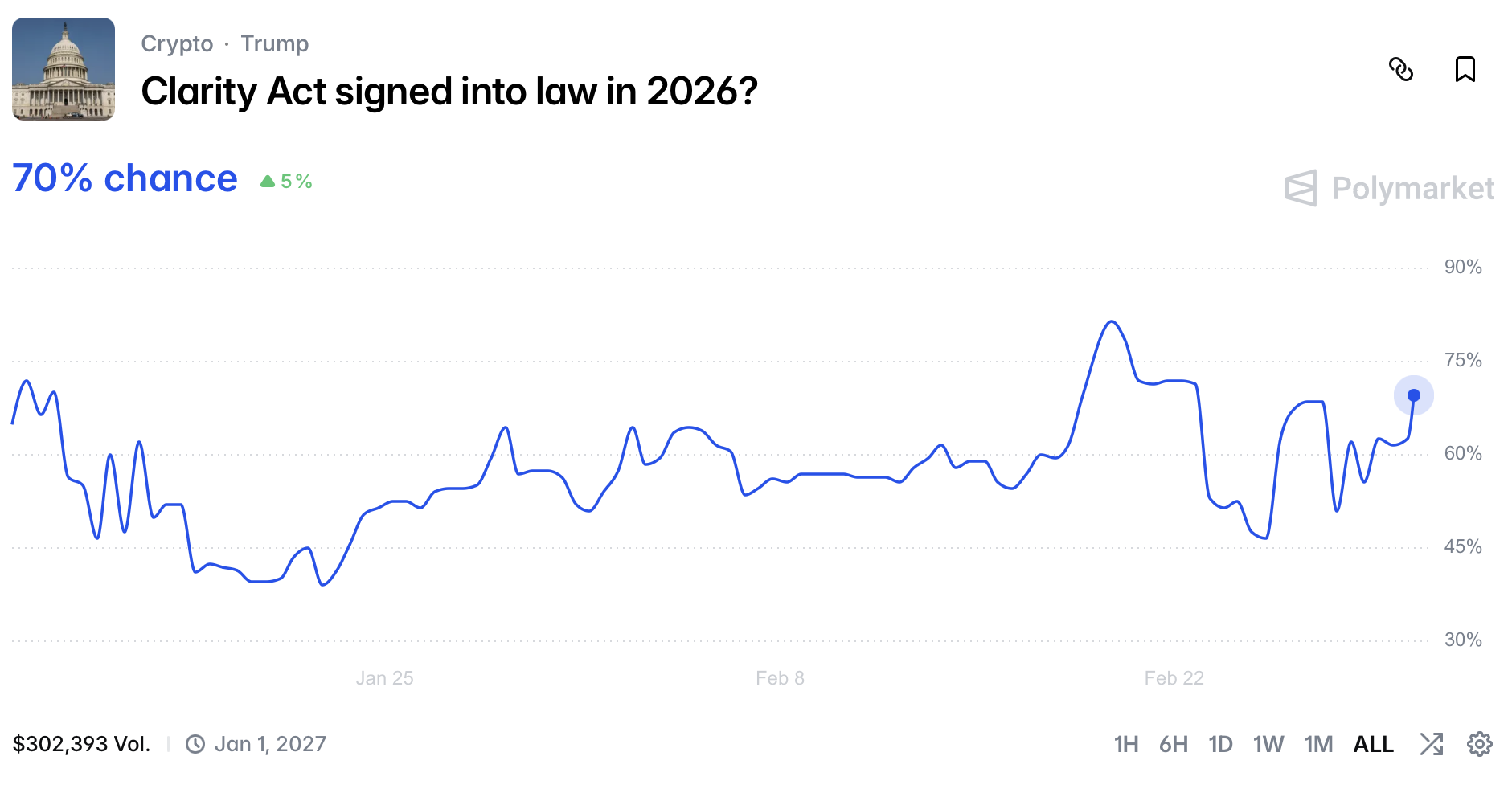
Source: Polymarket
Magazine: Clarity Act risks repeat of Europe’s mistakes, crypto lawyer warns