


 Written by Helen Partzstaff writerEdited by Yohan Yunstaff editor
Prediction markets defy crypto downturn with record Q2 volume: CoinGecko
Latest NewsPublishedJul 16, 2026
Prediction markets reached a record $113.8 billion in notional volume in Q2 as spot CEX trading, derivatives volume and stablecoin market cap declined.

Cryptocurrency markets struggled broadly in the second quarter of 2026, with declines across stablecoins, spot trading and derivatives, but prediction markets reached record highs.
Spot trading volume across the top 10 centralized exchanges (CEXs) fell to $1.95 trillion in the second quarter of 2026, a 27.9% drop from $2.7 trillion in Q1, according to CoinGecko’s latest Crypto Industry Report published Thursday.
CEX perpetual futures volume also declined 10% to $12.7 trillion, while the stablecoin market slipped 1.6% to $305.1 billion. In contrast, prediction markets recorded their strongest quarter on record with $113.8 billion in notional volume.
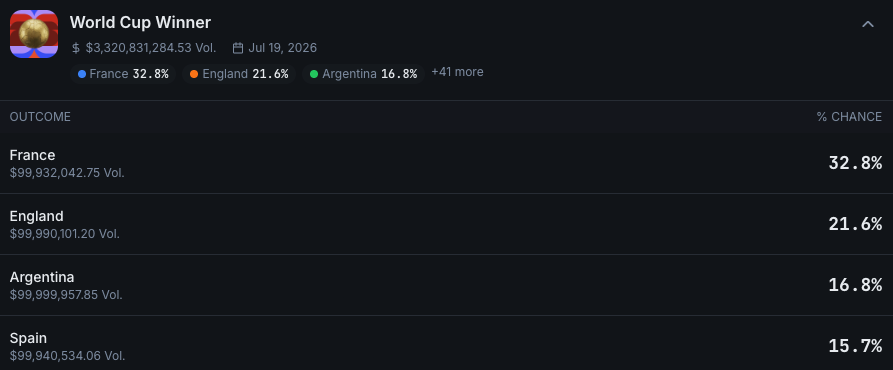
The divergence highlights the growing role of prediction markets, with sports and politics emerging as the sector’s biggest drivers. Polymarket’s World Cup winner market alone has attracted more than $3.3 billion in trading volume, while contracts tied to the 2028 US presidential election rank among the platform’s largest markets, according to Polymarketscan data.
Source: Polymarketscan
Binance extends dominance despite bear market as DEX activity falls
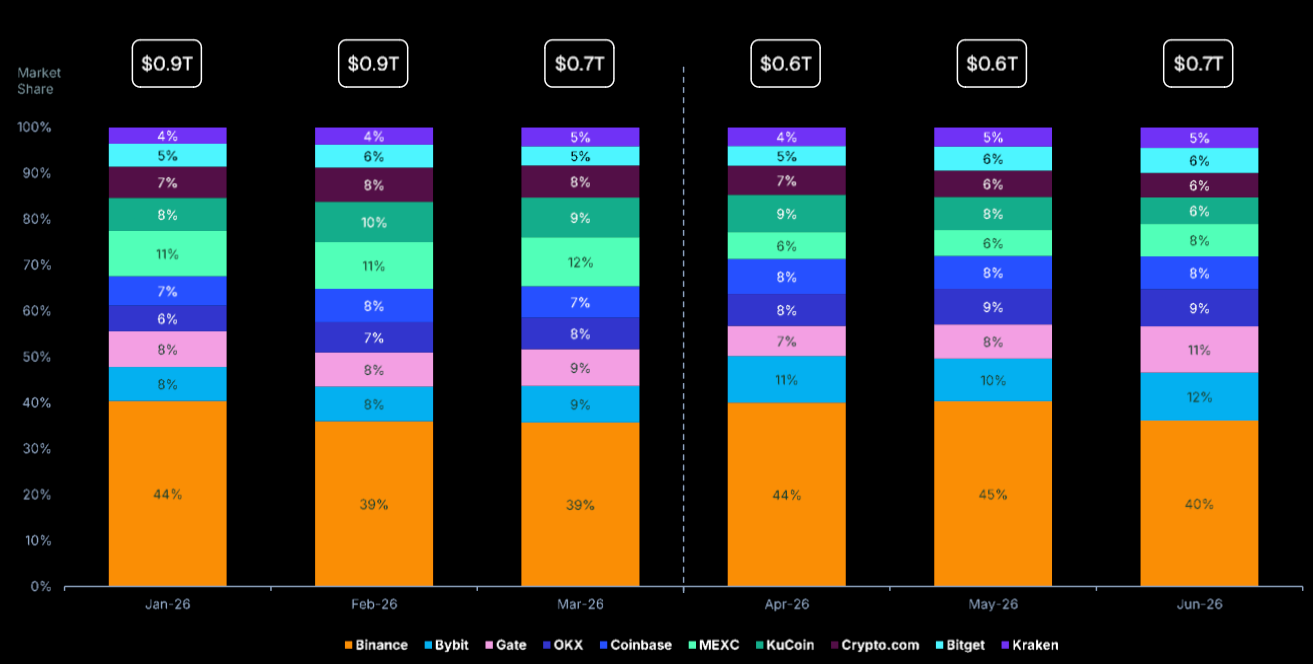
Despite the bear market, Binance extended its dominance, with a 38.7% market share in Q2. In contrast, MEXC saw the biggest slump among spot CEXs, with trading volume more than halving from $275.2 billion in Q1 to $121.2 billion in Q2.
DEX activity also weakened during the quarter, with the top 10 spot DEXs processing $408.9 billion in volume, down from $556.4 billion in Q1. Uniswap strengthened its position as the leading DEX, holding a 41.2% market share despite a 21.4% drop in volume to $168.5 billion.
Source: CoinGecko
The declines came as the broader crypto market weakened, with total market capitalization falling 12.6% to $2.1 trillion during the quarter. April also marked a record month for hacks in decentralized finance (DeFi), highlighting ongoing security concerns across decentralized platforms.
Kalshi holds lead as prediction markets expand
Prediction market activity peaked in June, coinciding with the start of the FIFA World Cup, as monthly notional volume — the total value of all contracts traded — reached an all-time high of $50.7 billion, up 91.9% from the average of the previous five months.
Kalshi, the largest prediction market platform, maintained its lead over the quarter with a 58.9% market share, while Polymarket lost share from 35.8% to 30.2%. Robinhood-backed Rothera Markets climbed to fourth place.
Related: Czech Republic tells ISPs to block Polymarket after gambling blacklisting
The growth has drawn regulatory attention. In the US, regulators and states have clashed over whether prediction markets should be treated as financial markets or gambling platforms, with lawsuits involving platforms such as Kalshi escalating in 2026.
Authorities in other jurisdictions have also moved to restrict prediction markets, citing concerns including gambling rules, market integrity and potential insider trading risks.
Magazine: Has Bitcoin bottomed for this cycle? Analysts say ‘not yet’


Subscribe to daily byte-sized crypto news from Cointelegraph
Cointelegraph is committed to independent, transparent journalism. This news article is produced in accordance with Cointelegraph’s Editorial Policy and aims to provide accurate and timely information. Readers are encouraged to verify information independently.
More on the subject