


 Written by Sam Bourgistaff editorEdited by Ana Paula Pereiraformer editor
DraftKings eyes crypto offerings as it expands into prediction markets
Latest NewsPublishedDec 19, 2025
DraftKings launches a prediction markets app in 38 states, setting the stage for future crypto-linked contracts under a regulated US derivatives framework.

DraftKings is expanding beyond sports betting into the realm of prediction markets, laying the groundwork for future crypto-linked contracts as regulated event trading gains momentum in the United States.
As Bloomberg reported, the company announced on Friday that it has launched the DraftKings Predictions app, which allows users to trade contracts on sports and financial outcomes. At launch, the app is available in 38 states, with sports-related trading permitted in 17 of them.
DraftKings ultimately plans to expand its prediction market offerings beyond sports and finance to include contracts linked to crypto, entertainment and cultural events, according to Bloomberg.
DraftKings’ push into prediction markets is underpinned by regulated derivatives infrastructure connected to CME Group–style market standards.
The company said trading will be conducted through Railbird Exchange, a derivatives venue it acquired and which is registered with the US Commodity Futures Trading Commission, allowing DraftKings to offer event-based contracts within an established regulatory framework.
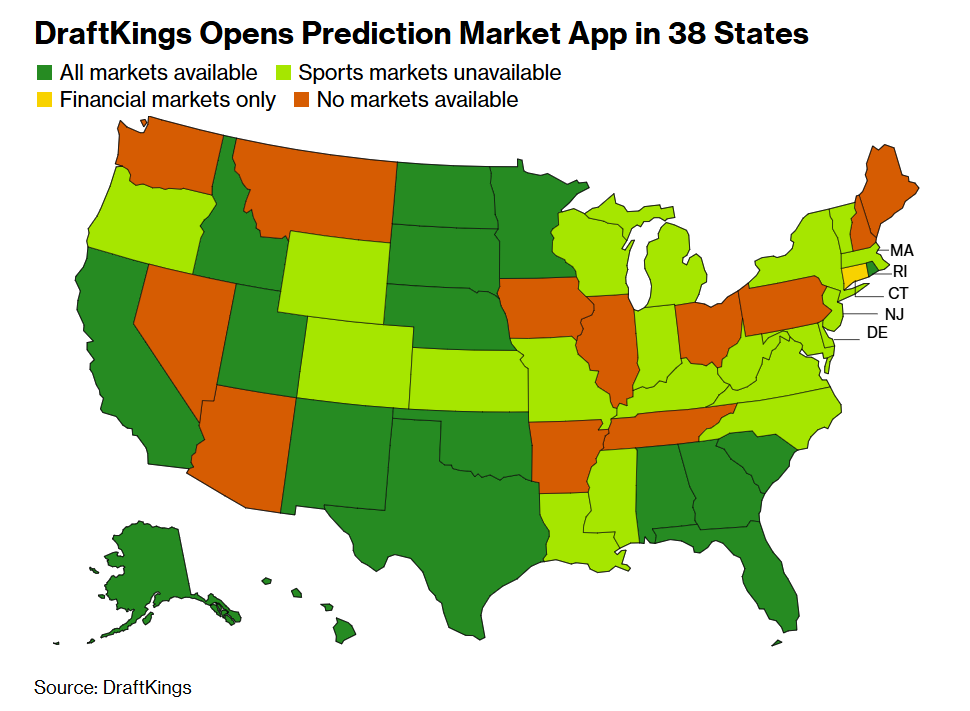
DraftKings’ growing national footprint. Source: Bloomberg
As a publicly traded US-based sports betting and entertainment company, DraftKings brings increased visibility and mainstream exposure to prediction markets and potentially crypto-linked contracts as regulated event trading gains traction in the United States.
In early November, DraftKings reported third-quarter revenue of $1.14 billion, up 4% year over year, alongside an adjusted loss of $127 million. The company said it expects to generate up to $6.1 billion in revenue this year, roughly triple the amount it generated in 2022.
Related: Polymarket shows stronger retention than most DeFi, wallets and exchanges
From Polymarket to Wall Street: Prediction markets go mainstream
While DraftKings’ prediction market offering is not built on blockchain or decentralized technology, the broader sector has gained momentum in recent years largely due to crypto-native platforms that redefined how prediction markets operate.
The most prominent example is Polymarket, which brought prediction markets onchain by using crypto rails to enable global participation and near-instant settlement.
The platform helped popularize prediction markets among crypto-native users, particularly during major political events and most notably the 2024 US presidential election. Its rise has coincided with growing interest in other event-based trading venues, including Kalshi, a US-regulated prediction market operating under the Commodity Futures Trading Commission (CFTC).
Beyond consumer-facing platforms, crypto-focused financial infrastructure providers are also expanding into the space. Bitnomial Clearinghouse, a derivatives clearing organization regulated by the CFTC, has signaled plans to support prediction markets tied to cryptocurrency and macroeconomic outcomes.
Crypto-native exchanges are also broadening their product suites to include prediction-style offerings. Coinbase recently announced plans to integrate stock trading and prediction markets into its long-term vision of becoming an “everything app.”
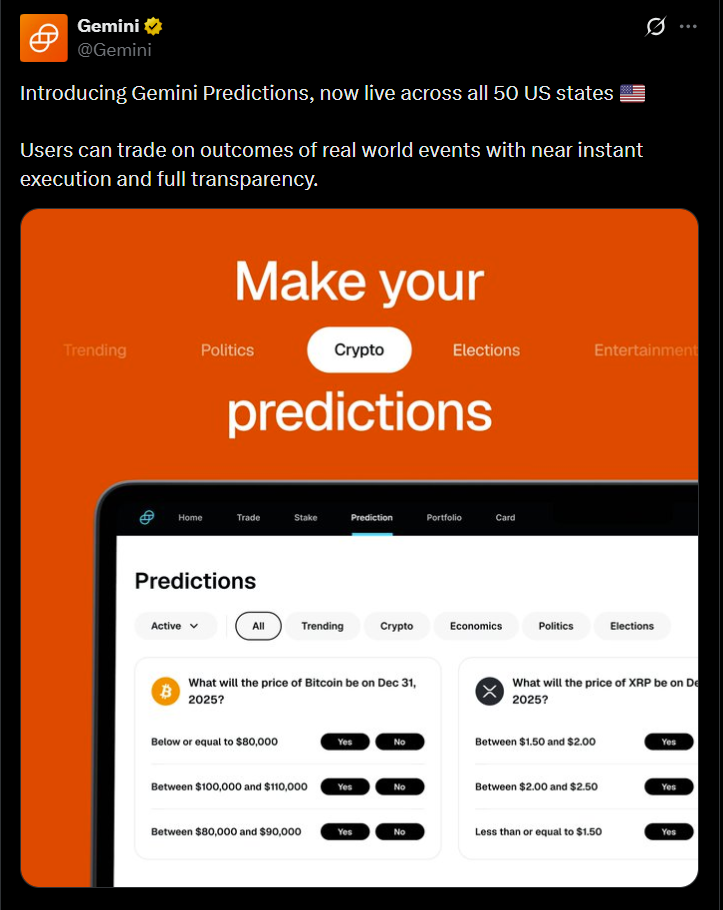
Source: Gemini
Meanwhile, the Winklevoss-led Gemini cryptocurrency exchange has launched prediction markets in the US, having secured the necessary regulatory approvals.
Related: Phantom taps Kalshi to offer regulated prediction markets in wallet


Subscribe to daily byte-sized crypto news from Cointelegraph
Cointelegraph is committed to independent, transparent journalism. This news article is produced in accordance with Cointelegraph’s Editorial Policy and aims to provide accurate and timely information. Readers are encouraged to verify information independently.
More on the subject