

 Written by Martin Youngformer writerEdited by Felix Ngstaff editor
Illicit stablecoin activity hit 5-year high of $141B in 2025: TRM Labs
Latest NewsPublishedFeb 20, 2026
Sanctions evasion networks, guarantee marketplaces, and large-scale money laundering schemes dominated illicit stablecoin use, says TRM Labs.
Illicit entities received around $141 billion via stablecoins in 2025, the highest level observed in the last five years, says blockchain analytics firm TRM Labs.
TRM said in a report released on Tuesday that the increase doesn’t reflect a broader growth in crypto-enabled crime, but does show a “deeper reliance on stablecoins within specific activity types where they offer clear operational advantages.”
Stablecoins have been particularly used in sanctions-linked networks and large-scale money movement services, it said.
Sanctions-related activity accounted for 86% of all illicit crypto flows in 2025. Of the $141 billion in stablecoin flows, around half, or $72 billion, was linked specifically to the Russian ruble-pegged token A7A5, “whose activity is almost entirely concentrated within sanctions-linked ecosystems,” TRM said.
Russian-linked networks, such as one called A7, intersect with other state-linked ecosystems, including entities tied to China, Iran, North Korea, and Venezuela, “underscoring how stablecoins have become a connective infrastructure for sanctioned actors seeking to move value outside traditional financial controls,” TRM stated.
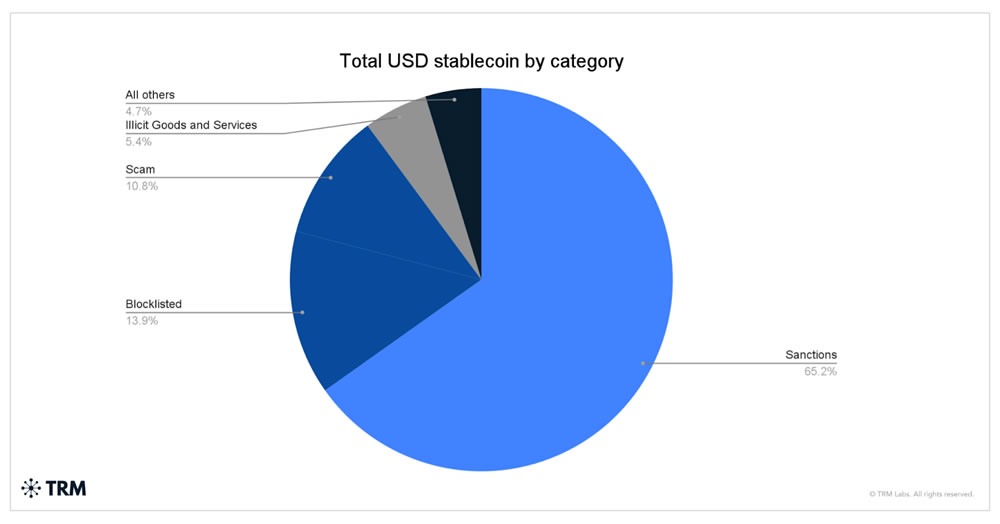
Evasion of sanctions accounts for the majority of illicit stablecoin use. Source: TRM Labs
Guarantee marketplaces exclusively on stablecoins
Comparatively, scams, ransomware, and hacking activity make more selective use of stablecoins, often favoring Bitcoin (BTC) or other crypto assets before using stablecoins later in the laundering process.
The report also noted that categories such as illicit goods and services and human trafficking showed “near-total stablecoin usage,” suggesting these markets “prioritize payment certainty and liquidity over price appreciation.”
Volume on guarantee marketplaces like Huione surged to over $17 billion by late 2025, predominantly in stablecoins.
“The fact that roughly 99% of this volume is denominated in stablecoins reinforces the role these services play as laundering infrastructure, not speculative venues,” they stated.
Related: Crypto launderers are turning away from centralized exchanges: Chainalysis
Chainalysis reported earlier in February that crypto flows to suspected human trafficking networks increased 85% year over year in 2025. International escort services and prostitution networks operated almost exclusively using stablecoins, they noted.
TRM Labs reported that total stablecoin transaction volume exceeded $1 trillion on multiple occasions in 2025.
Approximating this over a year yields around $12 trillion, meaning illicit use accounts for about 1% of the total.
Compared with the United Nations estimate, the amount of illicit money laundered globally in one year is 2% to 5% of global GDP, or around $800 billion to $2 trillion.
Magazine: Chinese New Year boosts interest, TradFi buying crypto exchanges: Asia Express


Subscribe to daily byte-sized crypto news from Cointelegraph
Cointelegraph is committed to independent, transparent journalism. This news article is produced in accordance with Cointelegraph’s Editorial Policy and aims to provide accurate and timely information. Readers are encouraged to verify information independently.
More on the subject