


 Written by Stephen Katteformer writerEdited by Felix Ngstaff editor
SEC drops case against BitClout founder with prejudice
Latest NewsPublishedMar 16, 2026
The regulator filed for dismissal of its case against BitClout founder Nader Al-Naji, after “reassessment of the evidentiary record."

Update: March 19, 12:24 AM UTC: This article has been updated to include responses from the SEC, Nader Al-Naji and Markus Levin, the co-founder of XYO.
The US Securities and Exchange Commission (SEC) has dropped a two-year-long case against the founder of the blockchain-based social media platform BitClout, Nader Al-Naji.
In the joint dismissal stipulation filed in the US District Court for the Southern District of New York on Thursday, the SEC cited the crypto task force, which was tasked with developing a regulatory framework for crypto in January 2025, and a “reassessment of the evidentiary record” as the basis for dismissal.
The regulator cautioned that the outcome doesn’t necessarily mean other enforcement actions will receive the same treatment. “The Commission’s decision to exercise its discretion and seek dismissal of this litigation is based on the particular facts and circumstances of this case and does not necessarily reflect the Commission’s position on any other case,” it said.
Still, under the Trump administration, the SEC has slowly been walking back its hardline stance toward crypto companies, dismissing a increasing number of enforcement actions.
An SEC spokesperson declined to comment beyond the public filings and associated court filings.
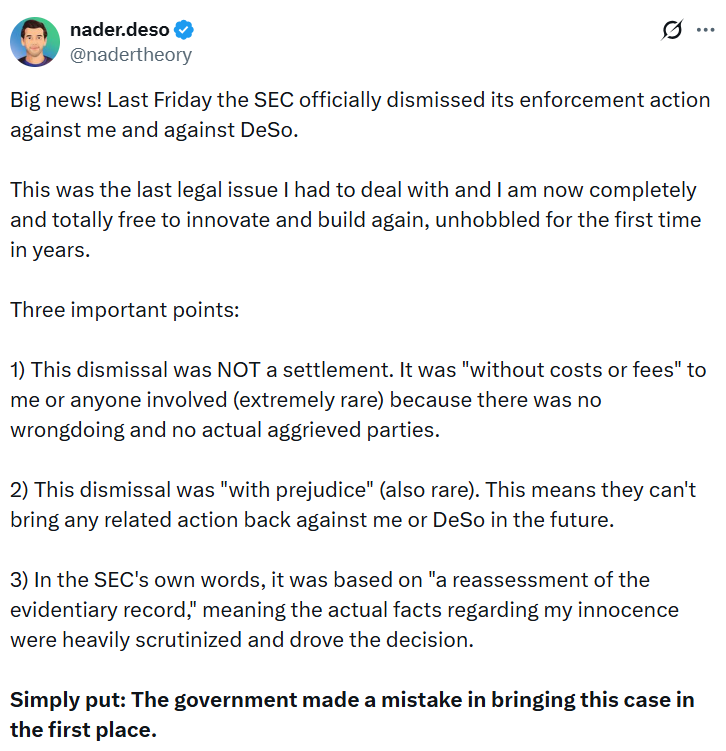
Naji said in an X post on Monday he was “unhobbled for the first time in years,” and accused the past administration of making “mistakes in bringing this case in the first place.”
“It was an alleged fraud with no actual misrepresentation nor any actual aggrieved parties. My lawyers said they'd never seen anything like this, and I think it speaks to how dogmatically anti-crypto the prior administration's SEC was,” he added.
Source: Nader Al-Naji
Accusations included spending money on a mansion
Al-Naji is a former Google engineer, the founder of the Basis protocol and creator of the DeSo blockchain. He founded BitClout and launched it publicly in March 2021.
The SEC’s July 2024 complaint accused Al-Naji of raising more than $257 million by selling the native token of the BitClout platform, BTCLT, while telling investors the funds wouldn’t be used to pay any BitClout team members.
Al-Naji was also accused of spending more than $7 million on personal items, including rent for a Beverly Hills mansion and cash gifts to family members, and also mischaracterizing the inner workings of the platform as decentralized, with no governing company controlling it, despite allegedly running the project behind the scenes himself.
As part of the settlement, Al-Naji has waived any claims for reimbursement of legal fees or expenses against the SEC. The regulator has dismissed the case with prejudice, meaning it can't bring another case against Al-Naji or the relief defendants mentioned, including his mother, wife, and several companies under his control, again using the same charges.
Markus Levin, the co-founder of XYO, told Cointelegraph that “reassessment of the evidentiary record” means the SEC re-examined the case and decided the facts didn’t support the charges as clearly as they believed, or proving the case in court would be more difficult than expected.
“Even when a complaint includes allegations about personal spending, regulators still have to prove the underlying legal violation. In a case like this, that usually means demonstrating that investors were misled, that the assets qualify as securities under US law, and that the founder knowingly misused investor funds,” he said.
If the evidence supporting that claim or the broader securities case weakens, the SEC may decide it’s not worth continuing. Crypto cases add another layer of complexity because courts are still debating how digital assets should be classified under securities law.”
Dismissals are uncommon, but not unusual
Levin said another factor in the dismissal could have been that the case might have required a definitive answer on how digital assets are classified under securities law, and the SEC might have decided “it’s strategically better to withdraw the case rather than push a weaker theory through the courts.”
“Dismissals aren’t common, but they aren’t extraordinary either. Regulators regularly reassess cases as litigation progresses and sometimes conclude the evidence or legal theory isn’t strong enough to continue,” he said.
“Crypto cases are somewhat unique because the legal framework is still evolving. Courts are still determining how existing securities laws apply to digital assets, which creates uncertainty that doesn’t exist in more established financial sectors.”
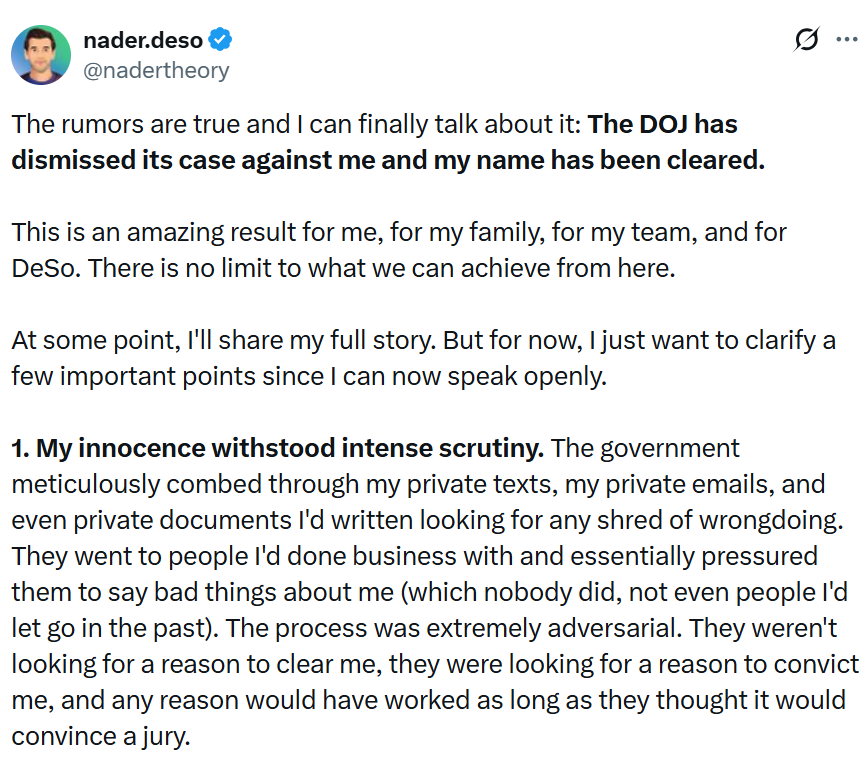
The Department of Justice also ended a parallel case accusing Al-Naji of wire fraud in February 2025 without prejudice. Al-Naji said in an X post last year that the government's case was dismissed because it didn’t hold up under scrutiny.
Source: Nader Al-Naji
Magazine: Spot Bitcoin ETFs first green week, crypto ATM losses surge 33%: Hodler’s Digest, Mar. 8 – 14


Subscribe to daily byte-sized crypto news from Cointelegraph
Cointelegraph is committed to independent, transparent journalism. This news article is produced in accordance with Cointelegraph’s Editorial Policy and aims to provide accurate and timely information. Readers are encouraged to verify information independently.