

 Written by Christina Combenstaff writerEdited by Ailsa Sherringtonformer editor
Nevada court hits Polymarket with temporary restraining order, tests CFTC control
Latest NewsPublishedFeb 3, 2026
A Nevada judge has temporarily barred prediction market Polymarket from offering event contracts in the state, pushing back against claims that only the CFTC can police those markets.

A Nevada state judge has temporarily forced onchain prediction market Polymarket to halt business in the state, with a ruling that challenges the industry’s argument that federal commodities law preempts state gambling rules.
In a Thursday order seen by Cointelegraph, the court granted the Nevada Gaming Control Board a 14‑day temporary restraining order (TRO) against Polymarket operator Blockratize. The order bans Polymarket from offering event‑based contracts to Nevada residents while the case develops. A preliminary injunction hearing is scheduled for Feb. 11.
The order leans on Nevada gambling statutes, finding at this early stage that Polymarket’s sports and other event markets constitute unlicensed wagering rather than regulated financial products.
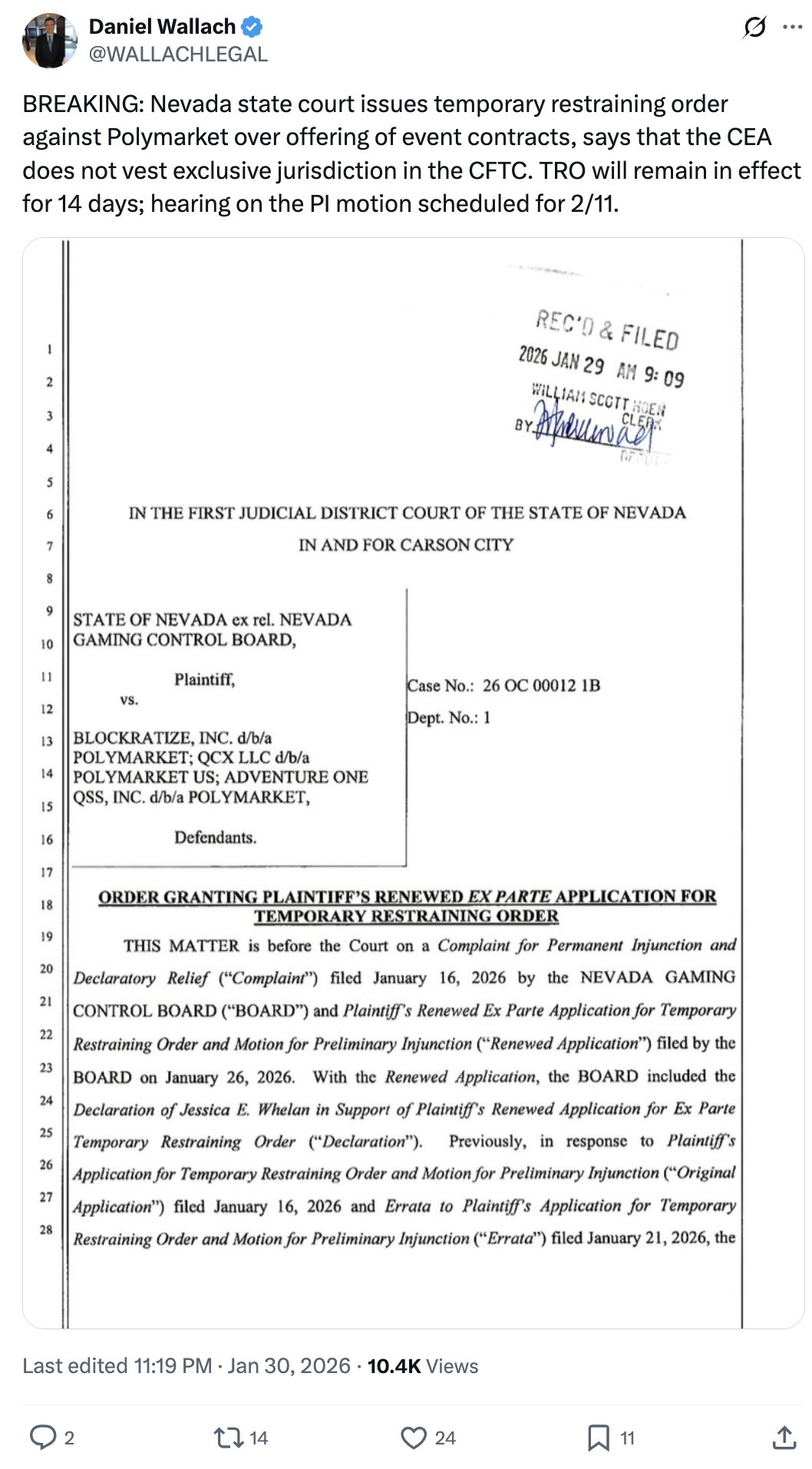
Sports and gaming lawyer Daniel Wallach provided Cointelegraph with a copy of the court order. Source: Wallach
The judge cited “immediate” and “irreparable” harm to the state’s ability to police betting integrity, underage gambling and suitability standards if the platform continued operating in the state without a gaming license.
In doing so, the court rejected Blockratize’s contention that the Commodity Exchange Act gives the US Commodity Futures Trading Commission (CFTC) exclusive jurisdiction over its event contracts, concluding that Nevada can still apply its own gaming laws.
Cointelegraph has reached out to Polymarket for comment.
Nevada joins Tennessee in prediction market pushback
The case follows a broader enforcement pattern in the prediction markets industry. Last month, Tennessee’s Sports Wagering Council ordered Kalshi, Polymarket and Crypto.com’s North American Derivatives Exchange to halt sports event contracts for state residents, void Tennessee trades and refund users. The council argued that those products were sports bets subject to state gambling regulation.
Related: Coinbase launches prediction markets in all 50 US states via Kalshi
Tennessee regulators emphasized consumer protection gaps, including age verification and responsible gaming tools, in their rationale.
The Nevada and Tennessee actions also land amid a wider clash. Kalshi, a CFTC‑designated contract market, has spent almost a year fighting state and federal cases over whether its products are derivatives or illegal gambling. Results have been mixed. It won temporary protection in some jurisdictions like Connecticut and New Jersey, but faced adverse rulings or dissolved injunctions in others, including Nevada and Maryland.
In December, Coinbase sued regulators in Connecticut, Illinois and Michigan. The crypto exchange asked federal courts to declare that prediction markets listed on a CFTC‑regulated venue fall under the Commodity Exchange Act and the CFTC’s claimed exclusive jurisdiction, as opposed to 50 separate state gambling codes.
Magazine: When privacy and AML laws conflict — Crypto projects’ impossible choice


Subscribe to daily byte-sized crypto news from Cointelegraph
Cointelegraph is committed to independent, transparent journalism. This news article is produced in accordance with Cointelegraph’s Editorial Policy and aims to provide accurate and timely information. Readers are encouraged to verify information independently.
More on the subject