


 Written by Christina Combenstaff editorEdited by Bryan O'Sheastaff editor
ZOOZ's Bitcoin treasury play faces Nasdaq delisting clock
Latest NewsPublishedDec 23, 2025
ZOOZ’s minimum bid‑price notice makes it the latest Bitcoin treasury stock to brush up against Nasdaq’s listing rules.

ZOOZ Strategy’s Bitcoin-backed stock has been put on a Nasdaq compliance clock after the exchange warned the company its shares no longer meet the $1 minimum bid-price requirement, raising the risk of delisting if the price fails to recover within six months.
The dual‑listed firm, which trades on Nasdaq and the Tel Aviv Stock Exchange, said in a Monday statement that it plans to monitor the situation, and it may consider a reverse share split if needed.
A reverse share split is when a company reduces the number of its outstanding shares and raises the price per share proportionally, typically to lift the stock price without changing the firm’s overall market value.
The top 100 Bitcoin treasury companies collectively hold over 1 million BTC, and the number of public companies holding Bitcoin rose 38% between July and September amid deepening institutional adoption. At the time, market watchers claimed that the rising accumulation by treasury companies place upward pressure on the price of Bitcoin.
Related: Monster week for crypto treasury firms with $8B buying blitz
ZOOZ’s Bitcoin bet under pressure
ZOOZ is built around a long‑term Bitcoin treasury strategy, and has accumulated 1,036 BTC (BTC) as a strategic asset, which gives its shareholders indirect exposure to Bitcoin. That pitch helped the stock grab attention when it launched earlier this year, but it has not prevented the share price from sliding under the $1 threshold.
The notice does not mean an immediate delisting. Under Nasdaq rules, ZOOZ has until June 15, 2026, to post a closing bid of at least $1 for 10 straight trading days, and could be eligible for a second grace period if it meets other criteria.
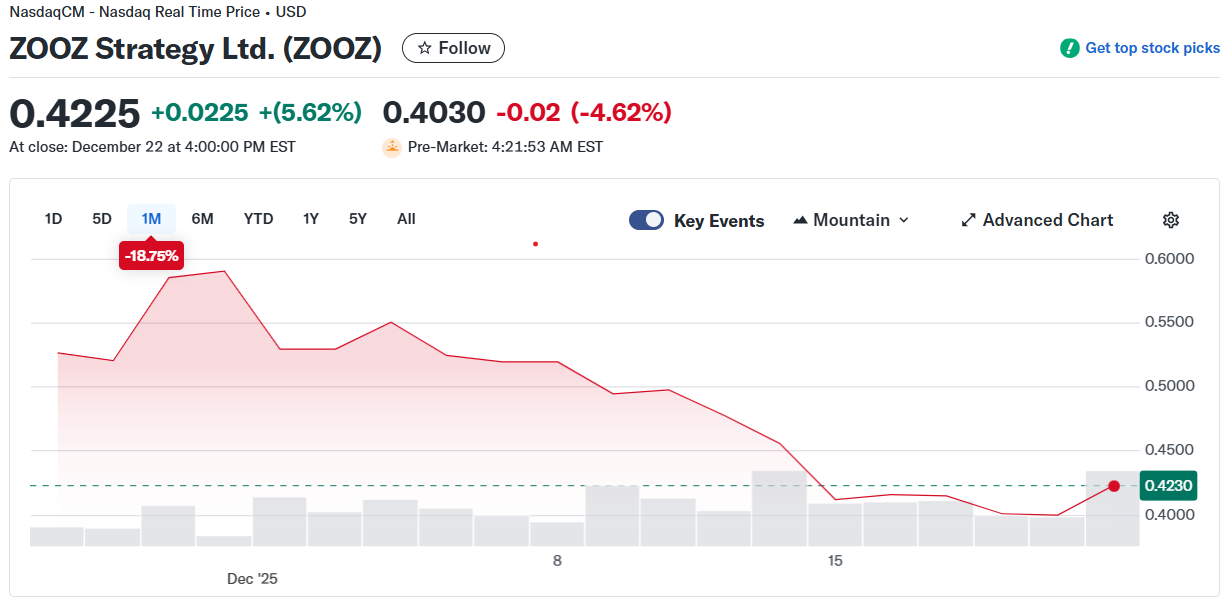
Zooz share price tanks below $1. Source: Yahoo Finance
For now, the company says its operations are unaffected, but acknowledges that it may need to use “available options.”
Related: ETHZilla liquidates $74.5M in Ether to redeem convertible debt
Winners and losers of the Bitcoin strategy
ZOOZ’s warning lands less than a week after KindlyMD, another Bitcoin treasury player created via a merger with David Bailey’s Bitcoin‑native holding company Nakamoto, disclosed its own price‑deficiency notice from Nasdaq after its shares slipped below the $1 mark.
Listing pressure is not limited to pure Bitcoin treasuries. Digital Currency X Technology (DCX), a digital‑asset firm that reports more than $1.4 billion in token holdings following its EdgeAI token acquisition, announced on Dec. 18 that it had received a separate Nasdaq non‑compliance notice tied to minimum market‑value requirements.
This doesn’t mean that all Bitcoin treasuries are on thin ice. Tokyo‑listed Metaplanet, which also leans on Bitcoin as a treasury asset, has continued to find ways to tap capital markets, most recently clearing the issuance of new shares and Bitcoin‑linked dividend instruments aimed at institutional investors.
Strategy, the best‑known corporate Bitcoin holder, has also kept pressing its strategy into December, adding roughly $980 million in BTC in mid‑month and lifting its total stash to over 671,000 coins.


Subscribe to daily byte-sized crypto news from Cointelegraph
Cointelegraph is committed to independent, transparent journalism. This news article is produced in accordance with Cointelegraph’s Editorial Policy and aims to provide accurate and timely information. Readers are encouraged to verify information independently.
More on the subject