



 Written by Dilip Kumar Patairyastaff writerEdited by Rahul Nambiampurathstaff editor
ChatGPT can read your finances, but it still cannot be your advisor
MagazinePublishedMay 25, 2026
AI finance tools can analyze your money habits, but users should not confuse financial analysis with personalized investment advice.

AI can read your finances, not your life
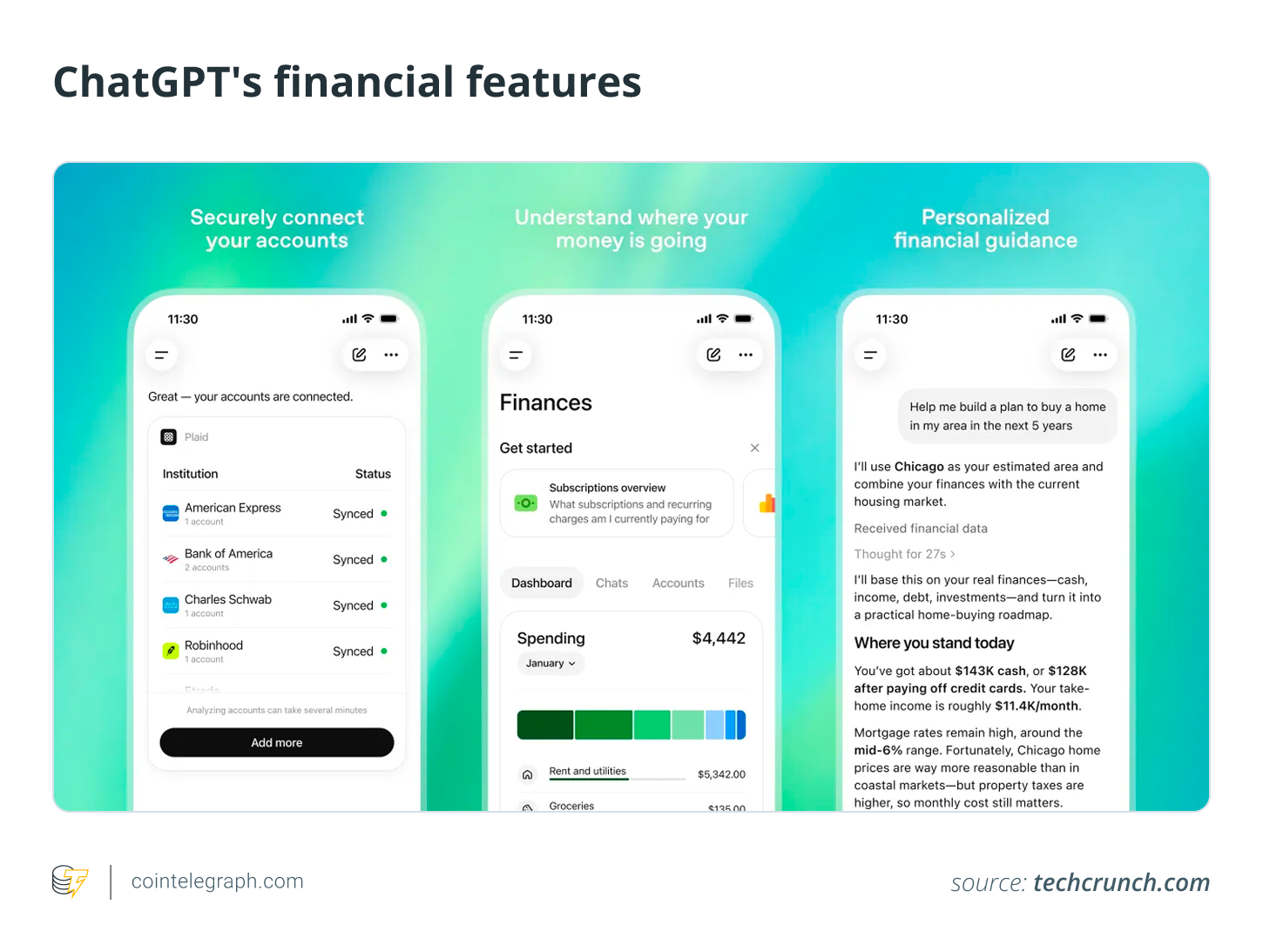
Artificial intelligence (AI) is moving further into personal money management. Following OpenAI’s launch of account-linked features in ChatGPT, users can now ask natural-language questions about their spending, recurring payments, savings and portfolios rather than reviewing spreadsheets or navigating banking platforms.
The interaction may feel advanced. ChatGPT can now connect to users’ Chase, Fidelity and Robinhood accounts, but experts are already raising concerns.
A conversational AI tool can summarize transaction details, identify spending patterns and explain financial concepts in plain language. For many, particularly younger investors and those interested in crypto, this may feel like the beginning of smarter financial oversight.
However, there is an important difference.
Analyzing financial information is not the same as providing sound financial advice. Despite ChatGPT’s ability to review spending records and portfolio details, it still lacks the regulatory accountability, personal judgment and contextual understanding expected of a qualified financial professional.
AI could develop into a powerful financial support tool. However, relying on it instead of human judgment involves risks that users may underestimate.
What ChatGPT’s finance features can actually do
OpenAI’s financial account integration allows users to link compatible accounts through platforms such as Plaid. Once connected, ChatGPT can review account balances, spending patterns and payment records.
This enables questions such as:
- “Where is most of my money going?”
- “How much am I spending on subscriptions?”
- “Why did my expenses increase last month?”
- “Which categories take up most of my budget?”
- “How diversified are my investments?”
Instead of manually sorting through apps or spreadsheets, users can ask questions directly about their financial data.
This could significantly change personal money management. Traditional budgeting apps often require users to interpret charts, labels and summaries on their own. AI makes the process more interactive and easier to understand.
For anyone who feels overwhelmed by money management, that ease of use can be helpful.
Why this is a big change
Money management has traditionally been fragmented. Bank accounts, investment platforms, crypto exchanges, credit services and tax software typically operate separately.
AI changes how users interact with this information.
Instead of navigating multiple dashboards, people may increasingly turn to conversational tools that bring together details from different sources. In this role, AI acts as a financial translator.
This matters because the challenge is often not a lack of financial data, but difficulty understanding it. A conversational tool that explains the following could reduce confusion:
- Spending habits
- Borrowing patterns
- Recurring payments
- Cash flow changes
- Portfolio risks
- Tax categories
This may be particularly appealing to younger, tech-savvy users who are already comfortable sharing personal information with AI.
However, convenience introduces a new risk: overconfidence.
Did you know? Modern financial aggregation tools can automatically categorize thousands of transactions, helping people identify recurring subscriptions, unusual spending patterns and budget leaks in seconds rather than manually reviewing statements.
AI money tools: Understanding is not guidance
A major misconception about AI money tools is that analysis automatically amounts to financial advice.
It does not.
A qualified financial professional must assess whether a financial decision is suitable for a person’s circumstances. This involves considering factors such as:
- Risk tolerance
- Income stability
- Family responsibilities
- Health-related expenses
- Long-term goals
- Debt obligations
- Tax situation
- Legal or regulatory risks
- Emotional approach to money
Financial decisions are highly personal.
An AI tool might identify a large amount of idle cash and suggest considering higher-risk investments. However, it may not know that the person is preparing for medical treatment, supporting elderly relatives or facing job uncertainty.
Similarly, AI might flag a large crypto allocation without understanding whether the person has deliberately accepted that level of risk as part of a broader financial plan.
Whether a financial decision is suitable often depends on details that people never enter into digital platforms.
AI personalization does not guarantee suitability
AI tools can feel highly personalized because they draw on a person’s financial information. However, personalized output is not the same as suitable advice.
A conversational tool might provide suggestions that seem insightful simply because it references actual account balances or spending patterns. This natural style of interaction can lead users to believe the system understands their financial situation more fully than it does.
This creates a psychological risk.
People often place trust in tools that sound knowledgeable and confident. When an AI tool recommends reallocating a portfolio, reducing emergency savings or adjusting holdings, some may follow those suggestions without carefully evaluating the risks.
This risk is even greater in unpredictable markets such as crypto.
A conversational AI tool might explain market movements convincingly while still overlooking important factors such as:
- Market sentiment
- Liquidity risks
- Regulatory uncertainty
- Tax implications
- A person’s emotional ability to withstand losses
Regulators focus on AI financial risks
Financial regulators are paying closer attention to AI-powered investment tools and the claims used to promote them.
The US Securities and Exchange Commission (SEC), the Financial Industry Regulatory Authority (FINRA) and state securities regulators have warned investors about fraud involving purported uses of AI and other new technologies.
The SEC has also brought enforcement actions against investment firms for making false and misleading claims about their use of AI.
One major concern is “AI washing,” in which companies exaggerate or misrepresent how they use AI to make an investment product or service appear more advanced than it is.
Fraud is another risk.
Scammers are increasingly using AI-related language to build trust in fake trading platforms, automated investment schemes and crypto-related scams. Claims about AI-driven returns or automated market analysis may be used to make fraudulent offers appear credible.
This matters because conversational AI can sound convincing, even when its output is wrong or based on unreliable information.
An AI assistant may provide a plausible-sounding explanation for a risky financial decision without verifying the accuracy of the information behind it.
Financial information is different from regular data
An often-overlooked aspect of AI finance tools is privacy. Financial records reveal far more than account balances.
Transaction histories can reveal:
- Daily habits
- Travel patterns
- Healthcare expenses
- Changes in personal relationships
- Debt-related stress
- Donations to causes
- Subscriptions
- Investment strategies
Financial data can create a detailed picture of a person’s life. Anyone connecting financial accounts to digital services should understand what information is shared, how it is handled and which third parties may be involved.
Important questions include:
- What information is stored?
- How long is it retained?
- Can conversations be reviewed?
- What happens after an account is disconnected?
- Can third-party services access any of the information?
- How is financial data protected?
The issue is not necessarily that AI services are insecure. It is that combined financial data can be highly sensitive and valuable.
Did you know? The term “robo-advisor” became popular after automated investment platforms began offering algorithm-driven portfolio management in the late 2000s, long before generative AI chatbots entered personal finance.
Convenience can increase exposure
When individuals connect bank accounts, investment accounts, crypto platforms and credit services to a single conversational AI tool, they create a highly sensitive financial hub.
Even if the AI service is secure, account holders may still face risks such as:
- Phishing attempts
- Account takeover
- Stolen login credentials
- Malware
- Social engineering
Cybercriminals may target accounts linked to financial aggregation tools because access could reveal information about multiple assets and services in one place.
For crypto investors, this may be especially important because exchange accounts, self-custody activity and bank transfers can be closely connected.
The more complete the financial picture, the more valuable it may become to attackers.
AI can explain crypto risks, not remove them
Crypto investors may be particularly interested in testing AI money management features. A conversational tool might explain financial concepts clearly without fully assessing the risks involved. In highly volatile markets, confident-sounding responses can create a false sense of security.
ChatGPT can already assist with:
- Summarizing decentralized finance (DeFi) activity
- Categorizing wallet transactions
- Explaining staking processes
- Reviewing exchange records
- Assessing token allocations
- Organizing information for tax filings
These are practical uses, but AI should not replace personal judgment.
Crypto markets involve risks that even experienced professionals may struggle to assess:
- Smart contract vulnerabilities
- Liquidity failures
- Stablecoin depegging
- Governance risks
- Regulatory interventions
- Platform collapses
- Speculative token trends
Safety limits of AI in personal finance
AI works best as a financial support tool, not as a replacement for human judgment. Decisions involving investments, debt, taxes or long-term financial goals should not be based on AI output alone.
It can help users understand spending patterns, organize information and identify questions worth exploring. However, anyone using AI tools to review personal finances should also take basic precautions.
- Connect only the accounts needed for a specific purpose.
- Review account permissions and remove access when it is no longer required.
- Protect linked accounts with strong passwords and two-factor authentication.
- Avoid uploading sensitive financial documents unless required and only after understanding how the information will be handled.
- Verify important financial information independently before making a decision.
- Treat AI-generated insights as a starting point for research, not as personalized financial advice.
ChatGPT can make financial information easier to explore, but understanding data is only one part of making sound financial decisions. The value of AI lies in helping users ask better questions, not in making those decisions for them.


Subscribe to daily byte-sized crypto news from Cointelegraph
Cointelegraph publishes long-form journalism, analysis and narrative reporting produced by Cointelegraph’s in-house editorial team with subject-matter expertise. All articles are edited and reviewed by Cointelegraph editors in line with our editorial standards. Some articles contain affiliate links, from which Cointelegraph may earn a commission. These relationships do not influence which products we review or our editorial conclusions. Content published in here does not constitute financial, legal or investment advice. Readers should conduct their own research and consult qualified professionals where appropriate. Cointelegraph maintains full editorial independence.
More on the subject