


 Written by Aaron Woodformer editorEdited by Ailsa Sherringtonformer editor
Crypto mortgages in US face valuation risks, regulatory uncertainty
MagazinePublishedJan 20, 2026
Some lenders are willing to accept Bitcoin and recognize crypto holdings when considering a mortgage application, but issues around risk remain.

On Jan. 16, Pennsylvania-based lender Newrez announced plans to accept certain cryptocurrency holdings when considering mortgage applications. The change, which the company said will take effect in February, will apply to loans for homes, refinancing and other investment properties.
For Newrez, the plan comes on the tailwinds of directions from the US Federal Housing Finance Agency (FHFA) last year. In June 2025, the FHFA ordered Fannie Mae (Federal National Mortgage Association) and Freddie Mac (Federal Home Loan Mortgage Corporation) to develop plans for recognizing crypto in loan applications.
In doing so, crypto gained at least partial recognition from two major government enterprises that provide liquidity and stability to mortgage markets. At the time, Michael Saylor, chair of Bitcoin (BTC) treasury company Strategy, said, “Future generations will remember this as the moment Bitcoin entered the American dream.”
But despite guidance from housing authorities and growing acceptance, issuers are still risk-averse, and regulatory clarity is far from solid.
Crypto mortgages give young Americans a fighting chance
Expanding the “American dream” — i.e., homeownership — was at least one prominent motivator for the FHFA to make its decision. In his official directive to Fannie Mae and Freddie Mac, the agency’s director, Bill Pulte, wrote that crypto was to be considered as part of those companies’ goal to “help ensure sustainable, long-term home ownership.”
Homeownership rates in the US have remained relatively stable for the last 60 years. Peaks and valleys have occurred during recessions and other volatile economic events, yet the rate has stayed somewhere between 60% and 70%.
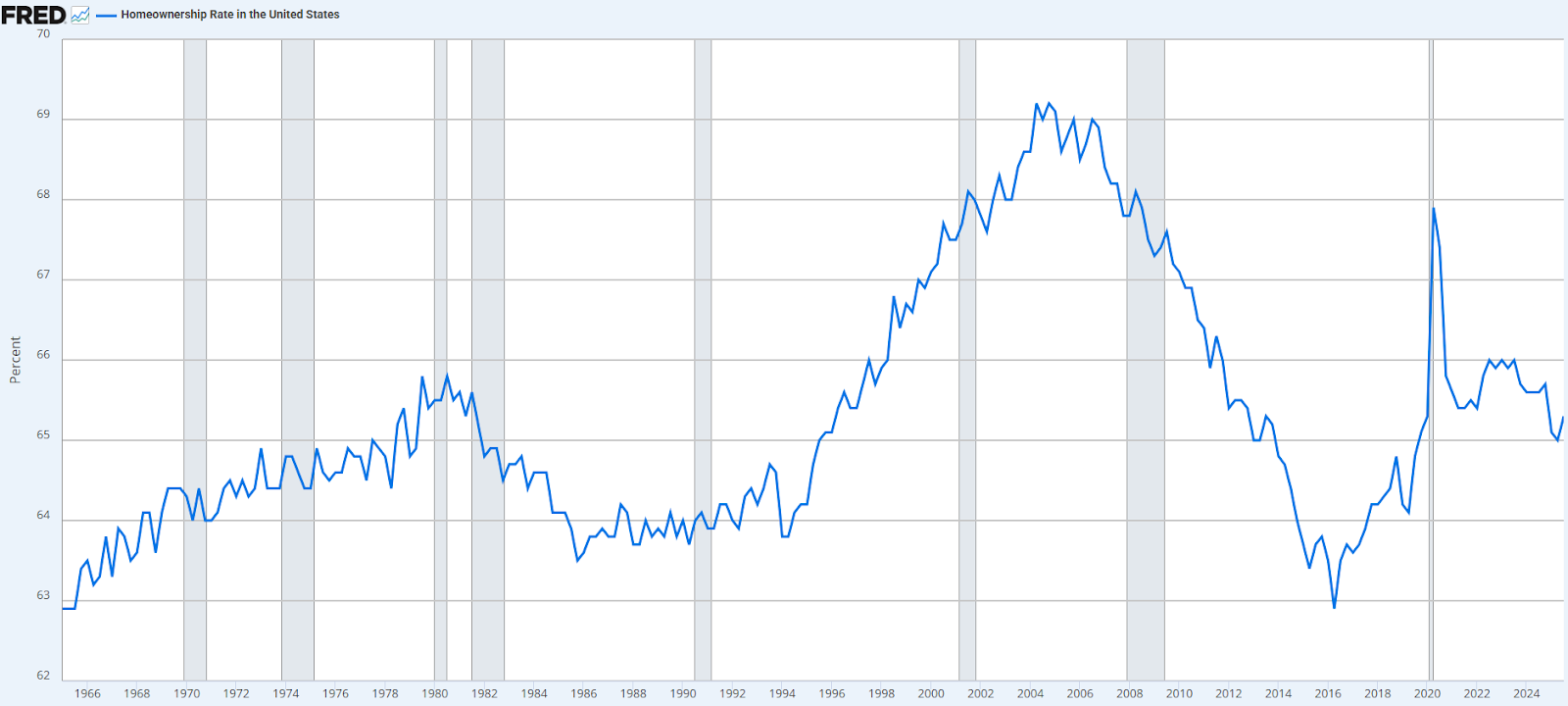
Home ownership rates in the US are generally in the 60% range. Source: US Federal Reserve
But in recent years, the average age of homeowners has spiked. It was around 39 years old in 2010. Just 15 years later, the average age nearly doubled to 59. This shows that there are few young entrants from the Millennial and Gen Z generations into the real estate market.
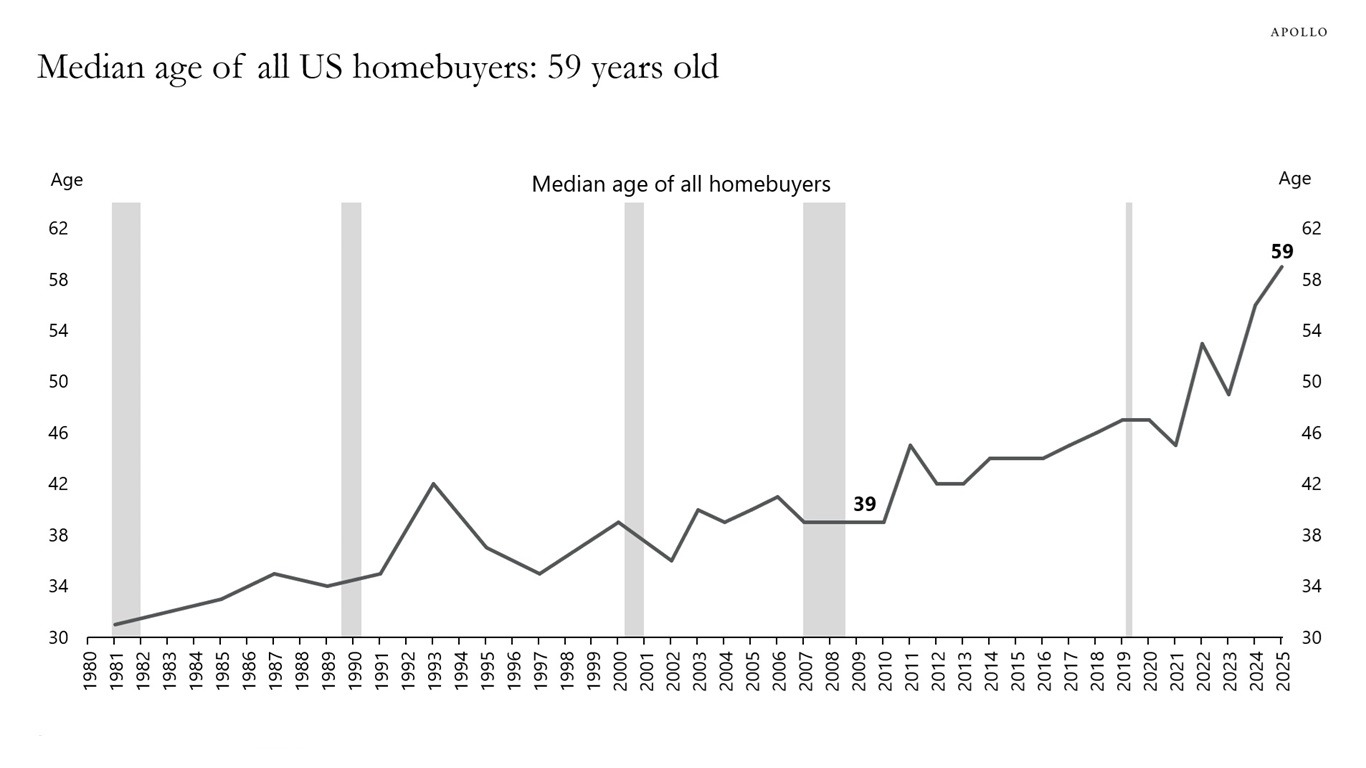
The median age of US homeowners is nearly 60 years old. Source: Apollo, National Association of Realtors
The concentration of single-family homes into fewer hands is exacerbated by the presence of major institutional investors in the housing market. A 2023 report from the Hamilton Project found that so-called mega-investors owned as much as 27% of single-family home rental stock in Atlanta. They owned 45% in Memphis and 37% in Birmingham.
The vast majority of crypto owners are under 44. Allowing them to use their holdings to count toward a mortgage could, at least in some small way, make it easier for younger investors to own homes.
Related: US regulator orders Fannie Mae, Freddie Mac to consider crypto for mortgages
Pulte recently said in an interview with CNBC, “We are doing everything we can to increase affordability. One of the reasons that we are doing this with regard to crypto is because crypto has an enormous opportunity to help with [affordability.]”
In 2022, well before the guidance from the FHFA, Miami-based fintech company Milo announced that borrowers would be able to use their crypto in securing 30-year mortgages while retaining ownership of their assets. At the time, Milo CEO and founder Josip Rupena said, “The existing ways for crypto consumers to access home credit has left them with unintended tax liabilities of selling for a down payment.”
But if crypto mortgages do have the ability to affect positive change in homeownership, they still have challenges to contend with.
Investors should expect to “take a haircut” on crypto valuations
The FHFA may have opened the door a crack for crypto — but caveats apply. The asset in question must be held on US-regulated exchanges. Fannie Mae and Freddie Mac must also consider risk mitigation.
While it is able to direct Fannie Mae and Freddie Mac to make recommendations and assessments, the FHFA can’t force individual lenders to accept crypto.
And even if lenders accept crypto, they may not accept every altcoin out there. Charles Whalen, chairman of Whalen Global Advisors, told CNBC, “There are some lenders right now that are willing to do business based on Bitcoin.”
“Not so much the other tokens, but I think Bitcoin is way in the lead in terms of getting this kind of recognition.”
He said that these types of loans are possible but are confined mostly to what the industry calls “private label” or “jumbo markets.”
“These are not mortgages that are going to be sold to Fannie Mae or Freddie Mac,” Whalen said.
Crypto investors may be further dismayed by having to “take a haircut” on their crypto valuations. In order to manage crypto’s notorious volatility, lenders may assume that the crypto price will fall, decreasing its power as collateral.
Future of US crypto mortgages partially driven by politics
There may also be a political component to crypto mortgages. Pulte said that his June order was partly “in keeping with President Trump’s vision to make the United States the crypto capital of the world.”
Daryl Fairweather, chief economist at Redfin, said that the order “helps normalize crypto, helps to legitimize cryptocurrency, which I think helps the president’s agenda.” Whalen said that the move should be seen as more political than substantive.
Top Democrats were notably opposed to the move. Five senators, including crypto critic Elizabeth Warren and former presidential candidate Bernie Sanders, signed a letter in which they claimed Pulte was prioritizing politics over risks to the financial system.
“Your order states that ‘each Enterprise must submit and receive approval from its Board of Directors.’ However, you are the current Chair of each Board, and you have stacked the Boards with members who represent FHFA personnel and your industry allies,” they wrote.
“There also appears to be a serious conflict between your ability to order and approve the Enterprises’ proposals as FHFA Director and to ultimately influence the development of such proposals as Chair of the Enterprises’ boards,” they continued.
Republican lawmakers have attempted to codify the order into law. Wyoming Senator Cynthia Lummis introduced a bill, the 21st Century Mortgage Act, to do just this in July 2025. The bill hasn’t gone anywhere; it’s still sitting in the Committee on Banking, Housing, and Urban Affairs.
The political momentum behind crypto loans may have its limits. Whalen said that major lenders could have a hard time getting behind the bill due to the market risk between when the crypto is considered for a loan and when it gets turned into dollars.
“The mortgage market ultimately is about a lender helping you buy your house, and then they sell that loan into the bond market. That bond transaction is in dollars.”
While lenders consider the order and its implications for their business models, the Trump administration is making strides elsewhere to try to lower housing costs. This month, the administration floated different ideas for expanding homeownership. National Economic Council Director Kevin Hassett hinted at a plan to let Americans use their retirement savings, like 410(k) plans, to make down payments.
Trump has also suggested banning large institutional investors from buying single-family homes. He wrote on Truth Social on Jan. 7:
“For a very long time, buying and owning a home was considered the pinnacle of the American Dream [...] It is for that reason, and much more, that I am immediately taking steps to ban large institutional investors from buying more single-family homes, and I will be calling on Congress to codify it.”
There is currently strong political momentum behind cryptocurrencies in Washington, from stablecoins to crypto mortgages. But much of this momentum, and any potential effect it could have on housing affordability, is ultimately dependent on whether lenders think it makes sound business sense.
Magazine: Here’s why crypto is moving to Dubai and Abu Dhabi


Subscribe to daily byte-sized crypto news from Cointelegraph
Cointelegraph publishes long-form journalism, analysis and narrative reporting produced by Cointelegraph’s in-house editorial team with subject-matter expertise. All articles are edited and reviewed by Cointelegraph editors in line with our editorial standards. Some articles contain affiliate links, from which Cointelegraph may earn a commission. These relationships do not influence which products we review or our editorial conclusions. Content published in here does not constitute financial, legal or investment advice. Readers should conduct their own research and consult qualified professionals where appropriate. Cointelegraph maintains full editorial independence.
More on the subject