
 Written by Isabelle Castrostaff writerEdited by Bryan O'Sheastaff editor
Tether invokes The Big Short in swipe at S&P over USDT reserve risks
Latest NewsPublishedNov 18, 2026
S&P Global made no downward adjustment in its latest Stablecoin Stability Assessment, as 5 is the lowest available score.
S&P Global Ratings has kept Tether’s USDt at the lowest level on its stablecoin stability scale as riskier assets take up a growing share of the token’s reserves.
In a report published Nov. 18, S&P scored USDt’s ability to hold its dollar peg at 5 (weak). The assessment is unchanged from November 2025.
Higher-risk holdings, including gold, Bitcoin (BTC), public equities, secured loans and corporate bonds, were equivalent to 28% of USDt (USDT) in circulation as of Sept. 30, up from 24% a year earlier. “A significant drop in the value of these assets could lead to USDT being undercollateralized,” S&P said in the report.
“The problem is S&P’s framework, not our reserves,” Tether told Cointelegraph. “Their own history shows the underlying problem,” it added, referencing The Big Short, the film about the 2008 financial crisis.
Tether’s Sept. 30 reserve report, attested by BDO, showed approximately $191.5 billion in assets against $183.5 billion in liabilities, leaving roughly $7.95 billion in excess assets. The agency added that it found further weaknesses but made no downward adjustment “because our assessment cannot be lower than 5.”
S&P questions reserve oversight safeguards
Among the additional weaknesses highlighted by S&P was the regulatory oversight of El Salvador, where Tether relocated in January 2025.
According to the report, the National Commission of Digital Assets of El Salvador (CNAD), the regulatory body which oversees Tether in the country, requires 70% of the reserves to be held in assets that can be liquidated within 30 days. The company said they considered the framework “broad,” allowing for the inclusion of relatively high-risk assets like gold, BTC and loans.
The S&P also pointed to the lack of a requirement to segregate the reserve assets, unlike those expected by regulators in the US and Europe. As there is no publicly available information about segregation, the report states, there is no insight into how they are insulated from broader corporate risks.
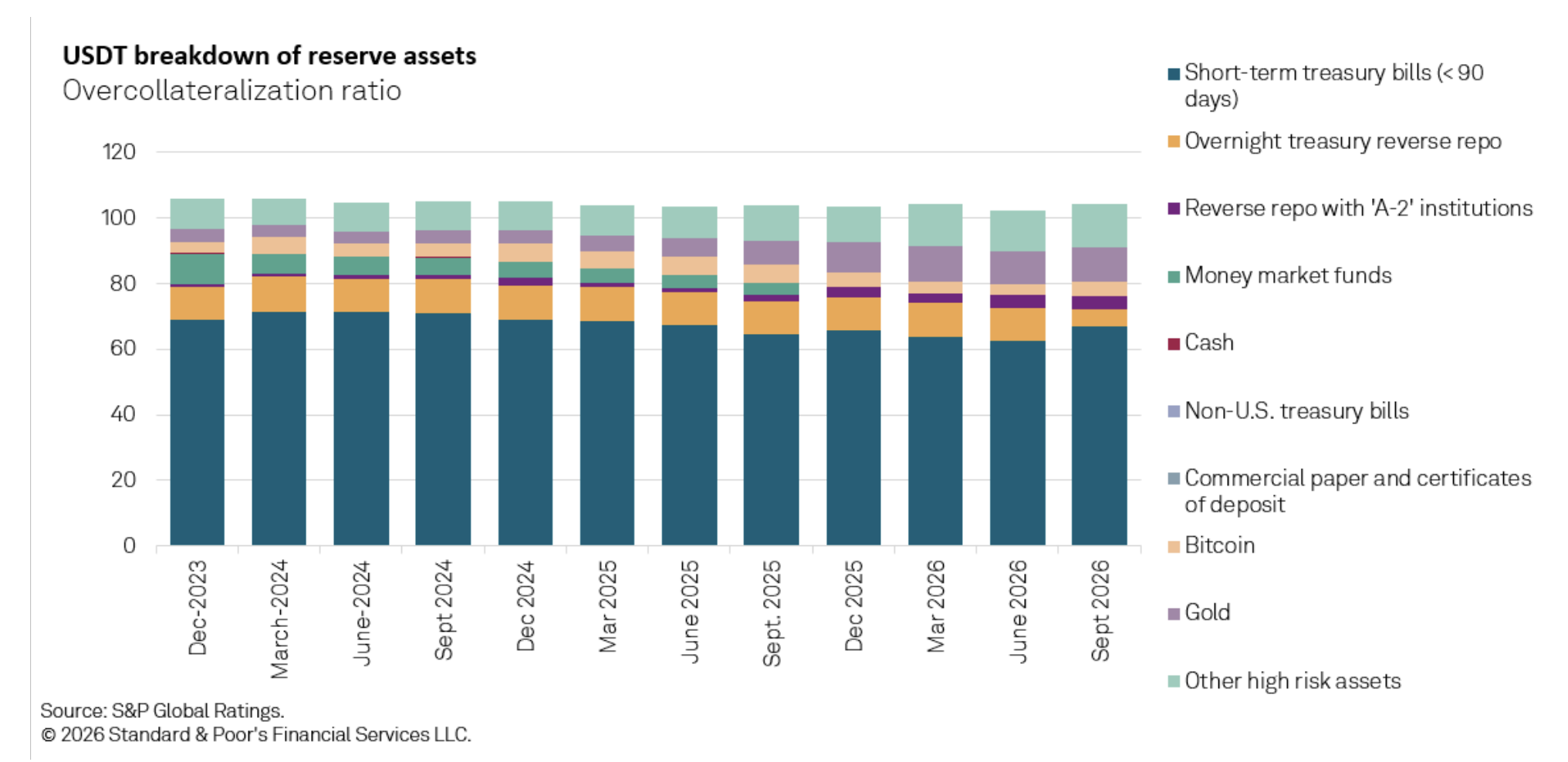
USDT’s breakdown of reserve assets. Source S&P Global
Audit disclosure remains a concern
In August 2026, KPMG confirmed they had issued an unqualified opinion on Tether’s 2025 accounts, in the company’s first “full independent audit”. The issuer highlighted that the audit supported the financial statements issued by the company.
However, S&P said the audited statements and the auditor’s report have not been published, which limits its ability to check the underlying information. Reserve reports also do not name the custodians and counterparties holding Tether’s assets, S&P said, and attestations remain quarterly while other stablecoins generally report monthly.
Related: Tether backs Bolivian fintech bringing USDT payments to food delivery and banking
At the time of S&P’s initial downgrade in 2025, Tether disputed the result. CEO Paolo Ardoino wrote on X, “we wear your loathing with pride,” pointing to past financial collapses as “proof” that traditional systems are broken.
Although the stability rating remained at 5, S&P ended the Nov. 18 report noting that Tether had maintained a good history of price stability, particularly in the last 12 months.
Magazine: How to preserve wealth and access funds during a national emergency
Start your day with crypto news and analysis for a professional audience.
Cointelegraph is committed to independent, transparent journalism. This news article is produced in accordance with Cointelegraph’s Editorial Policy and aims to provide accurate and timely information. Readers are encouraged to verify information independently.
More on the subject