

 Written by Aaron Woodformer editorEdited by Ailsa Sherringtonformer editor
What’s next for crypto in Europe after Christine Lagarde steps down?
MagazinePublishedFeb 21, 2026
ECB president Christine Lagarde is a crypto skeptic, but her likely successors are no more enthusiastic about cryptocurrencies.

European Central Bank (ECB) president Christine Lagarde is stepping down sometime before the French presidential election next year.
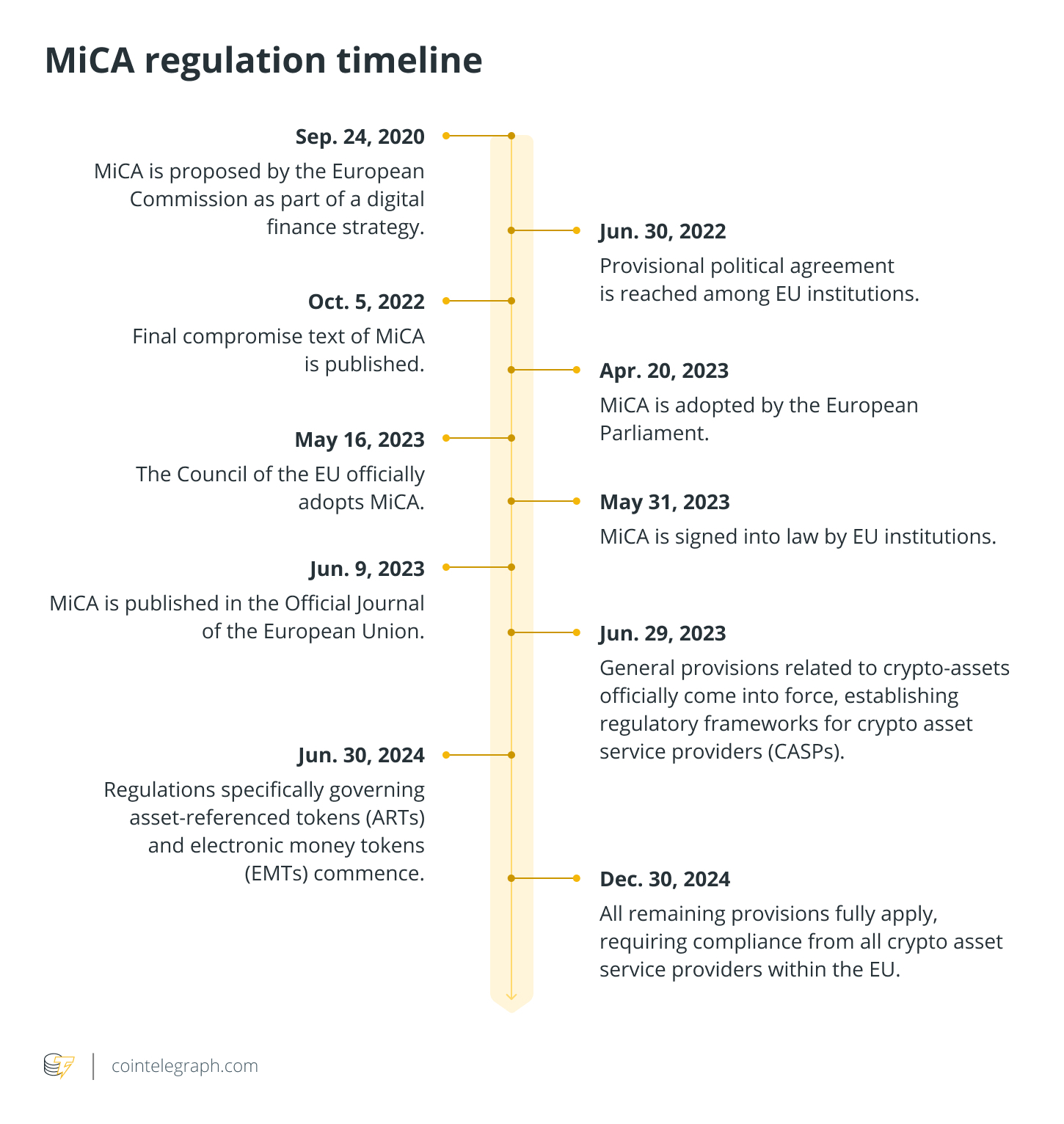
Under her leadership, the ECB has consulted on the Markets in Crypto Assets (MiCA) legislation that defined the crypto landscape in the European Union. The preeminent European bank also began work on the digital euro — the next iteration of the Eurozone’s currency.
But there is still work to be done on crypto policy in Europe. MiCA does not, in its current form, regulate decentralized finance (DeFi), and policymakers at the ECB are still deliberating over the digital euro’s final details.
While the exact timing of Lagarde’s departure has not yet been determined, observers are already speculating about who will take her place and how it will affect crypto policy in Europe.
Lagarde was a crypto-skeptic, critical of stablecoins
Like many central bankers, Lagarde has been cautious at best when it comes to cryptocurrencies. In 2022, she said regarding crypto, “My very humble assessment is that it is worth nothing.”
“It is based on nothing ... There is no underlying asset to act as an anchor of safety.”
She said that crypto should be regulated, citing concern that investors did not understand the risks associated with crypto investing and would “lose it all.”
This set the tone for the ECB consultations on MiCA that would follow. The ECB itself does not create laws, but throughout the legislative process, the ECB advised, observed and offered comments, particularly over areas related to monetary policy and payments regulations.
Even after MiCA was passed, Lagarde advocated for tight regulations on stablecoins and aligning international standards. In September 2025, she called on lawmakers in Europe to provide safeguards for stablecoins and equivalence for foreign stablecoin issuers to prevent the risk of stablecoin runs.
“European legislation should ensure that such schemes cannot operate in the EU unless supported by robust equivalence regimes in other jurisdictions and safeguards relating to the transfer of assets between the EU and non-EU entities,” she said.
“This also highlights why international cooperation is indispensable. Without a level global playing field, risks will always seek the path of least resistance.”
She further stated that stablecoins are a threat to national sovereignty and turn money from a public good into a privately controlled enterprise.
“When stablecoins are left unchecked, we risk creating a system in which money is controlled by the private sector. That is not the mandate we were appointed to serve as public servants.”
Demand for digital cash and the euro
While a noted crypto skeptic, Lagarde acknowledged the demand for digital currencies back in 2021. In an interview that year at the World Economic Forum, Lagarde said, “If customers prefer to use digital currencies rather than have banknotes and cash available, it should be available.”
“We should respond to that demand and have a solution that is European based, that is secure, that is available, and friendly terms that can be used as a means of payment.” At the ECB level, this response took the form of the digital euro.
But the wheels of Brussels do not turn quickly. The investigation phase for a digital euro began all the way back in October 2021. In October 2025, the ECB completed the preparation phase when its governing council decided to start preparing for issuance.
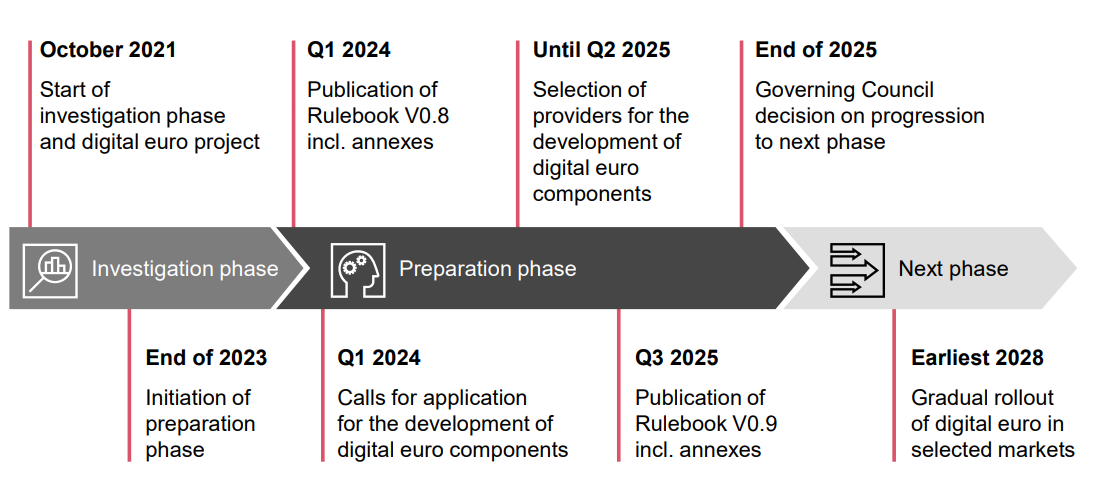
Envisioned timeline for digital euro rollout. Source: PwC
The digital euro has faced harsh criticism, namely that it will give central banks yet another tool to monitor consumer behavior, control spending and eradicate anonymous transactions. There have also been concerns over offline operability and overreliance on digital systems.
The ECB claims that the digital euro will have strict privacy standards and that it will bring all the same benefits of cash to the digital monetary space. In October 2025, Lagarde said that the ECB wants to make the euro “fit for the future, redesigning and modernising our banknotes and preparing for the issuance of digital cash.”
Her colleague, ECB executive board member Piero Cipollone, iterated that the digital euro “will ensure that people enjoy the benefits of cash also in the digital era. In doing so, it will enhance the resilience of Europe’s payment landscape, lower costs for merchants, and create a platform for private companies to innovate, scale up and compete.”
New ECB frontrunners unlikely to depart from cautious stance
Lagarde’s decision to step down comes at a politically fraught time. Leaving before the next French presidential election will allow President Emmanuel Macron to participate in picking her replacement.
France is the second-largest economy in the EU, and according to Reuters, no ECB president has been picked without a nod from Paris.
The right-wing National Rally has been ascendant in the polls recently, while Macron has failed to offer stable governance, with seven different prime ministers serving under his tenure. National Rally president Jordan Bardella claims that, in choosing a new ECB president, Macron would be able to exercise influence beyond the end of his official term.
According to the Financial Times, the current frontrunners to replace Lagarde are former Spanish central bank governor Pablo Hernández de Cos and former Dutch central bank governor Klaas Knot.
In 2022, Hernández de Cos said at a Bank of International Settlements (BIS) conference that crypto can “pose highly significant risks that are hard to understand and measure, even for the most experienced agents.”
He called for a robust regulatory framework to transition crypto from “that hyperbolic ‘Wild West’ myth to a more desirable orderly ‘railroad of civilisation.’”
Knot has been similarly cautious. Speaking before the BIS in 2024, he acknowledged the possible benefits of certain aspects of blockchain technology.
Related: How euro stablecoins could address EU’s dollar concerns
“Creating a digital representation of an asset and placing it on a distributed ledger could bring benefits to the financial system. This includes efficiency gains and potentially increased liquidity of certain assets. Of course, there may also be risks for financial stability.”
Still, he stressed the regulators were assessing the implications these technologies would have on broader financial stability, stating that, “We cannot presume that this innovation, and potentially more decentralization, will bring significant benefits to the global financial system.”
In June 2025, he addressed stablecoins specifically. Knot said that whether the next form of money comes via stablecoins or already established payment networks “should be something we are agnostic on.”
While neutral on the manner of technology supporting financial innovation, he said that “fostering innovation must not come at the expense of stability.”
While often criticized for the glacial pace of progress, the EU managed to pass a comprehensive crypto framework earlier than the far more crypto-friendly United States. This framework included guidance and input from a crypto-cautious central bank, with a skeptic at the helm.
Magazine: Bitcoin may take 7 years to upgrade to post-quantum: BIP-360 co-author


Subscribe to daily byte-sized crypto news from Cointelegraph
Cointelegraph publishes long-form journalism, analysis and narrative reporting produced by Cointelegraph’s in-house editorial team with subject-matter expertise. All articles are edited and reviewed by Cointelegraph editors in line with our editorial standards. Some articles contain affiliate links, from which Cointelegraph may earn a commission. These relationships do not influence which products we review or our editorial conclusions. Content published in here does not constitute financial, legal or investment advice. Readers should conduct their own research and consult qualified professionals where appropriate. Cointelegraph maintains full editorial independence.
More on the subject