


 Written by Aaron Woodstaff writerEdited by Ailsa Sherringtonstaff editor
Prediction market battle gets closer to Supreme Court
MagazinePublishedApr 24, 2026
If the Ninth Circuit Court of Appeals rules in favor of Nevada and against prediction markets, the question of who can regulate Kalshi seems ripe for the Supreme Court.

Over the last year, prediction markets have become embroiled in a widening tangle of legal disputes across the United States.
At its heart, state regulators dispute whether platforms like Kalshi, or those offered by Robinhood and Coinbase, should be able to offer contracts on the outcome of sports events. The platforms contend that they are part swap contracts regulated at the federal level.
State gambling regulators have taken legal action, issuing cease-and-desist letters, and some states, like Arizona, have even taken the platforms to court on criminal charges.
Earlier this month, the Department of Justice took some of those state regulators to court, bringing the prediction market issue closer to the highest court in the country.
If prediction markets walk like a duck and talk like a duck…
For the last several months, state gaming and gambling regulators across the country have issued cease-and-desist letters to the main prediction markets operating in the US.
As challenges ramped up, Michael Selig, the head of the Commodity Futures Trading Commission (CFTC), which regulates prediction markets, said that the agency would “defend its exclusive jurisdiction.”
On April 2, he made good on his promise. The CFTC filed lawsuits against actions in three different states: Illinois, Connecticut and Arizona.
At the time, the agency claimed that the states “attempted to outlaw, regulate, or otherwise restrain the activities of [designated contract markets] that facilitate trading in lawful event contracts. Congress long ago decided that a national framework for commodity derivatives markets was preferable to a fragmented patchwork of state regulations.”
But not everyone is convinced of prediction markets’ Congressional mandate, particularly given the platforms’ de facto status as a sportsbook.
While prediction markets contain “contracts” for a wide variety of events ranging from elections to armed conflicts, the lion’s share of their earnings come from sports.
As of March 2026, 85% of volume on Kalshi was sports “predictions,” according to data from investment research platform Artemis.
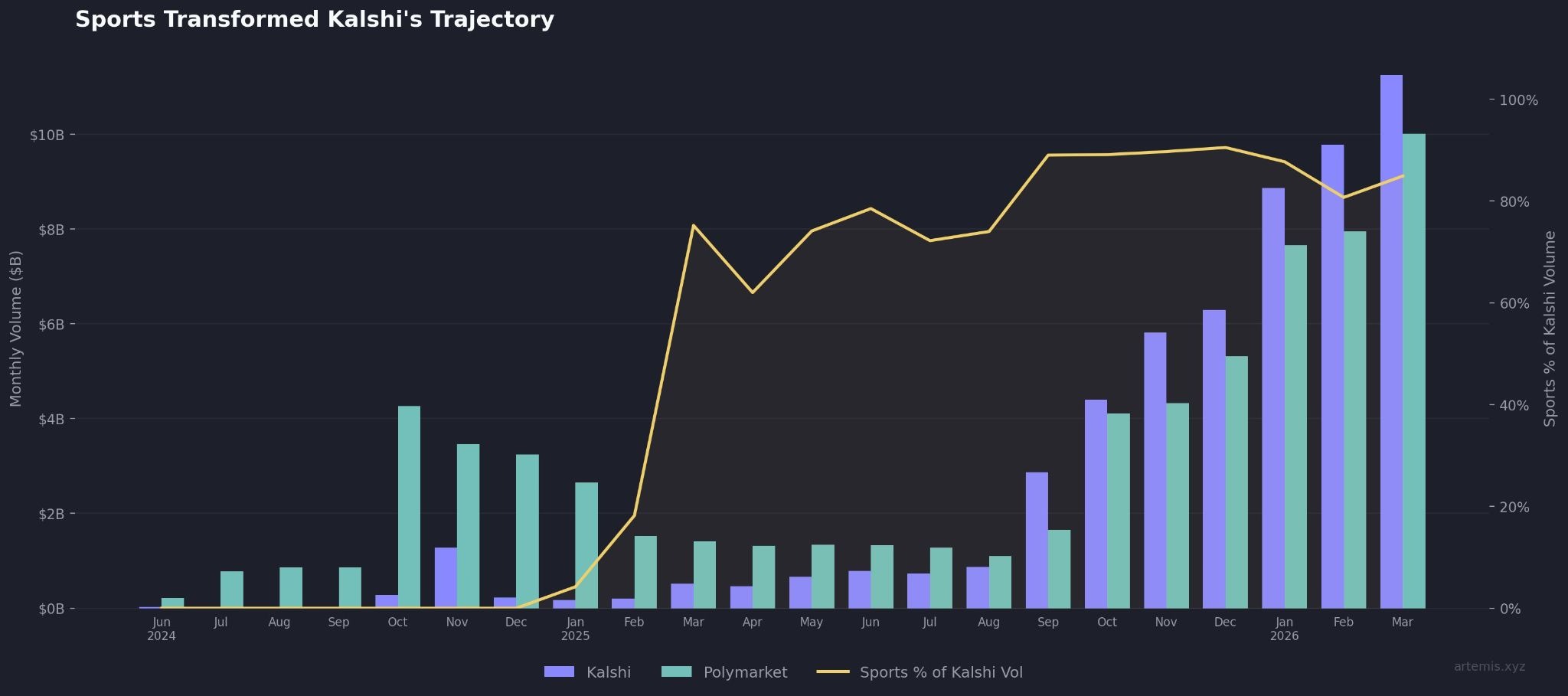
Sports-related contracts skyrocketed on Kalshi. Source: Artemis
Karl Lockhart, an assistant professor of law at the Chicago-based DePaul University, said, “Congress doesn’t hide elephants in mouseholes [...] If Congress had really meant to authorize these designated contract market places to offer sports gambling products, you’d think they’d be more explicit about it.”
This problematic association with sportsbooks has also come up in court. In her dissenting opinion in the Kalshi case against New Jersey in the Third Circuit Court of Appeals, Judge Jane Roth referred to official marketing materials.
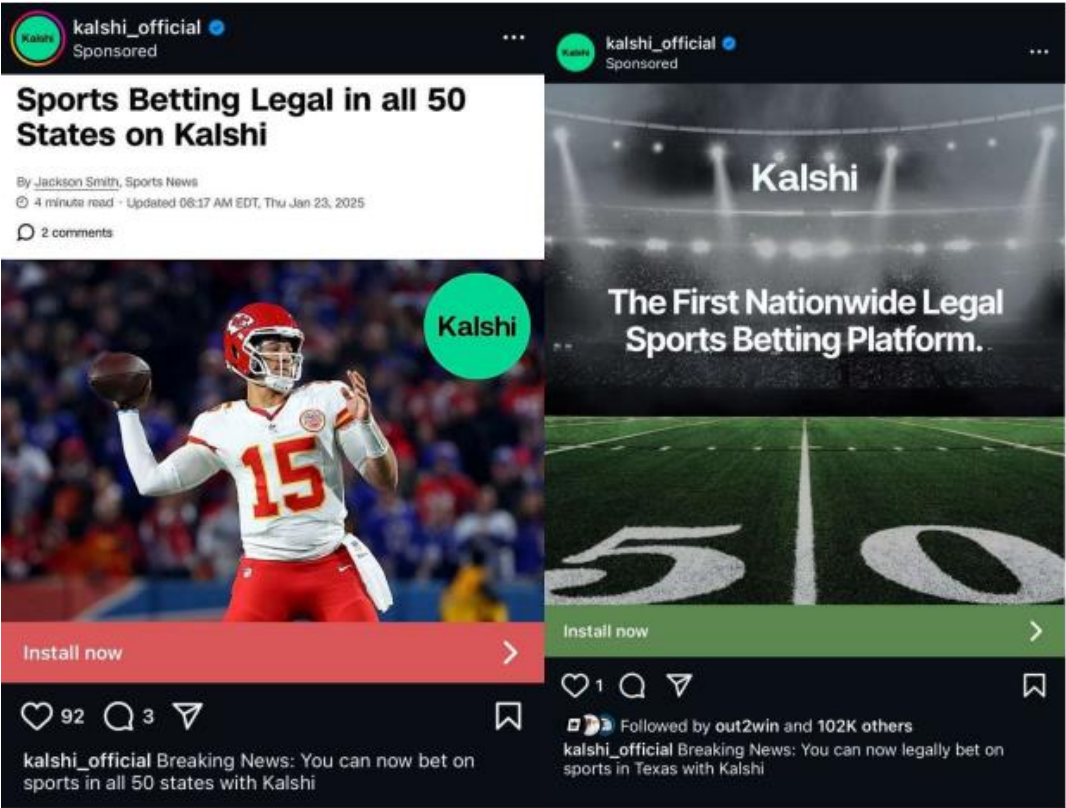
Source: Third Circuit Court of Appeals
“Marketing materials such as these, coupled with the fact that Kalshi’s sports related offerings are a dead ringer for the products offered by state-regulated online sportsbooks, make it difficult for me to accept the proposition that Kalshi is not facilitating gambling,” she said.
“Basic abductive reasoning tells us that if it looks like gambling, talks like gambling, and calls itself gambling, it’s gambling.”
Ultimately, the Third Circuit Court of Appeals ruled that New Jersey did not have the authority to regulate prediction markets.
But now, in Nevada, the Ninth Circuit Court is hearing the state’s case against Kalshi. According to the Nevada Independent, some of the presiding judges are unimpressed with its arguments.
Related: Federal regulation looms as 11 states go after prediction markets
Judge Bridget Bade said, “I think I see one of these ads almost every day on my phone [...] It's a lost cause. I don't care about sports. So you can tell them to stop sending them to me, but it seems like they are advertising this as sports betting.”
Daniel Wallach, a sports betting and gaming lawyer, recounted an interaction on X.
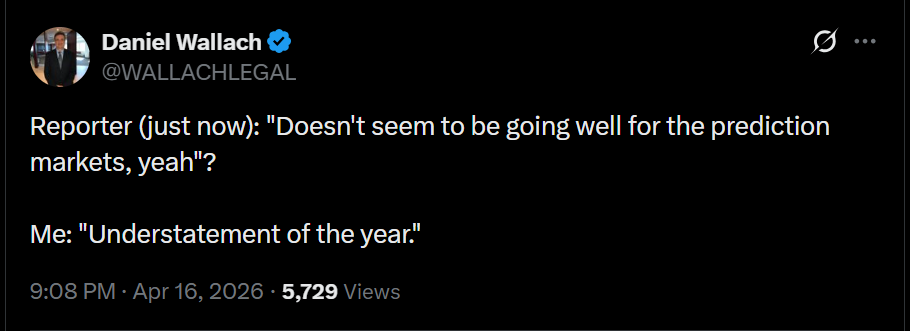
Source: Daniel Wallach
If the Ninth Circuit rules in favor of the state, the issue of whether Kalshi is offering betting will be set to go to the Supreme Court.
What could happen there is anyone’s guess. Austin Evers, a partner at Freshfields, told Fortune, “This is a classic case of old tools being applied to cutting edge technologies, and it’s too soon to say how courts will come out on those questions.”
States also concerned over insider trading
Meanwhile, as appeals courts grapple with what constitutes sports betting, some state authorities are cracking down on the prediction markets’ insider trading problem.
Illinois Governor JB Pritzker, whose state is already embattled with the federal government over its stance on Kalshi, signed an executive order on Tuesday. The order prohibits state employees from using insider information to “to participate or assist any person in prediction markets and event-based contracts.”
Said Pritzker, “Prediction markets have rapidly grown into a space where people can bet on real-world events without any oversight, including events people can influence [...] This opens the door to insider trading and abuse of confidential information.”
New York Governor Kathy Hochul followed suit on Wednesday, signing an executive order to the same effect. “Our actions will ensure that public servants work for the people they represent, not their own personal enrichment,” Hochul said in a statement.
Their concerns are well-founded. One anonymous trader bagged over $400,000 by placing large bets on US military action in Venezuela, just hours before the US government announced it kidnapped Venezuelan President Nicolas Maduro.
The problem is not confined to the US. In France, police are investigating alleged tampering with weather forecasting equipment at Paris’s Charles de Gaulle airport that coincided with suspicious Polymarket bets.
In Israel, an air force reservist has been charged with leaking classified data via a Polymarket bet. He allegedly earned $244,000 by “betting” on the time of an Israeli air strike on Iran. He was privy to the details of the strike thanks to his role in the armed forces.
Magazine: AI-driven hacks could kill DeFi — unless projects act now


Subscribe to daily byte-sized crypto news from Cointelegraph
Cointelegraph publishes long-form journalism, analysis and narrative reporting produced by Cointelegraph’s in-house editorial team with subject-matter expertise. All articles are edited and reviewed by Cointelegraph editors in line with our editorial standards. Some articles contain affiliate links, from which Cointelegraph may earn a commission. These relationships do not influence which products we review or our editorial conclusions. Content published in here does not constitute financial, legal or investment advice. Readers should conduct their own research and consult qualified professionals where appropriate. Cointelegraph maintains full editorial independence.
More on the subject