

Here’s what happened in crypto today
49 minutes ago

 Written by Sam Bourgistaff writerEdited by Robert Lakinstaff editor
Mastercard expands its crypto footprint, Ether treasury companies keep buying and Bitcoin ETFs face fresh outflows as institutional crypto demand diverges.

Institutional crypto activity took a mixed turn this week as major financial institutions continued expanding into digital assets even while investor demand for Bitcoin funds weakened.
Mastercard secured regulatory approval to grow its crypto operations in New York, underscoring how traditional payment companies are continuing to build around stablecoins, tokenized payments and blockchain infrastructure. At the same time, Ether treasury companies kept accumulating ETH and increasing staking activity as they searched for ways to stand apart from passive crypto investment products.
But signs of slowing investor appetite also emerged. US spot Bitcoin ETFs extended their outflow streak, pushing cumulative 2026 inflows closer to negative territory after another week of institutional withdrawals.
Mastercard has secured a coveted BitLicense from the New York Department of Financial Services (NYDFS), giving the payments giant regulatory clearance to expand its crypto and stablecoin operations in one of the toughest jurisdictions in the United States.
The timing is notable, given that Mastercard is aggressively building crypto partnerships across stablecoins, tokenized payments and onchain commerce. The company already works with several blockchain networks and wallet providers, including MetaMask, as part of its broader strategy to make digital assets interoperable with existing card infrastructure.
New York’s BitLicense regime has historically been an obstacle for crypto companies because of its stringent compliance requirements, with many companies avoiding the state altogether rather than endure the licensing process. Mastercard’s approval signals that regulators are increasingly willing to accommodate established financial institutions entering the digital asset sector, especially those focused on payments and settlement rails instead of speculative trading.

Source: Mastercard
BitMine Immersion Technologies purchased 111,942 Ether last week, its largest ETH acquisition of 2026 so far, after the cryptocurrency briefly fell below $2,200. The buying spree comes as company chairman Tom Lee renewed his bullish thesis that Ethereum is entering a long-term crypto “supercycle” fueled by tokenization and AI-driven financial infrastructure.
Lee said Bitmine views recent market weakness as an opportunity rather than a warning sign. The company has steadily accumulated ETH during periods of volatility, mirroring the Bitcoin treasury strategy pioneered by Michael Saylor.
Bitmine now controls nearly 5.4 million ETH, setting an ambitious target to control 5% of Ethereum’s circulating supply. However, the buying spree hasn’t come without costs. BitMine is currently sitting on $7.8 billion in paper losses tied to its ETH portfolio, according to industry data.

Source: Kalshi Crypto
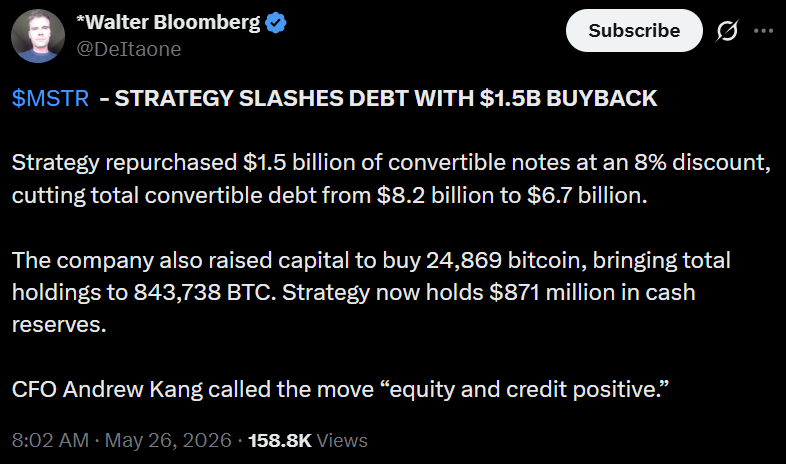
Michael Saylor’s Strategy repurchased $1.5 billion of convertible notes at a discount, reducing its outstanding debt tied to its 2029 maturities to approximately $6.7 billion, in the latest sign that the company is restructuring its balance sheet while continuing to anchor itself in Bitcoin accumulation.
The debt buyback matters because Strategy’s Bitcoin strategy has always depended on its ability to continuously refinance and manage leverage.
Under Saylor, the company became known for issuing debt to acquire Bitcoin at scale, effectively transforming itself into a publicly traded BTC holding vehicle. But as interest rates rose and market volatility intensified, investors increasingly scrutinized the sustainability of that model.
Source: Walter Bloomberg
Bitcoin ETF outflows are wiping out 2026’s gains
US spot Bitcoin ETFs are edging closer to slipping into net negative territory for 2026 after logging six consecutive trading days of outflows. Cumulative inflows for the year have now shrunk to just $536 million following another $105.2 million in withdrawals on Friday alone, according to Farside data.
The outflow streak has drained roughly $1.55 billion from Bitcoin ETFs since May 14, the last day the sector recorded net inflows. BlackRock’s iShares Bitcoin Trust led Friday’s losses with nearly $69 million in outflows, while Fidelity’s Wise Origin Bitcoin Fund lost another $36 million.
The pressure comes as some major institutional investors appear to be scaling back their Bitcoin ETF exposure. Jane Street cut its Bitcoin ETF holdings by about 70% in the first quarter, while Goldman Sachs also reduced its position.
Crypto Biz is your weekly pulse on the business behind blockchain and crypto, delivered directly to your inbox every Thursday.