


 Written by Derek Andersenformer writerEdited by Ana Paula Pereirastaff editor
IBM offers guidance for successful implementation of digital euro
Latest NewsPublishedAug 31, 2023
Five members of IBM Consulting created a list of points that the European Commission could consider to optimize its proposed digital euro legislation.

IBM has some ideas about what it will take to make the digital euro a success, which it shared in a recent blog post. It suggested five items for designers to help the European Central Bank (ECB) digital currency “enter the highly competitive, multifaceted, and heterogeneous payments landscape in the Eurozone.”
Some of IBM's points are already found in the European Commission (EC) legislative proposal. “Build on existing rails,” the first point, is already foreseen in the EC plan, although it can be extended, the five authors said. Simplicity will be key to initial adoption, they reasoned, and familiarity reinforces that.
Intermediaries will also have a role to play in digital euro acceptance, and the digital currency should be designed to accommodate their needs:
“We see a need for a more granular ecosystem of intermediaries. The future intermediary landscape for the digital euro should be envisioned as multi-level. Planning for more than one intermediary between the retail user and ECB’s digital euro components would better support smaller intermediaries.”
Standardization of APIs would simplify integration and encourage competition, the post said.
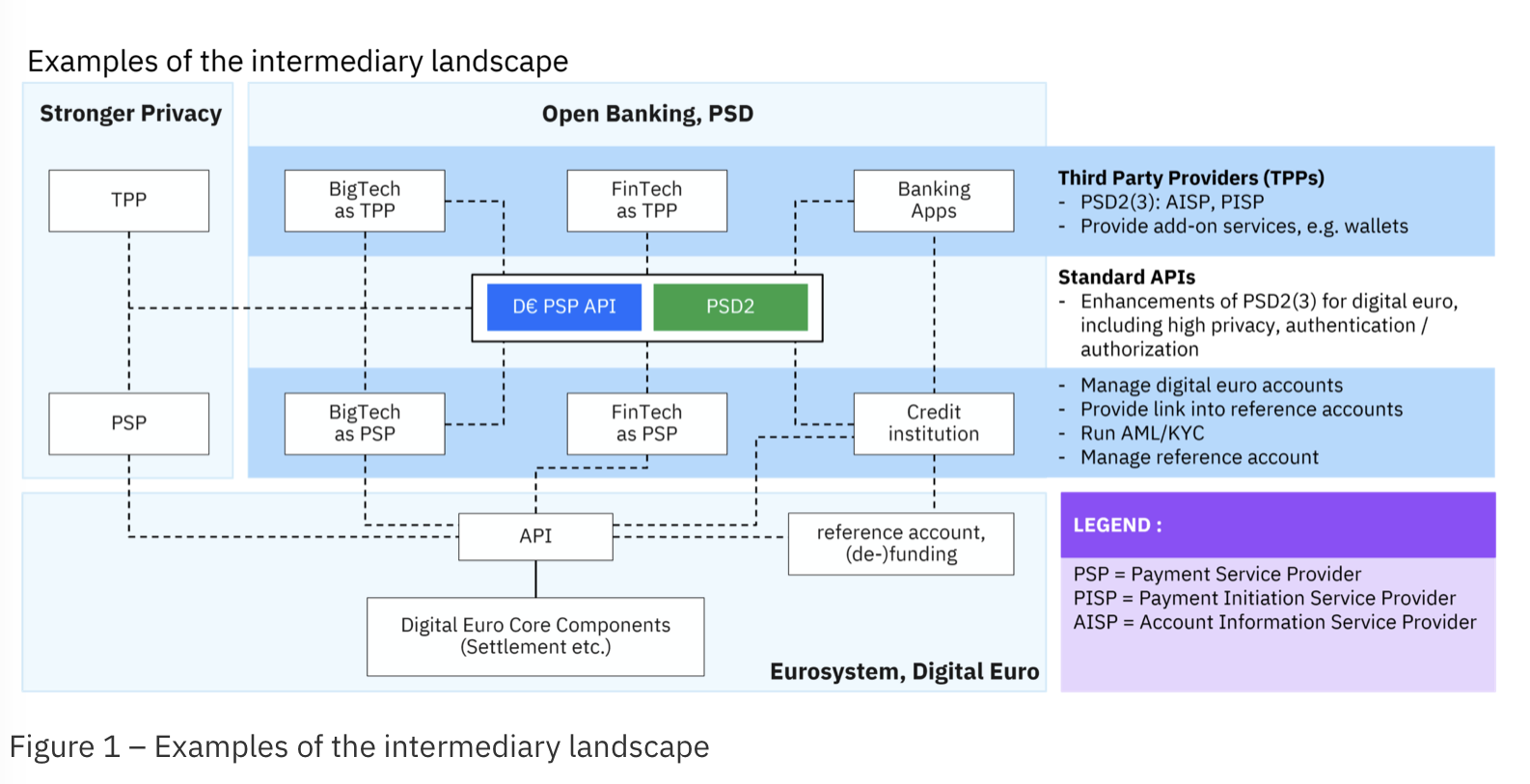
Possible intermediation schemes for the digital euro. Source: Digitale Perspektive
The EC proposal includes strong offline privacy guarantees that could be extended to online activities to ensure end-to-end transaction privacy, IBM suggested. The proposed legislation offers privacy measures “consistent with current digital payment’s privacy levels.” IBM said privacy rules need to be harmonized with several existing regulations, including reporting thresholds, to ensure that reporting is siloed.
Related: UK financial watchdog announces launch of permanent Digital Sandbox in August
Distributed ledger technology is not essential for the creation of a digital euro, the authors noted, but blockchain technology offers the most benefits. Its operation need not be any more carbon-intensive than non-blockchain systems, they added.
Finally, go slowly but surely, IBM advises. Start with a minimal viable product for faster time to market and a sandbox to deal with the great complexity of the future digital euro’s operating environment.
Pixel Perfect.
Take a look at IBM headquarters from around the globe. #WorldPhotoDay— IBM (@IBM) August 19, 2023
Magazine: ‘Moral responsibility’: Can blockchain really improve trust in AI?


Subscribe to daily byte-sized crypto news from Cointelegraph
Cointelegraph is committed to independent, transparent journalism. This news article is produced in accordance with Cointelegraph’s Editorial Policy and aims to provide accurate and timely information. Readers are encouraged to verify information independently.
More on the subject