


 Written by Turner Wrightstaff writerEdited by Ana Paula Pereiraformer editor
IMF lays out guidelines for addressing stablecoin risks, beyond regulations
Latest NewsPublishedDec 4, 2025
The fund identified “strong macro-policies and robust institutions” as a response to the potential risks of stablecoins, above a patchwork of global regulations.

The International Monetary Fund (IMF) released a comprehensive report on the potential impact of the growing stablecoin market and the adequacy of global regulations in handling it.
In the “Understanding Stablecoins” report released on Thursday, the IMF analyzed the various approaches regions, including the United States, the United Kingdom, Japan and the European Union, had taken in establishing a regulatory framework for stablecoins.
Although the report noted that emerging regulations could mitigate risks to macrofinancial stability, the landscape was “fragmented,” both in policymakers’ approaches and how stablecoins are issued.
“The proliferation of new stablecoins across different blockchains and exchanges raises concerns about inefficiencies due to potential lack of interoperability,” said the IMF. “Moreover, this can introduce differences and roadblocks among countries, due to different regulatory treatment and transaction hurdles.”
The IMF added:
“Although regulation of stablecoins helps authorities address [certain] risks, strong macro-policies and robust institutions [...] should be the first line of defense [...] International coordination remains key to solving these issues.”
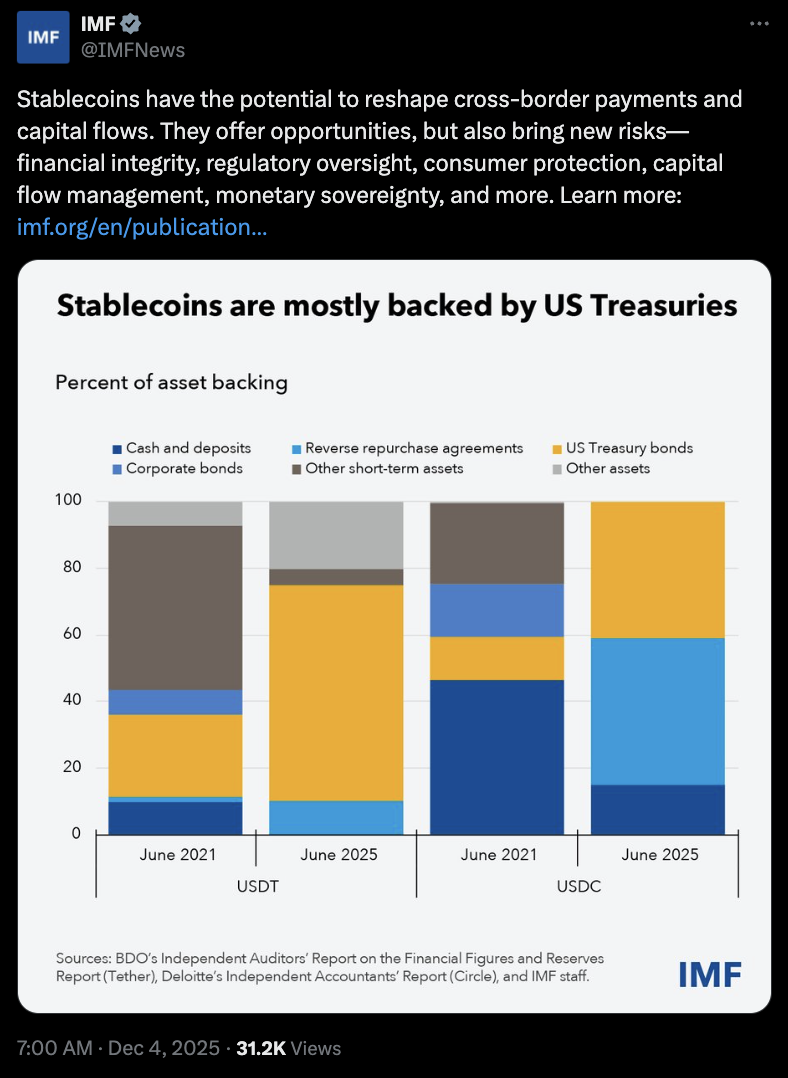
Source: IMF
The report said that two of the largest stablecoins by market capitalization, Tether’s USDT (USDt) and Circle’s USDC (USDC) were “backed mostly” by short-term US Treasurys, reverse repo collateralized with US Treasurys, and bank deposits. Forty percent of USDC’s reserves and about 75% of USDt’s reserves consisted of short-term US Treasurys, with Tether’s stablecoin also holding 5% of its reserves in Bitcoin (BTC).
Related: IMF warns tokenized markets may deepen flash crashes, says governments will step in
The overwhelming majority of the global stablecoin market consists of coins pegged to the US dollar. However, a small number of issuers have denominated their offerings in different currencies, such as the euro. As of December, the total market is worth more than $300 billion.
The GENIUS Act is being implemented in the US
After US President Donald Trump signed the GENIUS bill into law in July, regulators have been working to establish regulations to set up a comprehensive framework for payment stablecoins in the country. Blockchain security auditor CertiK reported on Thursday that the move had effectively moved liquidity into separate pools for US and EU stablecoins.
Magazine: Koreans ‘pump’ alts after Upbit hack, China BTC mining surge: Asia Express


Subscribe to daily byte-sized crypto news from Cointelegraph
Cointelegraph is committed to independent, transparent journalism. This news article is produced in accordance with Cointelegraph’s Editorial Policy and aims to provide accurate and timely information. Readers are encouraged to verify information independently.
More on the subject