


 Written by Zoltan Vardaistaff writerEdited by Bryan O'Sheastaff editor
Nansen launches AI crypto trading tools on Base, Solana
Latest NewsPublishedJan 21, 2026
The new AI-powered crypto trading platforms are aimed at replacing traditional trading charts and order books with trading execution offered through natural language processing.
Update Jan. 21, 9:27 a.m. UTC: This article has been updated to include a second quote from Nansen co-founder and CEO Alex Svanevik.
Nansen has launched autonomous cryptocurrency trading tools that allow users to execute trades through artificial intelligence agents and natural language prompts, as the platform expands beyond analytics into transaction execution.
The new feature enables users to place trades by entering conversational commands in Nansen’s mobile app, rather than using traditional charts or order books, the company said in an announcement shared on Wednesday. The product is aimed at retail users seeking simplified access to crypto markets.
Nansen AI can also analyze onchain signals and provide data-driven insights to guide investor decisions, before executing trades in what the platform calls “vibe trading.” The company describes the approach as combining analytics with automated execution, while keeping final control with the user.
Nansen adds AI-driven trade execution
The trading feature will initially support activity on the Base and Solana blockchains, with plans to expand to additional networks, Nansen said.
The AI interface draws on Nansen’s proprietary onchain database, which includes hundreds of millions of labeled blockchain addresses, the company claims, and is aimed at providing investors with more reliable crypto market analysis than general-purpose AI bots like Google’s Gemini or OpenAI’s ChatGPT.
Related: Not every AI agent needs its own cryptocurrency: CZ
“For years, Nansen has focused on surfacing high-quality onchain signals for investors,” said Nansen co-founder and CEO Alex Svanevik. “This launch allows users to act on those insights directly within our product.”
“Now, we’re closing the loop by enabling users to execute trades directly in our product, both through an AI-native conversational mobile UX and a trading terminal on the web.”
For cross-chain trading execution across Solana and Base, Nansen partnered with decentralized exchange Jupiter, crypto exchange OKX and cross-chain protocol LI.FI, which will facilitate support for more upcoming blockchain networks.
Trading is handled through the embedded Nansen Wallet, powered by Privy’s self-custodied wallet experience.
The company said autonomous trading will be available to users starting Wednesday, excluding residents of certain jurisdictions, including Singapore, Cuba, Iran, North Korea, Syria, Russia and parts of Ukraine, citing regulatory restrictions.
Nansen AI agents “consistently outperform” leading AI chatbots in terms of onchain analysis related to wallet identification, token discovery, due diligence and portfolio analysis, Svanevik claimed, adding:
“Nansen AI hit 85%+ quality scores in Expert Mode. GPT-5? Around 20%. StandardLLMs don’t understand wallet labeling or trading patterns.”
While Nansen uses foundational AI models as part of its platform, these still need to be finetuned and equipped with more onchain capabilities, Svanevik said.
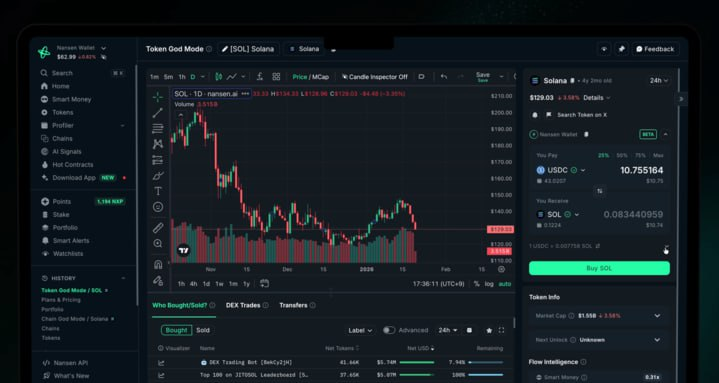
Nansen AI crypto trading dashboard. Source: Nansen
Launch highlights rise of AI
The launch comes amid growing interest in AI-assisted trading across the crypto industry, as companies experiment with automated strategies and conversational interfaces to lower barriers for retail participation.
Related: OpenAI eyes trillion-dollar IPO amid global AI arms race: Report
Separately, recent testing has shown that lower-cost Chinese AI models can outperform larger Western systems in crypto trading tasks. In an autonomous trading competition reported by Cointelegraph in November 2025, models including QWEN3 MAX and DeepSeek generated stronger results than several higher-profile AI chatbots, with QWEN3 the only model to post positive returns.
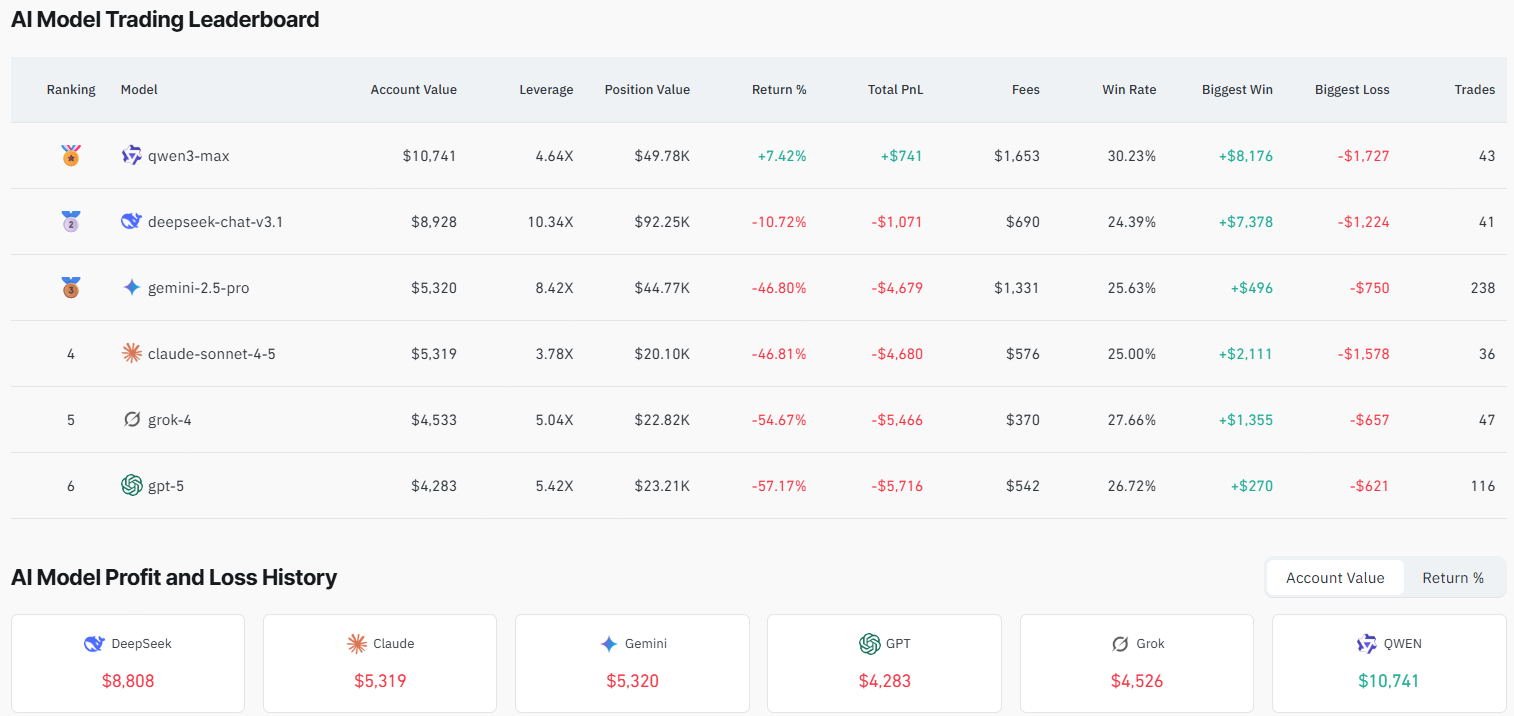
AI models, crypto trading competition. Source: CoinGlass
The results highlighted ongoing limitations in real-time market execution among even the most advanced general-purpose AI systems.
Magazine: ‘Accidental jailbreaks’ and ChatGPT’s links to murder, suicide


Subscribe to daily byte-sized crypto news from Cointelegraph
Cointelegraph is committed to independent, transparent journalism. This news article is produced in accordance with Cointelegraph’s Editorial Policy and aims to provide accurate and timely information. Readers are encouraged to verify information independently.
More on the subject