


 Written by Christina Combenstaff editorEdited by Bryan O'Sheastaff editor
New Coinbase report points to ‘broken’ traditional finance system: Armstrong
Latest NewsPublishedDec 17, 2025
A new Coinbase–Ipsos survey shows younger US investors are trading more often, taking more risk and putting a far larger share of their portfolios into crypto.

Coinbase CEO Brian Armstrong says we already know the traditional financial system is broken. Younger people increasingly feel “locked out of the old wealth ladder,” and seek alternative assets like crypto.
The numbers in Coinbase’s latest “State of Crypto” report back him up. The study, run by Ipsos in the fourth quarter, finds Gen Z and millennial investors are trading more often, taking more risk, and putting a much bigger slice of their portfolios into crypto and other non‑traditional assets than older generations.
Portfolio allocation and trading behavior
The survey of 4,350 US adults shows stock ownership is roughly the same across age groups (47% of younger investors versus 50% of older ones), but portfolio composition looks radically different.
Related: Standard Chartered, Coinbase deepen alliance to build institutional crypto infrastructure
Younger investors say 25% of their holdings sit in non‑traditional assets such as crypto, derivatives, and private investments, three times the 8% reported by older investors, or baby boomers.
Four in five younger respondents say they’re willing to try new investment opportunities before others do, and 84% say they want platforms that offer a wider range of assets beyond traditional stocks.
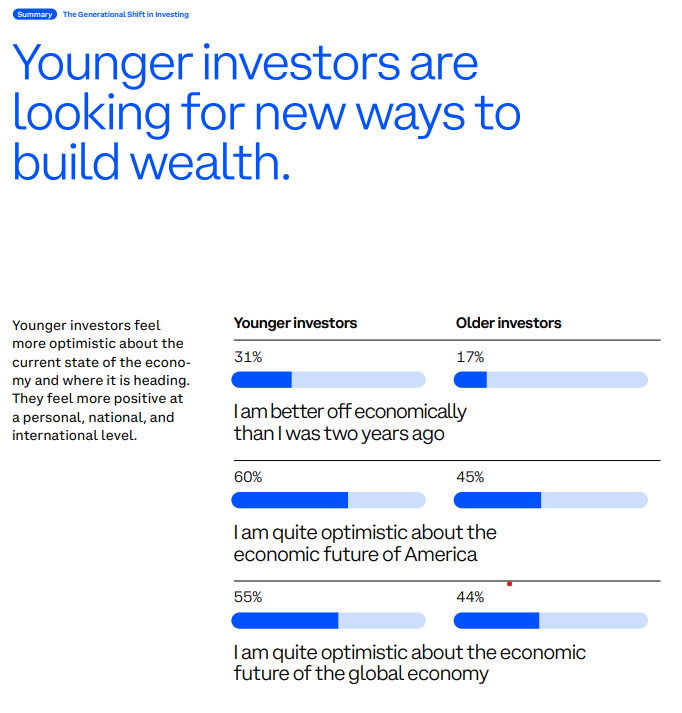
Younger investors seek new ways to build wealth. Source: Coinbase
Trading behavior is diverging just as sharply. Nearly three in 10 younger investors say they make a trade at least once a week, compared with 10% of older investors.
They are also far more likely to lean on high‑octane strategies. Of the respondents, 19% report using margin to boost upside, versus 8% of older investors, while 26% say they seek higher returns via high‑risk investments, compared with 18% among older cohorts.
Demand for “always‑on” markets is clear as well, with 63% of younger investors expressing interest in 24/7 stock market access, alongside strong interest in crypto derivatives, leverage and DeFi lending.
Related: The next era of crypto belongs to decentralized markets
Upside outside legacy channels
The report suggests this is as much about access as attitude. Almost three‑quarters of younger adults (73%) believe it is harder for their generation to build wealth through traditional means, compared with 57% of older respondents.
While 47% of younger investors own stocks, they are twice as likely as older investors to already own crypto, and four in five agree that cryptocurrency gives their generation more financial opportunities than they would otherwise have.
Around 70% say they personally know someone who has made “a lot of money” trading crypto, reinforcing the sense that upside lies outside legacy channels.
Related: Etsy witches can apparently turn you into a crypto millionaire for $73
A rise in copy and social trading
Where they get their cues from is shifting, too. Younger investors are much more likely to describe themselves as self‑directed, to trust their own research over a traditional adviser, and to look to TikTok, Reddit, YouTube, podcasts, and friends for ideas rather than just financial planners.
Two‑thirds say they would engage in copy or social trading on friends’ or prominent traders’ accounts if they could, versus less than a third of older investors.
Armstrong framed the findings as evidence that the existing system “isn’t working” for the youth and they are gravitating toward non‑traditional assets because those are the only venues that match their expectations for access and upside.
For product builders, the data points to a future where risk‑tiered offerings and round‑the‑clock markets will be central to serving the next generation of retail investors.


Subscribe to daily byte-sized crypto news from Cointelegraph
Cointelegraph is committed to independent, transparent journalism. This news article is produced in accordance with Cointelegraph’s Editorial Policy and aims to provide accurate and timely information. Readers are encouraged to verify information independently.
More on the subject