

 Written by SK Aroraformer writerEdited by Rahul Nambiampurathformer editor
Tajikistan’s mining crackdown shows how energy strain shapes crypto policy
MagazinePublishedDec 15, 2025
Tajikistan’s new law criminalizing unauthorized crypto mining shows how global energy shortages are reshaping digital asset regulation.

Key takeaways
- Tajikistan has criminalized the use of stolen electricity for cryptocurrency mining, introducing fines of up to $8,250 and prison sentences of up to eight years.
- The move follows an energy crisis in which widespread power shortages and reportedly illegal mining have caused millions in losses and infrastructure damage.
- The country joins a broader trend, as governments from Asia to the Middle East intensify crackdowns on unauthorized crypto mining to protect national power supplies.
- Crypto mining may be shifting, with some operators moving toward renewable energy sources and more energy-efficient technologies.
On Dec. 3, 2025, Tajikistan’s parliament formally approved amendments to its criminal code that make it a criminal offense to use electricity illegally for cryptocurrency mining. The new law introduces Article 253(2), titled “Illegal use of electricity for the production of virtual assets.”
Under the new law, anyone found mining digital assets using stolen or unmetered electricity faces serious penalties. The basic offense carries fines ranging from about $1,650 to $4,070.
If the act is committed by a coordinated group, penalties rise to $4,125-$8,250, or two to five years in prison. In cases involving large-scale or organized operations, offenders may face up to eight years in prison.
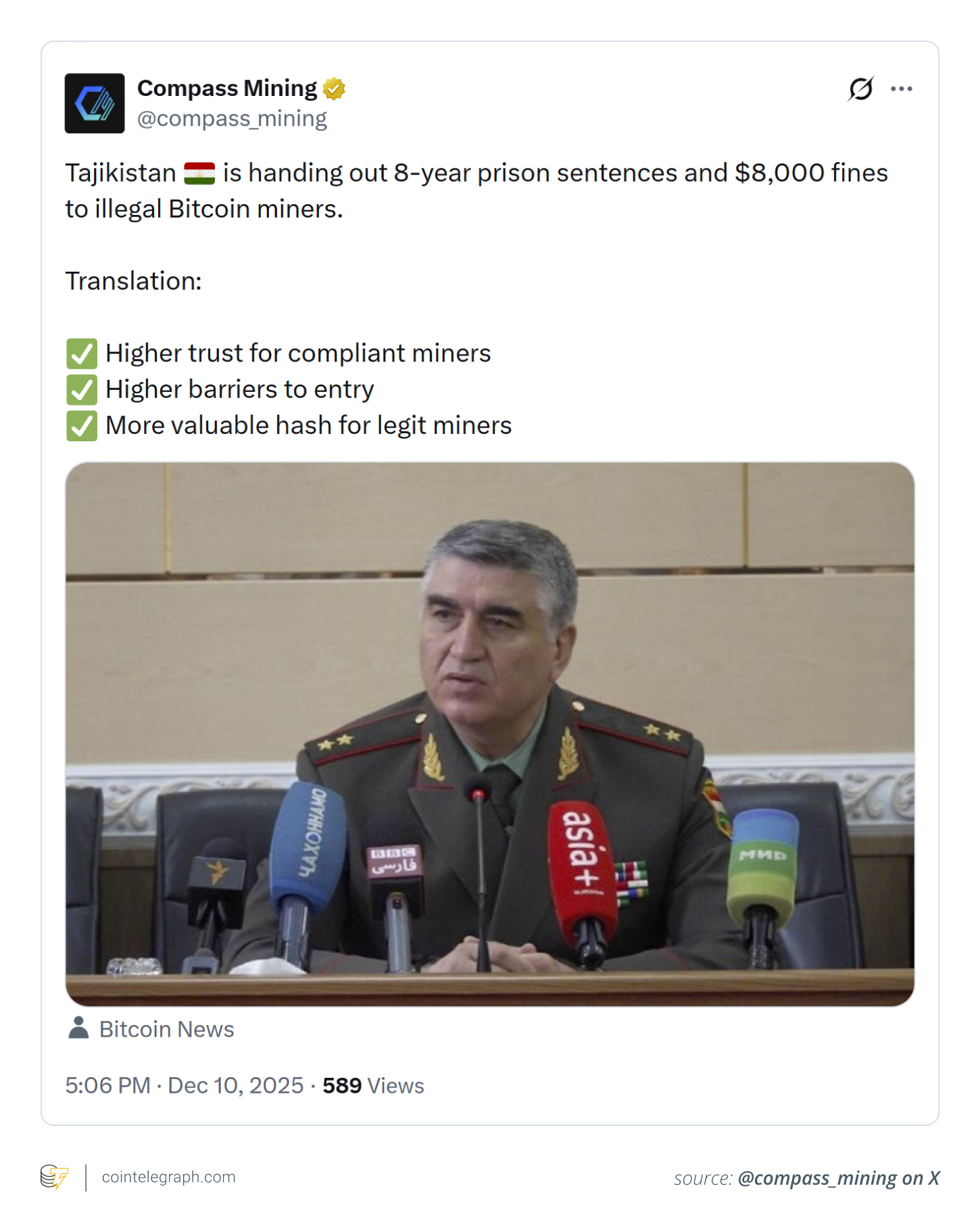
The bill was presented to parliament by Attorney General Habibullo Vohidzoda, who warned that unregulated mining had already caused regional power outages, millions in losses and an uptick in related crimes. He told lawmakers that damages from illegal mining had reached about $3.52 million and that several criminal cases were under investigation.
Power shortages in Tajikistan and mounting pressure
Tajikistan’s decision comes amid one of the most severe energy crises the country has faced in recent years.
- The country relies heavily on hydropower, and low water levels in reservoirs have forced authorities to ration electricity during the winter. In many areas, residents receive only two to four hours of power each day.
- Officials say unlicensed mining farms are worsening the situation. These operations often connect to the national grid illegally or bypass meters to avoid paying for power. The result is not only significant financial losses but also serious damage to power infrastructure.
Member of Parliament Shukhrat Ganizoda told lawmakers that a typical application-specific integrated circuits (ASIC) mining device draws about 3.5 kilowatts (kW) of power, while more advanced models can draw up to 6 kW. He said large mining farms running thousands of these machines place an enormous strain on the grid. Ganizoda added that perpetrators often tamper with wiring and meters to cut costs and maximize profits.
He also noted that illegal mining can contribute to tax evasion, untraceable financial transactions and attempts to conceal or launder criminal proceeds. The new legislation, he emphasized, is designed to protect both the country’s economy and its energy security.
Once signed by President Emomali Rahmon and published in state media, the law will take effect.
Did you know? Under Tajikistan’s new Article 253(2), mining cryptocurrency using stolen power can carry a prison sentence of up to eight years.
A global wave of crypto mining crackdowns
Tajikistan’s move is part of a broader international shift. Around the world, governments are rethinking their stance on cryptocurrency mining as energy costs rise and grids become strained:
- In Malaysia, authorities have uncovered thousands of illegal mining sites that siphoned off electricity worth more than $1 billion over the past few years.
- In Kuwait, officials launched a nationwide operation in 2025 to shut down unauthorized mining farms after power shortages worsened. Electricity usage reportedly fell by more than 50% in one area following the crackdown.
Even in countries that once embraced mining, such as China and Kazakhstan, energy shortages and rising environmental concerns have led to tighter regulations and, in some cases, outright bans. Many of these governments now treat unauthorized mining as theft or economic sabotage rather than a simple administrative violation.
The common thread is clear: Where electricity is cheap, subsidized or poorly monitored, crypto mining tends to surge. When energy becomes scarce, regulators step in to protect the grid and ensure the public has access to essential power.
Why Tajikistan’s mining crackdown matters for energy policy
Tajikistan’s new law highlights how cryptocurrency mining has shifted from a financial curiosity to a matter of national infrastructure and energy policy. Mining Bitcoin (BTC) and other proof-of-work cryptocurrencies consumes large amounts of electricity, and when done illegally, it creates a double burden.
First, it drains limited energy resources that should be available to households and industry. Second, it deprives the state of revenue and raises maintenance costs as infrastructure is damaged. For countries with fragile power systems, this combination can be very hard to manage.
In Tajikistan, authorities hope that criminalizing unauthorized mining will deter offenders and help stabilize the power grid. The law also signals to investors and businesses that the government is serious about regulating digital asset activity.
The move comes as the country strengthens penalties for other forms of power theft and nonpayment. Those offenses can already result in fines of up to $9,900 or prison sentences of up to eight years.
How miners and the crypto industry may respond
The tightening of rules in Tajikistan and elsewhere is likely to accelerate what analysts call “mining migration.” As one country enforces tougher penalties, miners often relocate to jurisdictions with more lenient rules or cheaper energy.
This pattern has played out before. When China banned crypto mining in 2021, much of the industry shifted to countries such as Kazakhstan, the United States and Russia. But as some of those regions experienced grid strain, many have since reevaluated their stance.
Experts say the future of mining will increasingly depend on access to renewable or surplus power. Operations that rely on sustainable energy are less likely to attract regulatory scrutiny. Some blockchain networks are also moving toward proof-of-stake models, which typically require far less electricity.
For Tajikistan, the hope is that the new penalties will discourage illegal mining altogether rather than push it further underground.
Energy security is now crypto policy
Tajikistan’s decision underscores a growing recognition that crypto mining is not just about digital finance. It touches on energy security, infrastructure resilience and environmental policy.
By making illegal mining a criminal offense, the government aims to send a clear message that energy misuse will not be tolerated. In a country where electricity shortages regularly affect daily life, the measure is as much about fairness as it is about technology.
For miners worldwide, Tajikistan’s example is a reminder that cheap or free electricity comes at a cost. As more governments treat energy theft as a serious crime, the global map of crypto mining will continue to shift toward regions that can balance innovation with responsibility.
In Tajikistan, that balance now means one thing above all: In the country, mining with stolen or unmetered electricity can now trigger criminal penalties, including prison time.


Subscribe to daily byte-sized crypto news from Cointelegraph
Cointelegraph publishes long-form journalism, analysis and narrative reporting produced by Cointelegraph’s in-house editorial team with subject-matter expertise. All articles are edited and reviewed by Cointelegraph editors in line with our editorial standards. Some articles contain affiliate links, from which Cointelegraph may earn a commission. These relationships do not influence which products we review or our editorial conclusions. Content published in here does not constitute financial, legal or investment advice. Readers should conduct their own research and consult qualified professionals where appropriate. Cointelegraph maintains full editorial independence.
More on the subject