


 Written by Adrian Zmudzinskistaff writerEdited by Bryan O'Sheastaff editor
Uniswap revives ICO-style token launches with new onchain auction system
Latest NewsPublishedNov 14, 2025
Uniswap launched Continuous Clearing Auctions, a new onchain token sale mechanism designed to offer transparent price discovery, debuting with Aztec’s sale.

Update (Nov. 19, 2025, at 6:40 am UTC): This article has been updated to add commentary from an Aztec representative.
Update (Nov. 21, 2025, at 7:00 am UTC): This article has been updated to add commentary from an Uniswap representative.
Decentralized finance heavyweight Uniswap introduced Continuous Clearing Auctions (CCA), a new protocol aiming to facilitate token offerings through its infrastructure.
According to a Thursday announcement, Uniswap’s CCA “helps teams bootstrap liquidity on Uniswap v4 and find the market price for new and low-liquidity tokens.” The company said this was just “the first of several tools” it is building to help projects launch and deepen token liquidity on the platform.
The announcement coincided with preparations for the first CCA-enabled sale. Privacy-focused Aztec Network opened its community-only AZTEC token sale on Thursday, with a public phase scheduled for Dec. 2.
The Aztec team claimed that it has “taken the community access that made the 2017 ICO era great and made it even better.” The team reportedly worked alongside Uniswap to develop the new protocol and “prioritize fair access, permissionless, onchain access to community members and the general public pre-launch.”
An Aztec representative noted that “on day 1 of the unlock, 100% of the community’s AZTEC tokens will be unlocked.” They explained that CCA protects against whale manipulation through real-time price discovery and what they view as fair onchain allocation.
“Retail users can set a cap, and the auction ensures they will fill tokens up to their cap the same as everybody else.” According to Aztec, this removes the advantages whales have in gas wars (higher fee wins) or over-committing to get larger allocations.
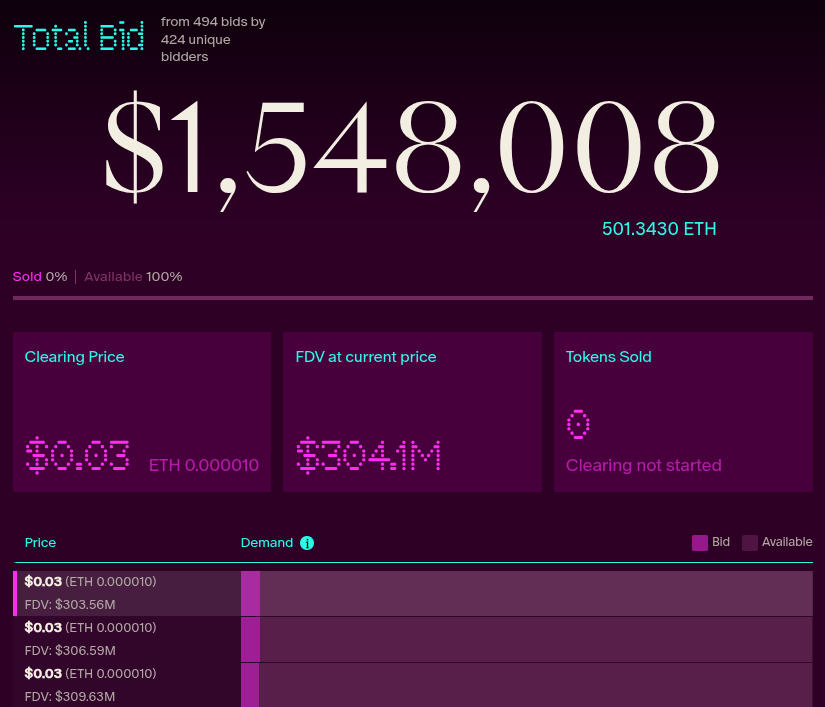
Aztec’s CCA-enabled token sale interface. Source: Aztec
A Uniswap representative told Cointelegraph that the major difference compared to most token sale systems is that “the entire mechanism is onchain and transparent.” They explained that “all its parameters are public and auditable” and “bidding, pricing and settlement all happen out in the open.”
A new token sale system
Uniswap said in the press release that “liquidity formation often happens behind closed doors,” leading to “information gaps, privileges a few players,” and sometimes “thin and unstable” markets. With CCA, the two partners hope to implement an onchain native market creation with transparent pricing, bidding and settlement, as well as gradual price discovery and automatic liquidity seeding to Uniswap’s decentralized exchange (DEX).
“No gatekeepers or offchain deals,” Uniswap said.
Related: DeFi players launch alliance to champion Ethereum to policymakers
CCA sales begin with projects defining the number of tokens on sale, the starting price, and the duration of the auction. They can also support running in tranches, verification tools such as ZK Passport (a privacy-enhanced, zero-knowledge proof-based Know Your Customer implementation), or entirely custom modules.
The Aztec spokesperson told Cointelegraph that integrating ZK Passport allows users to “complete verification without sending their sensitive passport data to third parties.” Instead, a cryptographic proof that the users is over 18 and not on sanction lists is provided.
“This allows Aztec to meet regulatory requirements for token sales while still ensuring no sensitive identity data is shared with a third party that may lose the data in a hack.“
Users can then place their bids, specifying a maximum price and a total spend. Bids cannot be withdrawn while in range, but there is no limit on the number of bids. Each bid is automatically spread across the remaining blocks of the auction and only fills if the block’s clearing price is at or below the limit price.
The Uniswap spokesperson said that since bids are spread across future periods in the auction, “decisions in the current period are always played out in future periods.” This purportedly makes it “very difficult for whales to reliably buy up the entire supply in one go or for sophisticated actors to unfairly trade against leaked information.”
Related: DeFi will become the default financial interface
CCA’s price discovery mechanism
At the end of each block, the protocol sets the highest price at which tokens were sold in that block. Higher bids fill first, then bids at the maximum price; everyone who fills in the block pays the same price.
Uniswap explained that as more bids divide the fixed per-block supply, clearing prices can either stay the same or increase. Early bidders are expected to get the better deals “since a larger portion of their bid can fill in earlier, cheaper blocks.”
The decentralized finance (DeFi) company announced that the CCA smart contract is now live and available to anyone. In the coming months, Uniswap also expects to release additional modules for the new token sale system.
The report came just days after Uniswap’s token rallied by over 38% following the Uniswap Foundation and Uniswap Labs’ proposal to activate a protocol-level fee mechanism to burn Uniswap (UNI) tokens. The team also announced a plan to burn 100 million UNI — roughly 16% of the UNI’s circulating supply — from the treasury.
Magazine: 2026 is the year of pragmatic privacy in crypto: Canton, Zcash and more
Subscribe to daily byte-sized crypto news from Cointelegraph
Cointelegraph is committed to independent, transparent journalism. This news article is produced in accordance with Cointelegraph’s Editorial Policy and aims to provide accurate and timely information. Readers are encouraged to verify information independently.
More on the subject