


 Written by Ezra Reguerrastaff writerEdited by Bryan O'Sheastaff editor
Succinct launches iPhone app to cryptographically verify photos
Latest NewsPublishedApr 24, 2026
Cryptography company Succinct launched Zcam, an iPhone camera app that signs photos and videos at capture to help prove media authenticity in the AI era.

Cryptography company Succinct has launched Zcam, an iPhone camera app that cryptographically signs photos and videos at the moment of capture to help prove their authenticity.
The company said Thursday that Zcam embeds a tamper-evident record linking media to the device that captured it, allowing viewers to verify that content was not digitally altered or generated by artificial intelligence.
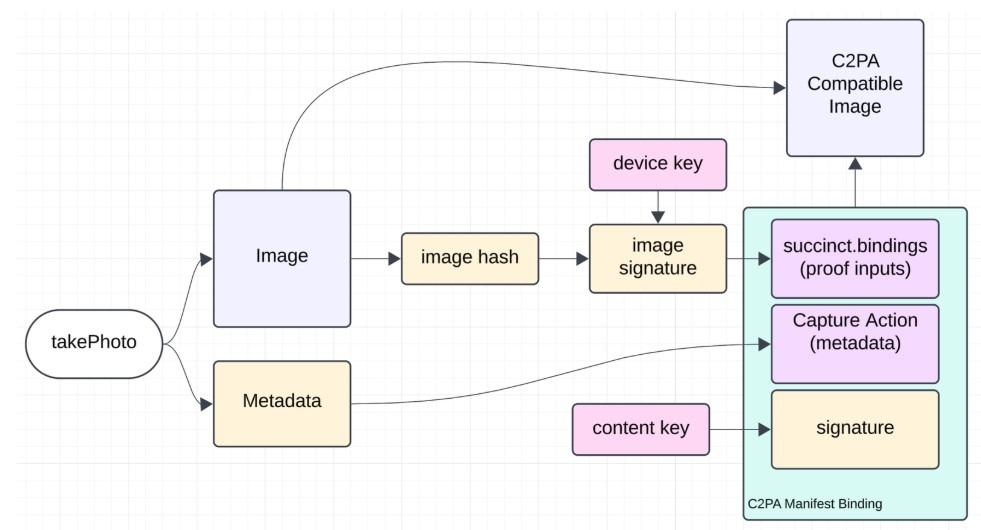
How the Zcam application works. Source: Succinct
According to Succinct, the app works by hashing raw image data and signing it using keys generated inside Apple’s Secure Enclave, a hardware-based security module. The resulting signature, along with capture metadata and attestation, is embedded into the file using the Coalition for Content Provenance and Authenticity (C2PA) standard, a framework for attaching tamper-evident provenance data to digital media.
Standards such as C2PA are designed to establish the origin and edit history of digital content by embedding signed provenance metadata into files. According to the C2PA, its open technical standard lets publishers, creators and consumers establish the “origin and edits” of digital content. It allows users to record how the content was created, which tools were used and how it changed over time.
Related: Spain seizes crypto cold wallets in illegal manga piracy raid
The launch pushes Succinct’s applied cryptography work beyond blockchain infrastructure and into media provenance, as companies look for ways to authenticate digital content at creation rather than rely only on after-the-fact AI detection tools.
The launch comes as security concerns in crypto increasingly include AI-driven fraud. On Thursday, blockchain security firm CertiK warned that deepfakes, phishing attacks and AI-assisted social engineering are likely to drive some of the largest crypto hacks in 2026. The report highlighted how attackers are using convincing synthetic media to deceive users and bypass security checks.
Crypto security expands beyond code as AI threats rise
Succinct said Zcam is an early step toward broader adoption of cryptographic provenance tools, which could be used in areas such as journalism, insurance claims and identity verification, where trust in digital media is increasingly critical.
The company acknowledged limitations in its current implementation, noting that the Zcam software development kit is unaudited and not production-ready. It also said secure enclaves have been compromised in the past and that ensuring a fully tamper-proof capture-to-signing process remains an active area of research.
Magazine: AI-driven hacks could kill DeFi — unless projects act now


Subscribe to daily byte-sized crypto news from Cointelegraph
Cointelegraph is committed to independent, transparent journalism. This news article is produced in accordance with Cointelegraph’s Editorial Policy and aims to provide accurate and timely information. Readers are encouraged to verify information independently.
More on the subject