


 Written by Helen Partzstaff writerEdited by Bryan O'Sheastaff editor
European banks seek exchange partners ahead of 2026 stablecoin launch
Latest NewsPublishedMar 2, 2026
Qivalis, a European banking consortium, is reportedly in talks with crypto exchanges ahead of a planned euro stablecoin launch in the second half of 2026.

Update (March 5, 9:00 am UTC): This article has been updated to add comments by Qivalis CEO Jan Sell.
Qivalis, a consortium of major European banks, is in advanced talks with crypto exchanges and liquidity firms to distribute its planned euro-pegged stablecoin.
“We are currently in discussions with various players in the ecosystem for distribution, including crypto exchanges, once we receive our license from the Dutch Central Bank,” Jan Sell, Qivalis CEO, told Cointelegraph.
The group, including banks such as ING, UniCredit, and the recent addition of BBVA, is moving toward the launch of a stablecoin in the second half of 2026, Spanish business newspaper Cinco Días reported Monday. The shareholder banks themselves will reportedly be able to distribute the stablecoin.
The news comes months after the banks first announced the consortium in September 2025 with nine initial members, including ING, UniCredit, CaixaBank, Danske Bank, Raiffeisen Bank International, KBC, SEB, DekaBank and Banca Sella.
Qivalis is considering both European and international partners
Qivalis CEO Sell, who is also a former head of Coinbase in Germany, said the consortium is considering partnerships with both European and international platforms.
This aligns with the project’s global vision and its priority to offer a “regulated, domestic alternative to US dollar-denominated stablecoins,” he noted.
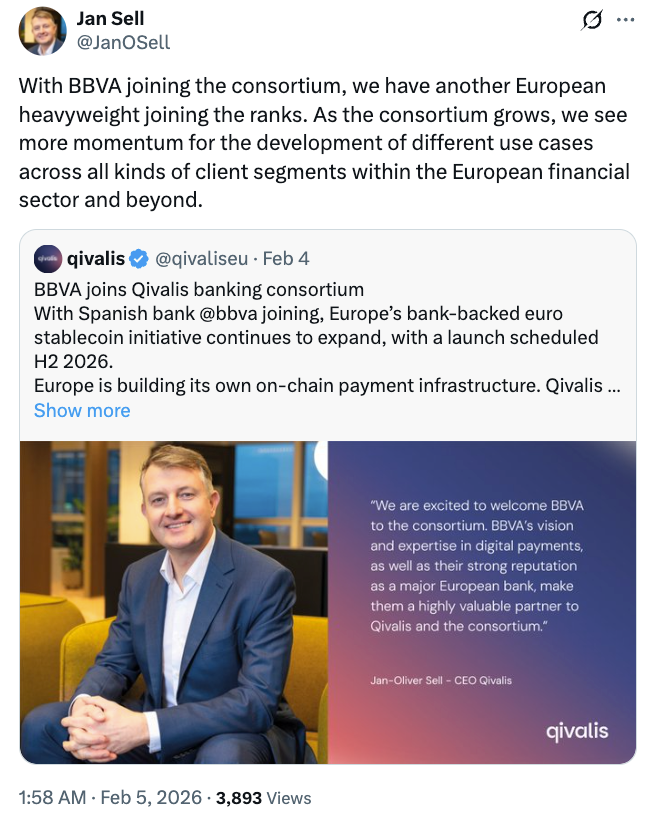
Spanish bank BBVA joined Qivalis as its 12th member in early February. Source: Jan Sell
“It’s essential for our core use cases, such as facilitating real-time, cross-border business-to-business payments and global trade,” he said.
The consortium is seeking partners that comply with European Union regulatory frameworks, including the bloc’s Markets in Crypto-Assets Regulation. According to the report, Bit2Me, a MiCA-licensed exchange in Spain, is among the platforms that have held talks with one of the consortium’s banks.
Related: Deutsche Bank-backed AllUnity launches Swiss franc stablecoin CHFAU
“The reserve structure will follow MiCA regulations, so initially a minimum of 30% in bank deposits and at most 70% in secure, low-risk assets,” the Qivalis CEO told Cointelegraph, referring to high-quality liquid assets, including short-term government bonds.
“This would change, should we become a significant issuer,” he added.
Qivalis chief financial officer, Floris Lugt, said the preference for short-term bonds is intended to avoid concentration risk in any single country. He added that the euro stablecoin will support 24/7 redemption for token holders.
Magazine: Clarity Act risks repeat of Europe’s mistakes, crypto lawyer warns
Subscribe to daily byte-sized crypto news from Cointelegraph
Cointelegraph is committed to independent, transparent journalism. This news article is produced in accordance with Cointelegraph’s Editorial Policy and aims to provide accurate and timely information. Readers are encouraged to verify information independently.
More on the subject