


 Written by Helen Partzstaff writerEdited by Bryan O'Sheastaff editor
Only KYC can stop insider trading on prediction markets, Messari says
Latest NewsPublishedJan 20, 2026
Insider trading is hard to curb on non-KYC prediction markets, but even identity checks do not fully eliminate abuse, according to Messari’s Austin Weiler.

Concerns over insider trading on prediction markets have intensified after a series of high-profile bets on geopolitical events, prompting fresh questions over whether it’s even feasible to curb such practices in the growing industry sector.
Preventing insider trading is realistically possible only on prediction markets applying Know Your Customer (KYC) measures, according to Austin Weiler, a research analyst at the blockchain intelligence firm Messari.
“For KYC’d platforms, the most effective mechanism is to restrict access upfront for users to specific markets,” Weiler told Cointelegraph, adding that state actors could be restricted from political or geopolitical markets.
“This does not fully eliminate abuse, since insiders can still share information with third parties, but it adds an important obstacle and raises enforcement standards,” he noted.
The problem with non-KYC prediction markets
For non-KYC, or fully onchain prediction markets, enforcement is extremely challenging and, in some cases, “nearly impossible,” Weiler said.
When wallets are not linked to real-world identities, there is no reliable way to identify traders or determine whether they have access to material non-public information (MPNI), he said.
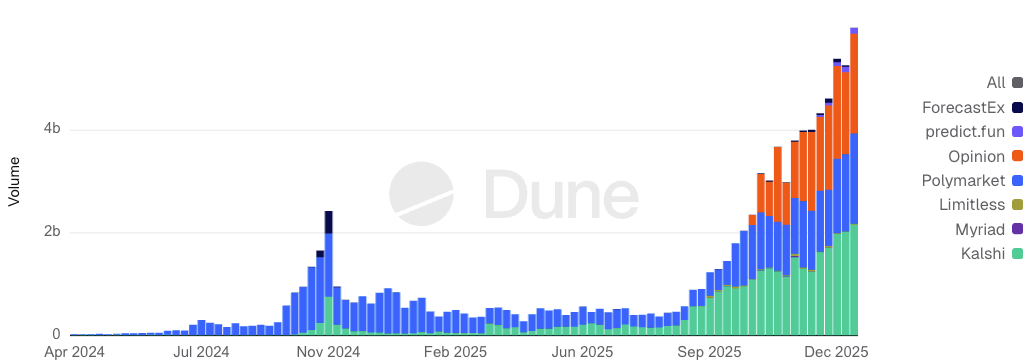
Trading volumes in prediction markets hit almost $6 billion by mid-January 2026. Source: Dune
“Prediction markets can attempt to monitor unusual trading behavior, cap trade sizes, or slow trading during sensitive geopolitical periods. However, these measures are easily bypassed,” Weiler said, adding:
“Bans targeting government officials are only realistically enforceable in KYC-based systems. While all onchain activity is transparent, transparency alone does not solve the attribution problem. Without identity verification, it is extremely difficult to link an onchain wallet to a specific official, state actor, or insider with confidence.”
Kalshi, Polymarket, Opinion: Who requires KYC and how?
At the time of writing, KYC requirements vary widely across established prediction platforms such as Kalshi and Polymarket, while decentralized alternatives do not appear to require identity checks, or cannot technically support them.
Kalshi enforces KYC requirements as part of its regulated model under the authority of the US Commodity Futures Trading Commission. On its sign-up page, Kalshi states that it requires basic personal information from users and may request further verification using an identification document.
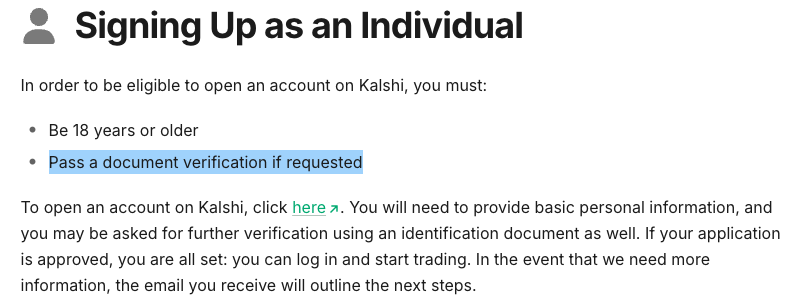
Sign-up process on Kalshi. Source: Kalshi
Polymarket applies KYC to its US-based users, while non-US versions of the platform operate without mandatory identity checks, with access reportedly available via VPN, according to social media reports. The platform does not publicly confirm this in its user guide.
Opinion, a decentralized prediction market backed by YZi Labs, a company linked to the former Binance CEO Changpeng Zhao, provides no public information on KYC requirements.
Cointelegraph approached Kalshi, Polymarket and Opinion for comment regarding KYC requirements but had not received any response at the time of publication.
Related: Tennessee sends cease-and-desist letters to Kalshi, Polymarket, Crypto.com
The news comes amid intense scrutiny of major prediction market platforms following high-profile bets tied to geopolitical events in Venezuela, including reports of an anonymous trader turning $30,000 into more than $400,000 just hours before US forces captured former Venezuelan President Nicolás Maduro.
Some US lawmakers, including Representative Ritchie Torres, have backed legislation including the Public Integrity in Financial Prediction Markets Act of 2026, aimed at barring government officials from trading on prediction markets when they hold material nonpublic information.
Magazine: How crypto laws changed in 2025 — and how they’ll change in 2026


Subscribe to daily byte-sized crypto news from Cointelegraph
Cointelegraph is committed to independent, transparent journalism. This news article is produced in accordance with Cointelegraph’s Editorial Policy and aims to provide accurate and timely information. Readers are encouraged to verify information independently.
More on the subject