


 Written by Biraajmaan Tamulystaff writerEdited by Ray Salmondformer editor
New Bitcoin whales are rewriting BTC’s market structure: Data
MarketsPublishedDec 19, 2025
Bitcoin’s onchain data reveals new BTC whales with 50% of the realized capital, highlighting a shift in how capital is shaping the market.
Freshly released Bitcoin (BTC) onchain data pointed to a less classic cycle peak or bottom and more toward a structural transition in how capital is entering the market.
Key takeaways:
- Nearly 50% of Bitcoin’s realized cap is now attributed to “new whales,” highlighting a structural reset of the network’s cost base.
- The Short-Term Holder (STH) supply expanded by about 100,000 BTC over 30 days, reaching an all-time high that signals intense demand.
New whales are rewriting Bitcoin’s cost base
Data from CryptoQuant shows that addresses classified as new whales now account for almost 50% of Bitcoin’s realized cap. Realized cap measures the value of BTC at the price each coin last moved, meaning this shift reflects where capital entered the network, not who owns the most coins.
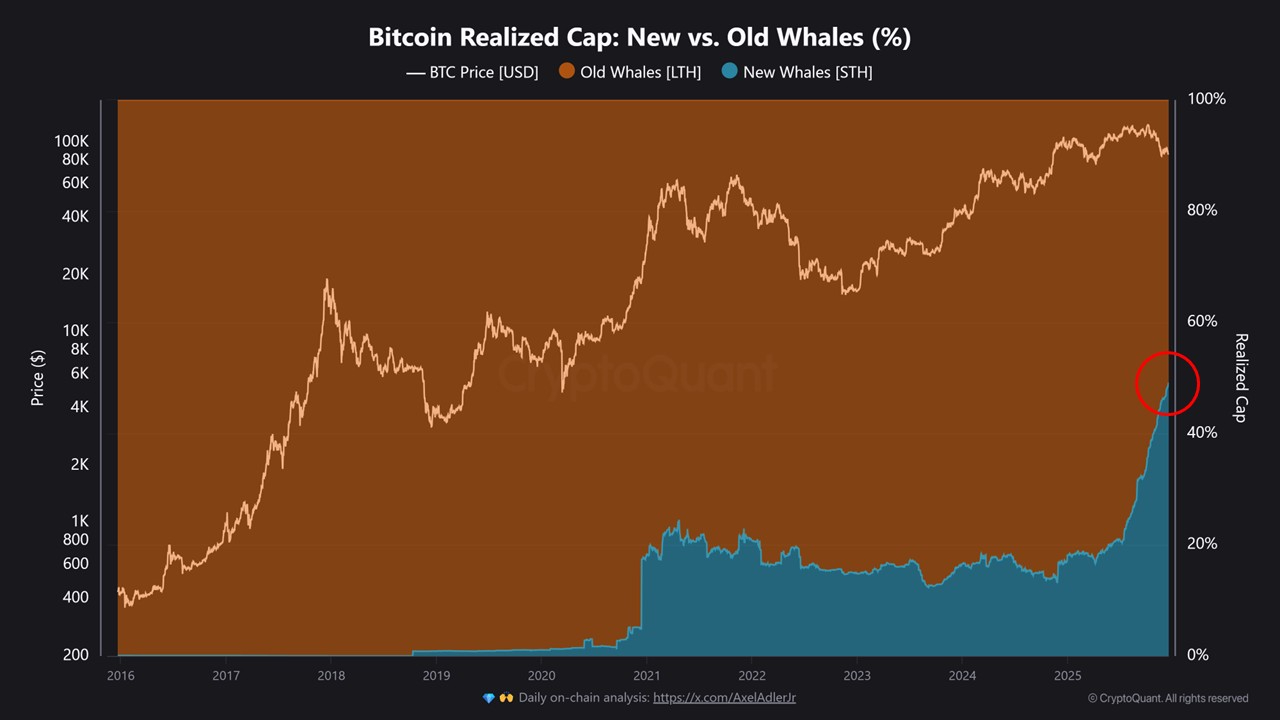
Bitcoin realized cap held by New Whales. Source: CryptoQuant
Before 2025, new whales accounted for no more than 22% of Bitcoin’s realized cap. Past bull markets were driven by whales that accumulated at low prices and distributed gradually, whereas now, new whales are deploying large amounts of capital at significantly higher price levels.
Notably, during market pullbacks, the realized cap share held by new whales has continued to rise, signaling a re-anchoring of Bitcoin’s aggregate cost basis rather than speculative churn.
Related: Bitcoin weekly RSI falls to the most oversold levels since $15K BTC price
Short-term demand surges as whales buy dip near $85,000
The short-term holder net position change (30-day) has reached an all-time high of nearly 100,000 BTC. This metric tracks the net change in supply held by coins younger than 155 days and reflects aggressive accumulation by new entrants.
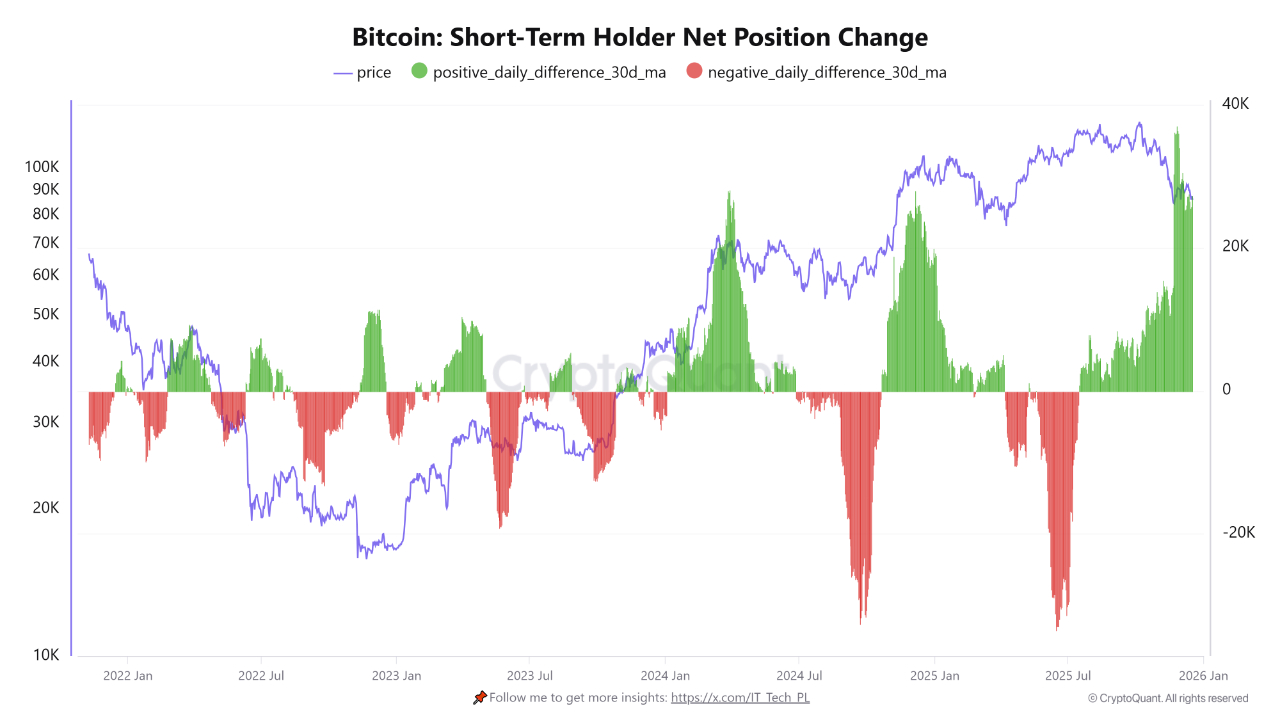
Bitcoin short-term holder net position change. Source: CryptoQuant
Such expansions occur during high-momentum phases, when demand overwhelms available supply, even if volatility remains elevated.
Meanwhile, recent Binance inflow data indicated that coins older than 155 days remained largely inactive, confirming that long-term holders did not distribute them. Instead, selling came primarily from short-term holders reacting to price weakness.
More importantly, about 37% of BTC sent to Binance originated from whale-size wallets (1,000–10,000 BTC), indicating that large capital was actively executing and seeking liquidity during the move.
Data from Hyblock reinforces this view. The cumulative volume delta (CVD), which measures whether buyers or sellers dominate, shows whale wallets ($100,000–$10 million) posted a positive $135 million delta this week.
In contrast, retail ($0-$10,000) and mid-size traders ($10,000-$100,000) recorded negative deltas of $84 million and $172 million, respectively. In effect, larger players absorbed selling pressure while smaller participants reduced exposure.
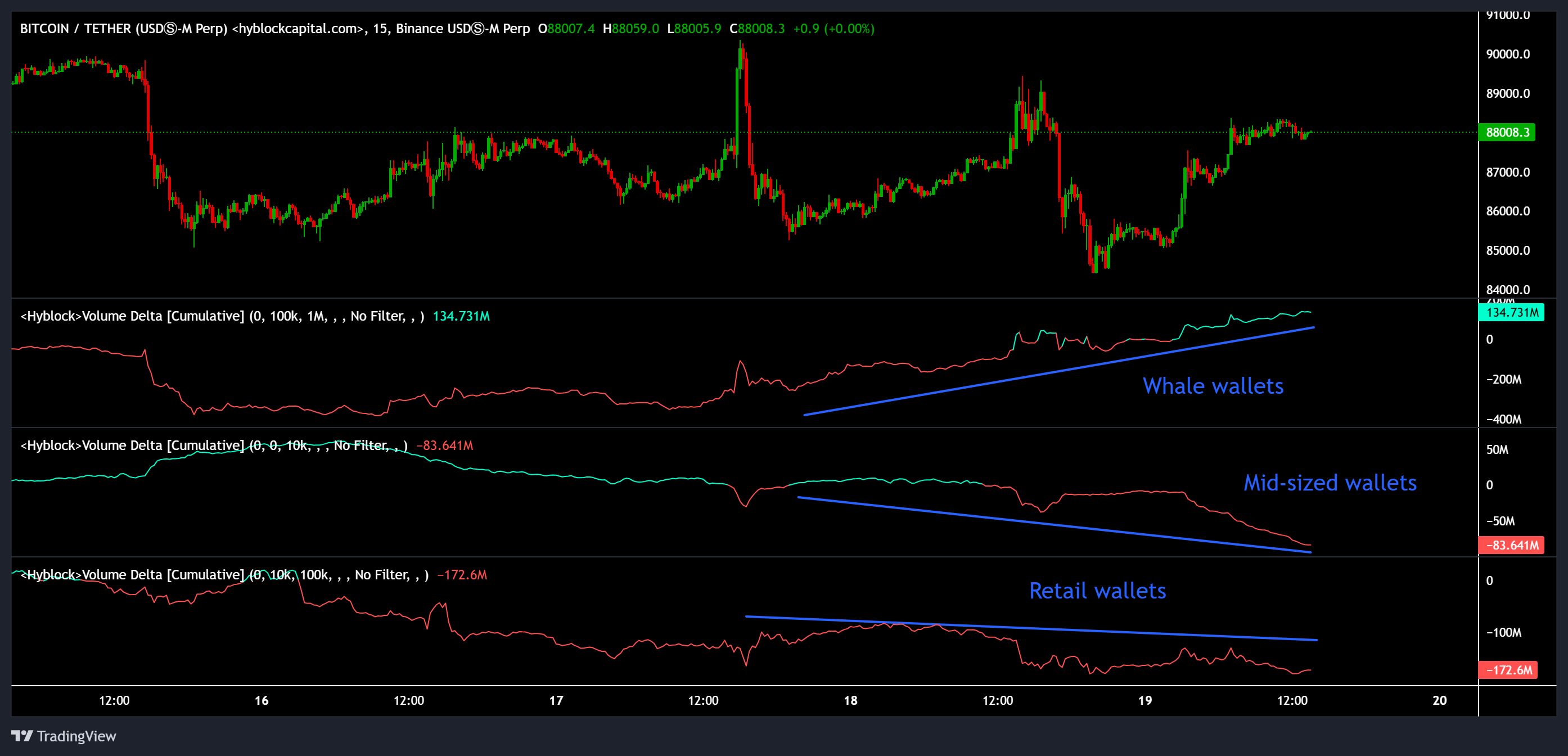
Bitcoin price, and cumulative volume delta for retail, mid-size, and whale wallets. Source: Hyblock Capital
Related: Fidelity macro lead calls $65K Bitcoin bottom in 2026, end of bull cycle
This article does not contain investment advice or recommendations. Every investment and trading move involves risk, and readers should conduct their own research when making a decision. While we strive to provide accurate and timely information, Cointelegraph does not guarantee the accuracy, completeness, or reliability of any information in this article. This article may contain forward-looking statements that are subject to risks and uncertainties. Cointelegraph will not be liable for any loss or damage arising from your reliance on this information.


Subscribe to daily byte-sized crypto news from Cointelegraph
This article is produced in accordance with Cointelegraph's Editorial Policy and is intended for informational purposes only. It does not constitute investment advice or recommendations. All investments and trades carry risk; readers are encouraged to conduct independent research.
More on the subject