


 Written by Marcel Pechmanformer writerEdited by Ray Salmondformer editor
SOL price action lags the wider altcoin market: Is Solana’s heyday over?
MarketsPublishedDec 18, 2025
SOL falls behind multiple altcoin competitors as its onchain activity, fee and DApp revenues slump. Cointelegraph explains why.

Key takeaways:
- SOL lagged the altcoin market as falling fees and DApp revenues signaled weaker Solana network demand.
- Growth shifted to Base, Arbitrum, Polygon and BNB Chain, reducing the odds of a near-term SOL rebound.
Solana’s native token, SOL (SOL), has fallen 32% since November, underperforming the broader altcoin market, which declined 21%. This gap has become a concern for bulls, especially given inflows into SOL exchange-traded funds and a growing number of companies adding the asset to their balance sheets as a reserve strategy.
Traders are now questioning what would need to change for SOL price to reestablish a sustained bullish trend.
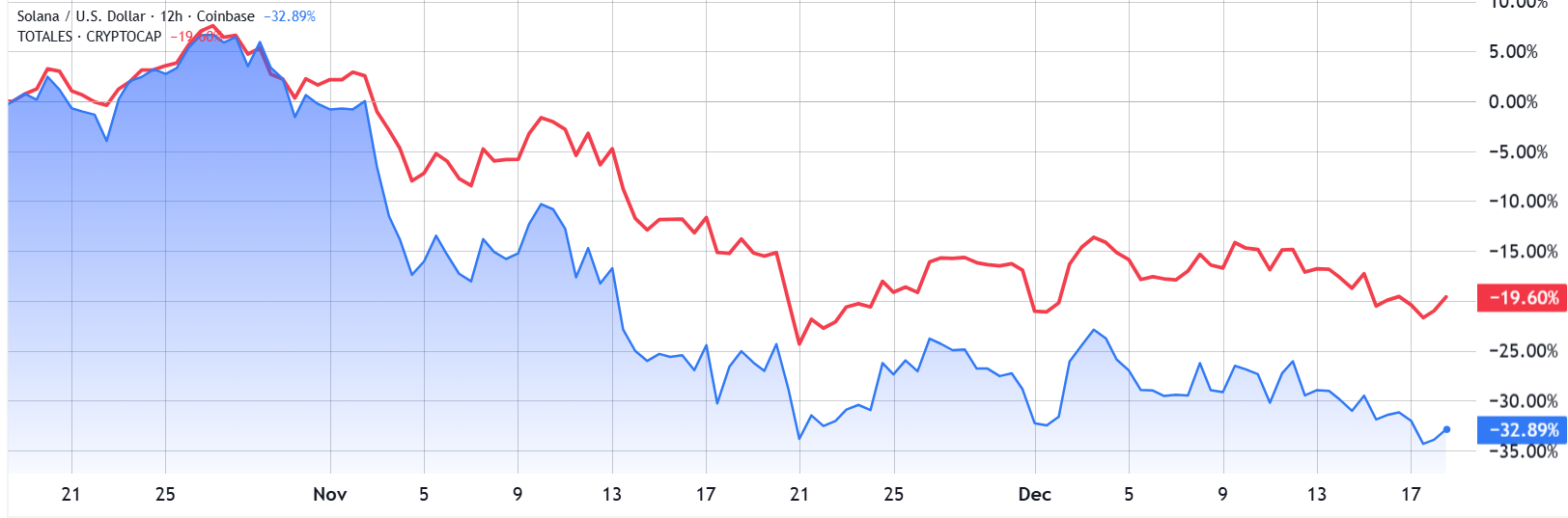
SOL/USD (blue) vs. total crypto capitalization (red). Source: TradingView
The Solana ETF industry in the US has accumulated $636 million in assets since the launch of the REX-Osprey SOL+Staking ETF in July. At the same time, companies such as Forward Industries (FORD US), Solana Company (HSDT US) and Sharps Technology (STSS US) have collectively added 20.35 million SOL to their balance sheets, valued at more than $2.5 billion.
Native staking on Solana has also helped limit the amount of SOL immediately available for sale. Nearly 68% of the circulating supply is currently delegated to the network’s proof-of-stake system, a share that has increased steadily over the past few months. Staking yields on Solana can exceed 6%, as SOL remains inflationary to offset the costs of operating validators.
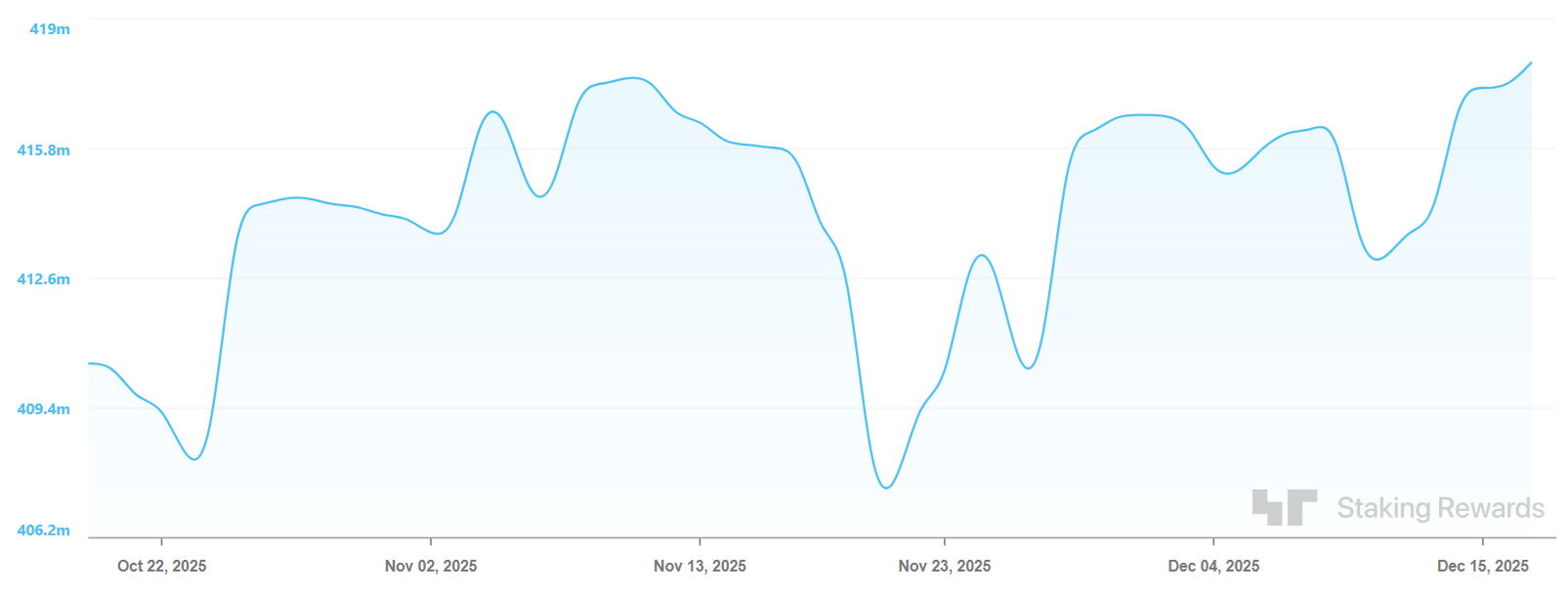
Native staked SOL on Solana network. Source: StakingRewards
Total staked SOL rose to 418 million from 410 million two months earlier, extending a trend that has been in place since March. As a result, SOL’s drop back toward the $120 level appears more closely tied to softer expectations for Solana network demand. Broader crypto adoption trends may have shifted toward competing platforms or alternative solutions that do not require direct blockchain settlement.
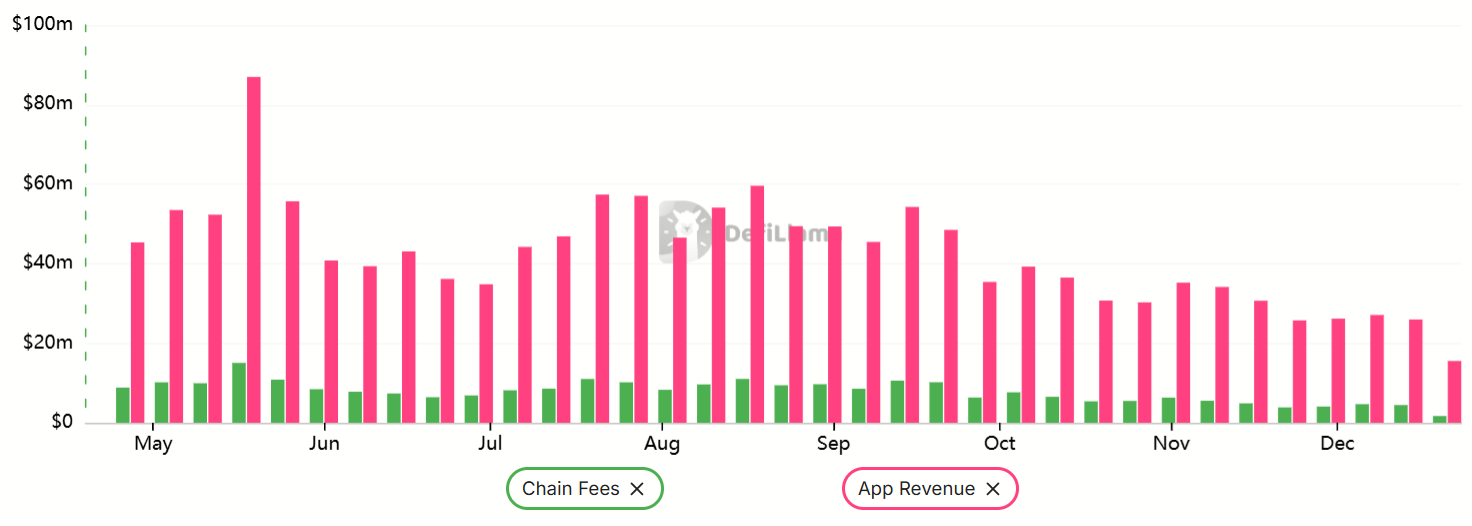
Solana network weekly chain fees vs. DApps revenue, USD. Source: DefiLlama
Solana onchain activity has been in steady decline since August, with weekly network fees falling to $4.5 million from $7 million just two months earlier. Decentralized applications (DApps) on Solana also experienced a 30% decline in revenue over the same period, dropping to $26 million per week. While Solana’s utility weakened, activity on other networks accelerated.
Solana onchain activity outpaced by Ethereum’s L2 ecosystem
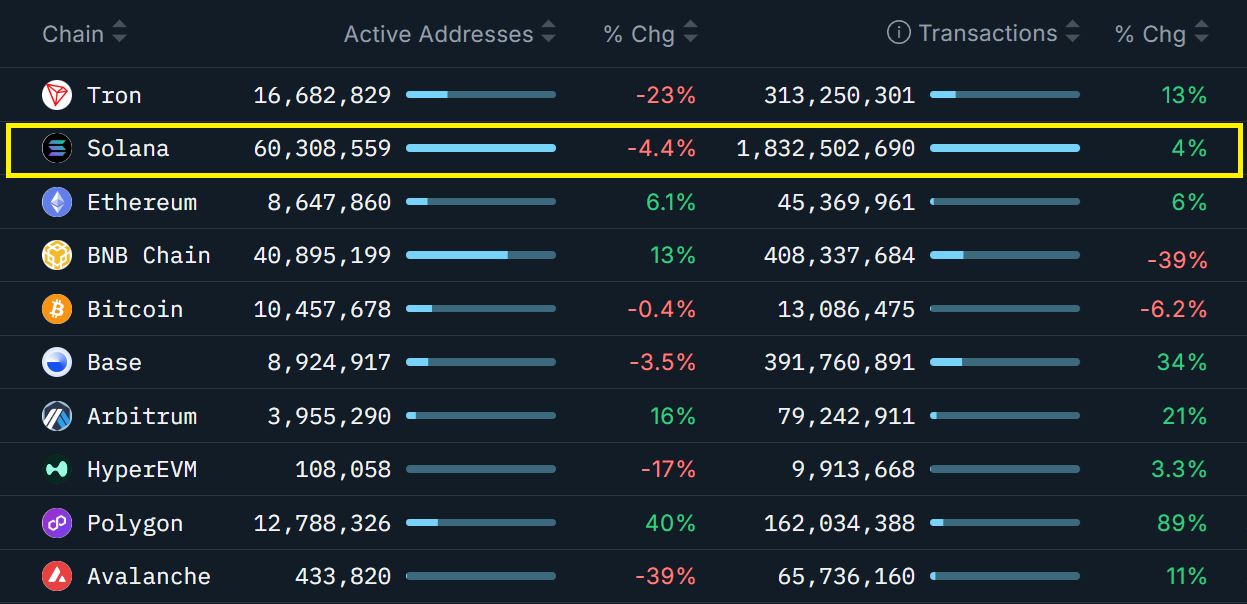
Top blockchains ranked by 30-day fees. Source: Nansen
Monthly transaction counts increased by just 4% on Solana and 6% on Ethereum. In contrast, activity surged 34% on Base, 21% on Arbitrum and 89% on Polygon. Even Tron, a direct competitor of Solana, recorded a 13% rise in 30-day transactions. The Ethereum layer-2 ecosystem continued to expand, offering low fees and collectively exceeding Solana’s $8.5 billion in total value locked (TVL).
Related: DAT longevity hinges on avoiding ‘mNAV roller coaster’-Solmate CEO
SOL investors also grew more cautious following the relative success of BNB Chain DApps such as Aster decentralized exchange and Four-meme, a memecoin launch platform. Support from the world’s largest cryptocurrency exchange gives these projects easier access to developers, marketing channels and a large user base. Binance’s recent move into prediction markets may further weaken the bullish case for SOL.
SOL is unlikely to close its performance gap versus the broader altcoin market without a clear reversal in Solana onchain activity. Whether competition comes from other blockchain networks or from traditional fintech players, such as Nasdaq’s plans for 23-hour trading, the prospects for sustained bullish momentum in SOL remain limited.
This article is for general information purposes and is not intended to be and should not be taken as, legal, tax, investment, financial, or other advice. The views, thoughts, and opinions expressed here are the author’s alone and do not necessarily reflect or represent the views and opinions of Cointelegraph. While we strive to provide accurate and timely information, Cointelegraph does not guarantee the accuracy, completeness, or reliability of any information in this article. This article may contain forward-looking statements that are subject to risks and uncertainties. Cointelegraph will not be liable for any loss or damage arising from your reliance on this information.


Subscribe to daily byte-sized crypto news from Cointelegraph
This article is produced in accordance with Cointelegraph's Editorial Policy and is intended for informational purposes only. It does not constitute investment advice or recommendations. All investments and trades carry risk; readers are encouraged to conduct independent research.
More on the subject