


 Written by Dilip Kumar Patairyaformer writerEdited by Rahul Nambiampurathformer editor
What NYSE’s exploration of onchain systems means for financial markets
FeaturesPublishedFeb 24, 2026
Tokenized securities, 24/7 trading and onchain settlement could allow the NYSE’s blockchain plans to reshape post-trade processes in financial markets.

Key takeaways
- Intercontinental Exchange (ICE)’s blockchain-based initiative is about upgrading market infrastructure, not adopting cryptocurrencies. It intends to use blockchain for improving settlement, reconciliation and collateral efficiency.
- Onchain delivery-vs.-payment settlement could significantly reduce counterparty risk and free up capital tied up in margins. It also shifts risk toward real-time liquidity needs and continuous funding requirements.
- While 24/7 trading may expand global access, it does not necessarily solve deeper market-structure issues. It could introduce liquidity fragmentation, wider spreads and noisier price discovery during low-volume periods.
- Stablecoins in this model act as institutional settlement rails rather than speculative assets. Their use inside regulated markets will require bank-grade custody, liquidity and compliance safeguards.
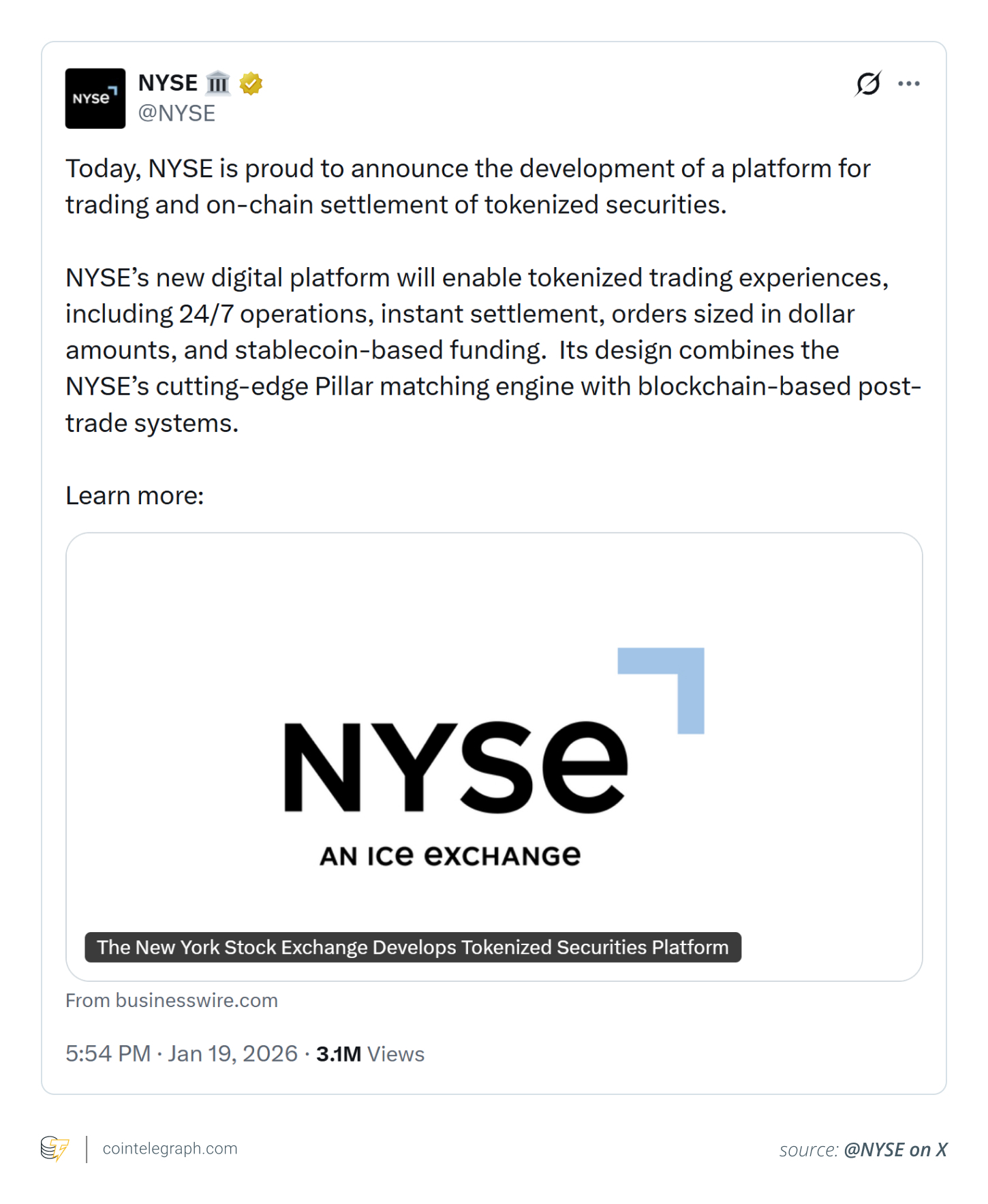
When Intercontinental Exchange (ICE), the parent company of the New York Stock Exchange (NYSE), announced it was developing a blockchain-based platform for tokenized securities, some observers interpreted it as traditional finance fully integrating crypto.
However, the initiative is just a strategic redesign of market infrastructure. The focus is on utilizing distributed ledgers to optimize collateral management and eliminate delays in legacy settlement systems.
ICE has indicated that the platform would enable 24/7 trading, incorporate onchain settlement elements, support stablecoin-based funding and feature tokenized versions of regulated securities, subject to regulatory approval. If rolled out at scale, this would represent one of the most significant efforts by a major exchange operator to weave blockchain technology into market operations.
This article explores how the NYSE is integrating blockchain to segregate execution from settlement, why onchain settlement becomes critical, the importance of 24/7 trading and stablecoins as institutional funding rails. It discusses how tokenization is becoming a part of mainstream finance, hurdles in the integration of blockchain technology with legacy systems and issues regarding adaptation.
How the NYSE is using blockchain technology to separate execution from settlement
The platform maintains a clear separation between trading and settlement. ICE plans to continue using the existing NYSE Pillar matching engine, which already manages high-volume equity trading, as the primary trading layer. Blockchain technology would primarily enhance post-trade processes, such as settlement, record-keeping and reconciliation.
This distinction is important, as inefficiencies in financial markets generally stem not from price discovery during trading but from delays and complexities in clearing, settlement, cross-party reconciliation and collateral handling.
Tokenized securities refer to regulated assets like stocks or exchange-traded funds (ETFs) whose ownership is recorded on a blockchain for greater efficiency. The underlying legal rights continue to be governed by existing securities laws and corporate regulations.
Why onchain settlement likely matters more than 24/7 trading
Even with faster settlement cycles in US equities, most trades still depend on multiple intermediaries, such as clearinghouses, custodians and agents, that reconcile records across parties. This creates layers of operational complexity and lingering counterparty risk during the settlement window.
Onchain settlement changes this fundamentally by enabling near-simultaneous transfer of ownership and payment on a shared, immutable ledger. This process, also called delivery-vs.-payment (DvP), sharply reduces counterparty exposure and minimizes reconciliation errors. DvP could free up capital tied up in margins or buffers for more productive uses. It tackles the core inefficiencies and risks in post-trade infrastructure.
Faster settlement, however, is not without trade-offs. It eliminates the time buffers that currently allow markets to resolve errors, unwind failed trades or handle liquidity squeezes. Risk simply shifts toward real-time liquidity demands, requiring participants to fund positions continuously rather than leaning on intraday credit. From a broader view, this redistributes rather than removes systemic risk.
What 24/7 trading may (and may not) achieve
Continuous trading appeals to global investors familiar with round-the-clock crypto or futures markets. For US equities, extended hours already exist, but they typically feature lower liquidity, wider spreads and higher volatility compared with core sessions.
Fully 24/7 markets could offer better access for international participants and potentially smoother reactions to off-hour news. Yet several concerns remain:
- Liquidity could thin out during quieter periods, forcing market makers to widen quotes or increase trading costs.
- Overnight or low-volume trading might amplify price swings, particularly around major global events.
- Price discovery could stay concentrated in traditional hours, with off-hours reflecting noisier or less representative signals rather than true efficiency gains.
Whether continuous trading truly enhances market quality or just spreads activity more thinly across time zones is still an open question.
Onchain settlement addresses deeper structural frictions in how trades are finalized, reducing risk and unlocking efficiency, while 24/7 trading mainly extends availability without necessarily fixing those underlying issues.
Did you know? Some stock exchanges already use microsecond-level timestamp synchronization from atomic clocks to track trade sequences. This means blockchain systems must integrate with ultra-precise time standards to avoid disputes over transaction ordering.
Stablecoins as institutional funding rails, not speculative plays
A key element in ICE’s proposal is the use of stablecoins to handle the cash side of trades. This would let funds settle 24/7, aligning with any move toward continuous securities trading and bypassing traditional bank-hour limitations. The process results in quicker, lower-friction movement of cash across borders and between counterparties.
If stablecoins are embedded in regulated market infrastructure, they are certain to face stringent compliance requirements. These include real-time compliance monitoring, high-grade custody arrangements, robust liquidity buffers and other safeguards on par with traditional settlement banks.
Stablecoins function strictly as wholesale settlement tools for institutions, not as retail payment or speculative instruments.
Tokenization steadily moving into mainstream finance
The NYSE-related efforts are part of a broader trend. Major asset managers, banks and market infrastructure providers are actively piloting or seeking approval to tokenize conventional assets. These include US Treasury bills, money market fund shares, ETF units and similar instruments.
Regulatory filings demonstrate that tokenization is expanding into areas traditionally seen as conservative and infrastructure-heavy. The objective is operational efficiency rather than innovation for its own sake. Advantages include accelerated settlement, programmable conditions, reduced manual reconciliation and potentially wider participation.
If tokenized versions of multiple asset classes become commonplace, post-trade processes could converge toward shared, interoperable ledger architectures. This would reduce overlap and duplication across today’s fragmented ecosystem of clearinghouses, custodians, transfer agents and registrars. However, to facilitate such an outcome, institutions and regulators need to align on standards, interoperability and risk controls.
Did you know? In traditional markets, a single stock trade can trigger a string of back-office messages between brokers, custodians and clearing agents, which is a key reason financial firms spend billions annually on post-trade IT systems.
Custody, records and legal ownership still the hardest hurdles
The biggest barrier to tokenized markets isn’t the blockchain technology itself. There is legal ambiguity regarding ownership. Traditional finance relies on clear, well-established rules for beneficial ownership, shareholder rights, voting, dividends and who maintains the definitive record.
In a tokenized world, regulators will need to decide what counts as the authoritative source of truth, whether it is the onchain ledger, the transfer agent’s registry, the broker-dealer’s books or some hybrid. Each choice affects investor protections, how corporate actions are handled, how disputes are resolved and who bears liability.
Custody adds another layer of difficulty. Even in permissioned, institutional-grade blockchains, managing private keys or equivalent controls requires robust answers on asset segregation, key recovery in case of loss, bankruptcy remoteness and operational continuity. These issues demand new frameworks that match or exceed existing standards.
These legal and operational questions are likely to slow adoption more than any technical limitations.
Clearinghouses and the shift to real-time risk management
ICE has also indicated interest in bringing tokenized deposits or similar mechanisms into clearinghouse operations. It has suggested integrating blockchain-based settlement tools with clearing infrastructure.
Clearinghouses have a role to play in neutralizing counterparty risk. Shorter or near-instant settlement windows can shrink exposure periods and lower overall risk. However, they also result in less time to detect and respond to defaults, collateral deficiencies or sudden liquidity stress.
This pushes clearing participants and operators toward continuous position monitoring, automated intraday margin calls, dynamic collateral valuation and well-tested playbooks for outages, cyber events or technology failures.
From a regulatory perspective, resilience in always-on, 24/7 environments becomes critical. Traditional markets have scheduled downtime. Continuous systems cannot afford unplanned interruptions without risking cascading outages.
Did you know? The NYSE once shortened its trading day during World War I and even shut down completely for four months in 1914. This shows that market “hours” have always evolved with technology, geopolitics and infrastructure limits.
Who stands to gain and who might need to adapt
If onchain market infrastructure demonstrates reliability and receives regulatory approval, several participants could see meaningful advantages:
- Global investors who want uninterrupted access to trading and settlement
- Institutions that could unlock more efficient use of collateral and reduce trapped capital
- Issuers interested in streamlined distribution channels and potentially broader reach.
On the flip side, intermediaries whose revenues rely heavily on today’s multi-step settlement workflows may face strong pressure to evolve or risk losing relevance. These include clearing agents, custodians and certain reconciliation services. Compliance teams would also shift from periodic, market-hours reporting to continuous oversight, adding complexity in the short term.
Whether these operational savings translate into lower costs for retail and institutional end investors depends on the level of efficiency passed through by exchanges, clearinghouses and other infrastructure providers.
A modernization effort, not a leap into crypto
The NYSE’s work on blockchain-based systems is an attempt to upgrade core financial infrastructure, including faster settlement, better collateral mobility and improved market access. In this case, blockchain serves as a technology layer for post-trade operations, not as an asset class. Success hinges on meeting the stringent requirements of regulated markets, including proven scalability, high operational resilience, full compliance alignment and broad institutional buy-in.
The success of this endeavor by the NYSE depends on several parameters, such as regulatory approvals, operational reliability and institutional willingness to migrate. The initiative signals that traditional exchanges are no longer treating tokenization as an experimental side project. Instead, they are evaluating whether blockchain-based systems can support the scale, stability and compliance demands of mainstream financial markets. This is a much higher bar than most crypto-native platforms have faced.


Subscribe to daily byte-sized crypto news from Cointelegraph
Cointelegraph is committed to independent, transparent journalism. This news article is produced in accordance with Cointelegraph’s Editorial Policy and aims to provide accurate and timely information. Readers are encouraged to verify information independently.
More on the subject