


 Written by Marcel Pechmanformer writerEdited by Ray Salmondformer editor
US Dollar Index nears 3-month high: Is this good or bad for Bitcoin?
MarketsPublishedMar 3, 2026
US Dollar Index strength, fear that BTC miners may liquidate their reserves and Bitcoin’s performance compared to stocks raise concerns among investors.

Key takeaways:
- Bitcoin shows resilience by decoupling from traditional equities and gold despite increasing US dollar strength.
- Institutional demand for Bitcoin remains robust, as evidenced by the $1.5 billion in recent ETF net inflows in seven days.
Bitcoin (BTC) successfully defended the $68,000 level on Tuesday despite a 1% decline in the Nasdaq 100 Index and a 3.6% drop in gold prices. Although Bitcoin initially decoupled from traditional markets, traders remain concerned as the US dollar strengthened against other major fiat currencies, even as the United States risks a prolonged war with Iran.
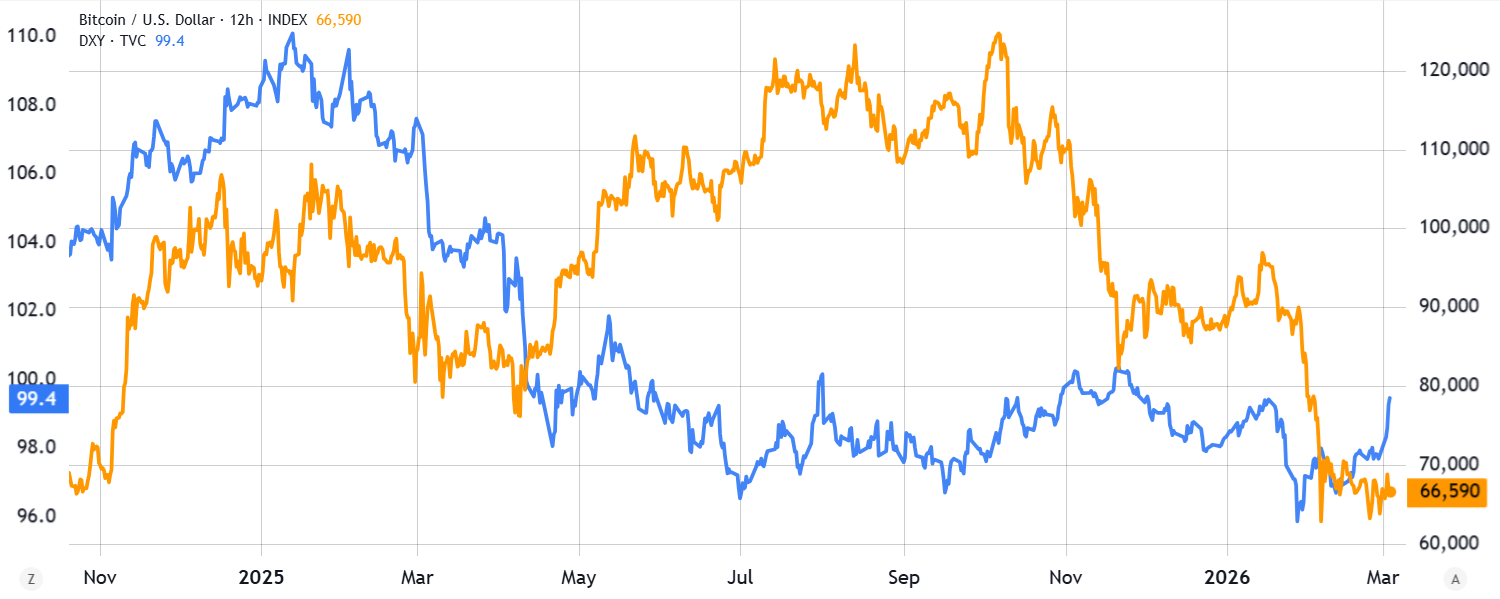
US Dollar Index (left) vs. Bitcoin/USD (right). Source: TradingView
The US dollar index (DXY) reached 99.4 on Tuesday, rising from 96.6 only three weeks earlier. This strength in the US dollar is attributed to investors seeking safety in cash and government bonds, signals typically associated with a risk-off environment. Conversely, periods of DXY weakness usually coincide with positive returns for Bitcoin, such as the bull run observed from March to August 2025.
However, a broader analysis shows the US Dollar Index remains well below the 105–110 range maintained from November 2024 to March 2025. The past 12 months in fact reflect consolidation rather than sustained strength. Bitcoin’s recent decoupling from tech stocks appears more significant, as the correlation had previously surged even with the Nasdaq 100 trading just 6% below its all-time high.
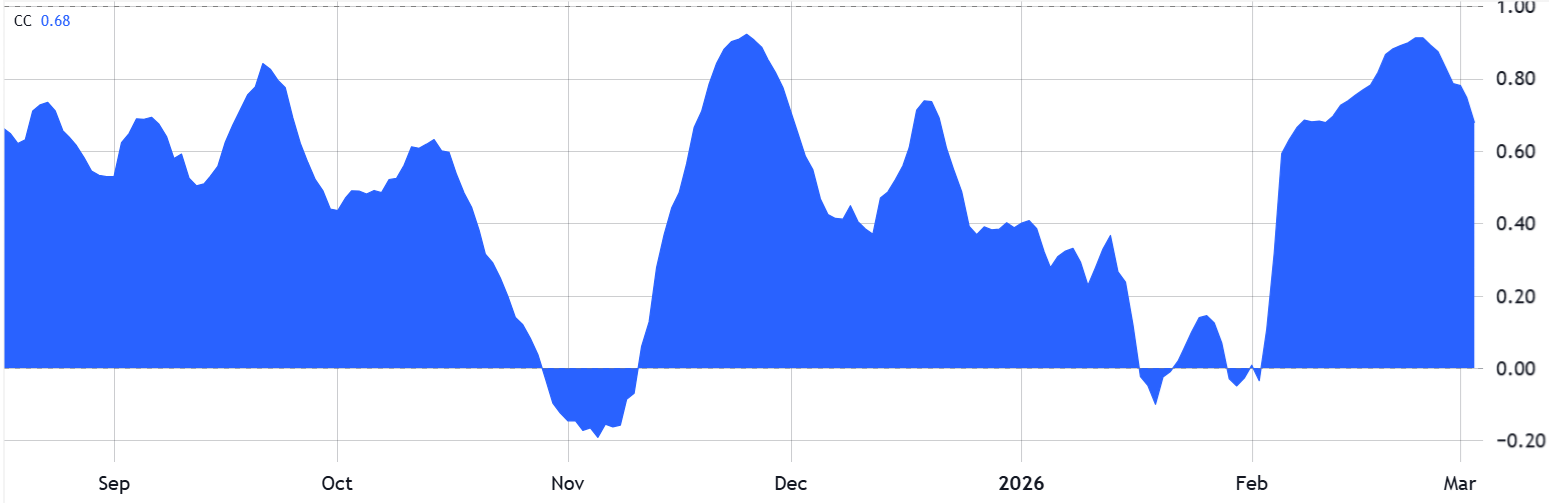
Bitcoin/USD 30-day correlation vs. Nasdaq 100 futures. Source: TradingView
The 30-day rolling correlation between Bitcoin and the Nasdaq 100 dropped to 69% after peaking at 92% one week prior. Bitcoin’s market identity has shifted repeatedly over time, being viewed variously as an independent monetary system, digital gold, an unstoppable onchain database or a speculative vehicle. Therefore, predicting a Bitcoin crash based solely on US dollar strength seems unjustified.
An undeniable lack of bullish momentum persists, likely driven by factors such as the Oct. 10, 2025, flash crash, quantum computing concerns, disappointment with the progress of a US Strategic Bitcoin Reserve and the shift of investor attention toward AI. Traders are also still searching for a specific catalyst for the decline toward $60,000, which heightens prevailing fear and uncertainty.
Bitcoin’s bear market enhances the impact of negative news
A recent US Securities and Exchange Commission (SEC) filing from MARA Holdings (MARA US) led market participants to misinterpret the company’s Bitcoin reserve strategy. Traders expressed concern that MARA might replicate the actions of other prominent listed miners, such as Cango (CANG US), Bitdeer (BTDR UR) and Core Scientific (CORZ US), which recently liquidated their entire Bitcoin holdings.

Source: X/RobSamuelsIR
Robert Samuels, MARA vice president of investor relations, denied those rumors, explaining that the company “may buy or sell from time to time,” which does not mean there is an intention to liquidate the majority of their reserves. Market participants may have acted impulsively before this clarification, largely because Bitcoin has been in a bear market while competitors shifted their core business models toward AI data centers.
Related: Bitcoin price chart ‘death cross’ is back, reviving late-cycle fears
Relative strength in the US Dollar Index should not be viewed as an automatic sell signal for Bitcoin. This is particularly true as the cryptocurrency shows resilience while gold exhibits signs of exhaustion, retesting $5,000 support following a 25% year-to-date rally in 2026. Bitcoin holders still face a difficult path toward regaining full confidence after a 52% contraction from the all-time high, though overall sentiment is beginning to improve.
The $1.5 billion in net inflows into Bitcoin exchange-traded funds since Feb. 24 serves as a clear indicator that institutional demand is accelerating. Nevertheless, traders will likely wait for a definitive breakout above $75,000 before concluding that the bear market has ended. Until that threshold is met, data points like the US Dollar Index will likely continue to exert some negative pressure on Bitcoin, regardless of the currently weak correlation.


Subscribe to daily byte-sized crypto news from Cointelegraph
This article is produced in accordance with Cointelegraph's Editorial Policy and is intended for informational purposes only. It does not constitute investment advice or recommendations. All investments and trades carry risk; readers are encouraged to conduct independent research.
More on the subject