

 Written by Nate Kostarstaff writerReviewed by Robert Lakinstaff editor
UAE-linked ADI Chain gains Ledger support amid stablecoin growth
Latest NewsPublishedMay 25, 2026
The integration gives ADI token holders access to Ledger’s self-custody platform as ADI Chain expands its stablecoin and tokenized asset network.

Ledger added native support for the $ADI token tied to ADI Foundation’s ADI Chain network, a UAE-linked, layer-2 focused on stablecoins and tokenized real-world assets.
ADI Chain is backed by Abu Dhabi-based Sirius International Holding, a subsidiary of International Holding Company, and backs the DDSC stablecoin ecosystem launched with First Abu Dhabi Bank. According to the company, the network is designed for institutional use cases including cross-border payments, treasury operations and trade settlement.
The integration allows users to store and manage $ADI through Ledger Wallet and the company’s hardware signing devices. ADI Foundation describes ADI Chain as infrastructure for regulated stablecoins and tokenized assets, with $ADI used as the network’s native gas token.
The announcement follows a recent 110 million dirham ($30 million) DDSC transfer disclosed by International Holding Company, which the company described as one of the largest publicly disclosed stablecoin transactions executed in the United Arab Emirates.
Related: UAE central bank says financial system stable amid missile and drone attacks
Euro-backed stablecoins expand despite limited market share
While dollar-backed stablecoins dominate the market, euro-denominated tokens account for more than 80% of the non-US dollar stablecoin sector, according to a March report from Dune Analytics commissioned by Visa. The report estimated the broader non-dollar stablecoin market at roughly $1.2 billion in supply, compared with a total stablecoin market exceeding $300 billion.
Dune said non-dollar stablecoins now process around $10 billion in monthly transfer volume, with euro-backed tokens increasingly used for payments, remittances, payroll and treasury operations. The report also pointed to growing adoption following the bloc's Markets in Crypto-Assets Regulation (MiCA), which introduced a formal framework for crypto asset service providers across the European Union.
However, an April report from advocacy group Blockchain for Europe claimed that MiCA’s strict reserve and interest rules have made euro stablecoins safer but less commercially competitive than US dollar-backed alternatives. The report cited DeFiLlama data showing euro stablecoins account for less than 1% of global stablecoin volume despite the euro’s broader role in international markets.
This month, the European Commission opened a review of MiCA rules governing stablecoins, reserve requirements and interest-bearing token products as officials reassess how the framework is functioning in practice.
Meanwhile, European institutions are accelerating efforts to develop local-currency stablecoin infrastructure. On May 20, euro stablecoin consortium Qivalis said it expanded to 37 member institutions after adding 25 banks across 15 countries ahead of a planned launch later this year. The group said the initiative is aimed at building a regulated euro-denominated alternative to US dollar-backed stablecoins.
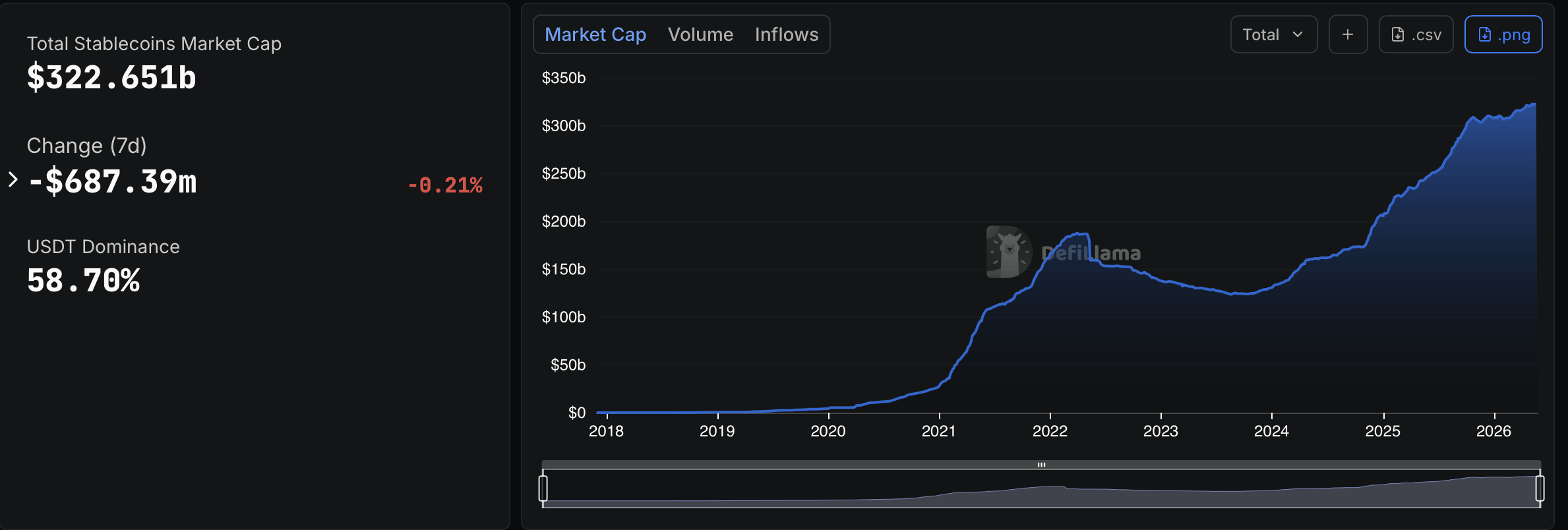
Stablecoin market cap. Source: DefiLlama
Magazine: ETH bears growling, Tom Lee’s buying, XRP to ‘explode’: Market Moves


Subscribe to daily byte-sized crypto news from Cointelegraph
Cointelegraph is committed to independent, transparent journalism. This news article is produced in accordance with Cointelegraph’s Editorial Policy and aims to provide accurate and timely information. Readers are encouraged to verify information independently.
More on the subject