


 Written by Zoltan Vardaistaff writerEdited by Bryan O'Sheastaff editor
Polymarket hit by fresh European crackdowns as Hungary, Portugal block access
Latest NewsPublishedJan 20, 2026
The moves highlight growing uncertainty over whether crypto prediction markets are to be treated as finance or gambling.

Update Jan. 20, 12:29 p.m. UTC: This article has been updated to include a paragraph on the details surrounding Portugal’s ban on Polymarket.
Hungary and Portugal have taken steps to restrict access to the crypto-based prediction market Polymarket, adding to mounting regulatory pressure on the platform across Europe.
Hungary’s regulatory authority, Szabályozott Tevékenységek Felügyeleti Hatósága, has temporarily blocked access to Polymarket’s domain and subdomains, citing the “forbidden organization of gambling activities.” According to an official notice released Friday, the restriction will remain in place until the authority completes its review.
Users reported being unable to access the platform using their Hungarian IP addresses, which now display a warning message from the country’s regulator.
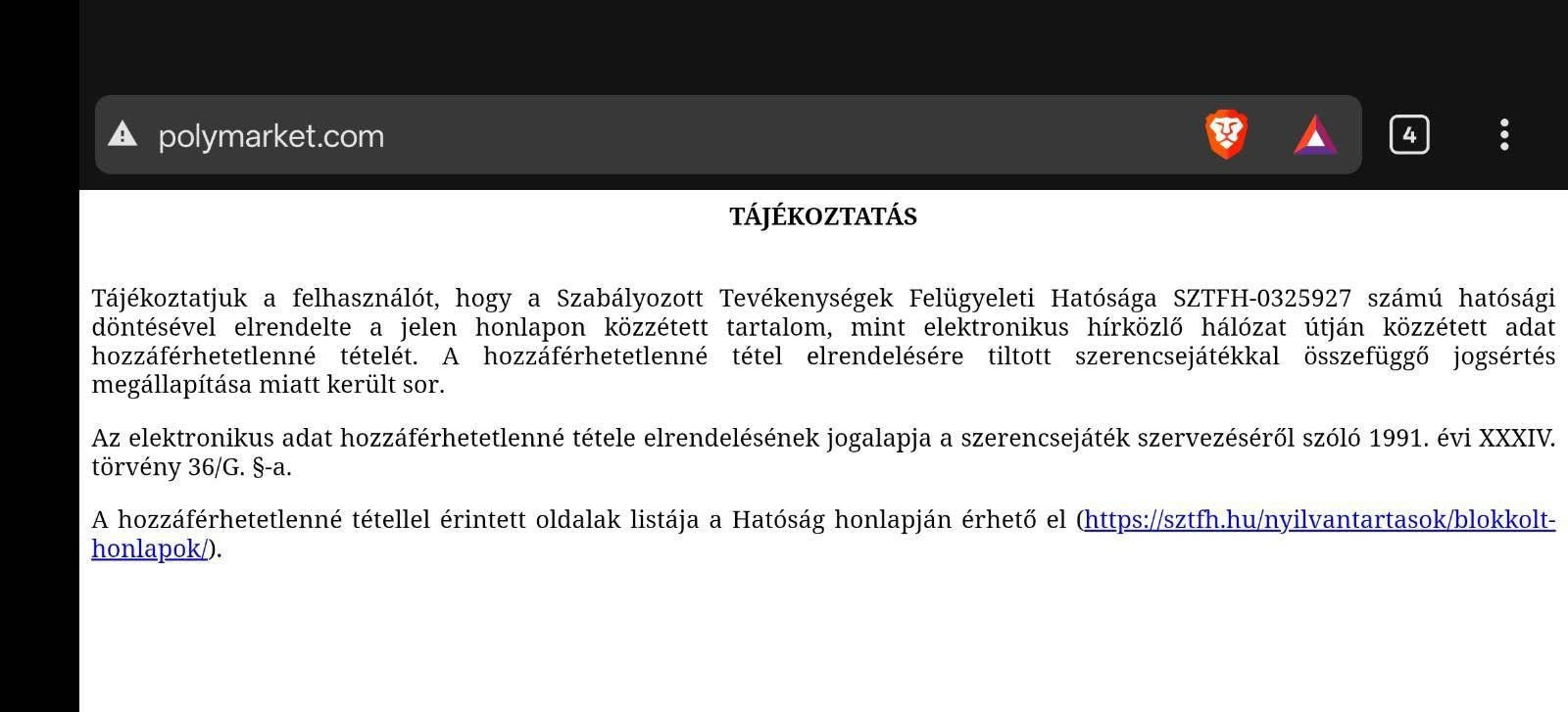
Hungarian regulatory authority’s message displayed when trying to access Polymarket for local users. Source: Deethz
In Portugal, the Gaming Regulation and Inspection Service (SRIJ) also ordered Polymarket to wind down activity in the country, but the platform was still available for users on Monday, according to local news outlet Rádio Renascença, suggesting enforcement was still in progress.
The regulator reportedly said Polymarket’s activity was illegal because the platform lacked the required license and operates in a country where political betting is banned nationwide. The report also identified about 4 million euros ($4.6 million) in wagers placed on Portuguese presidential races in the hours before the election results were announced, raising concerns about potential insider trading.
The latest crackdowns came a week after Ukraine blocked Polymarket, classifying its activities as unlicensed gambling under national law, Cointelegraph reported on Jan. 13.
Polymarket has also been restricted or blocked in several other countries over gambling concerns, including France, Belgium, Poland, Singapore and Switzerland.
France’s National Gaming Authority said in November 2024 that it planned to block the platform for failing to comply with national gambling laws. Switzerland followed later that month, when the Swiss Gambling Supervisory Authority classified Polymarket as unlicensed gambling and ordered access restrictions.
Poland added Polymarket to its registry of prohibited gambling websites on Jan. 8, 2025, and Singapore blocked access days later as part of a broader crackdown on unlicensed platforms. Belgium’s gambling regulator took similar action on Jan. 30, 2025, citing violations of the country’s gambling legislation.
Polymarket is already geoblocked in 33 countries, according to its website.
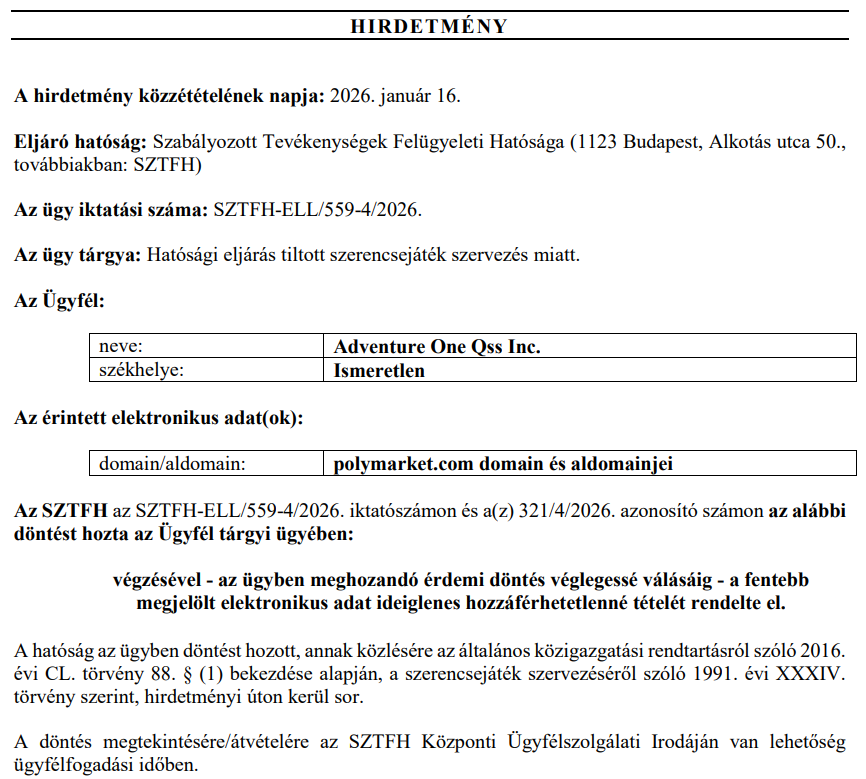
Hungarian regulatory authority blocks Polymarket access. Source: sztfh.hu
Related: ‘Elite’ traders hunt dopamine-seeking retail on prediction markets: 10x Research
Polymarket allows users to trade contracts tied to real-world outcomes, with prices set by market participants rather than a bookmaker. Supporters argue the model resembles financial markets more than traditional betting, while regulators in several jurisdictions have taken an opposing view.
Related: Prediction markets emerge as speculative ‘arbitrage arena’ for crypto traders
Polymarket faces scrutiny over insider trading
The Hungarian regulator’s decision follows a period of heightened scrutiny on Polymarket after a highly profitable bet on the removal of Venezuela’s president by the US raised insider trading concerns.
On Jan. 3, a Polymarket account placed a bet on a contract predicting that Nicolás Maduro would be removed from office just hours before US forces captured him in a military operation, netting the user about $400,000 in profit.
US lawmakers have since proposed legislation aimed at restricting political prediction market trading by government officials, adding to the regulatory spotlight on the sector.
Despite the mounting pressure, prediction market trading volume soared to a record $701.7 million on Jan. 12, with Polymarket competitor Kalshi accounting for about two-thirds.
Polymarket did not immediately respond to a request for comment on the latest regulatory actions.
Magazine: Train AI agents to make better predictions… for token rewards


Subscribe to daily byte-sized crypto news from Cointelegraph
Cointelegraph is committed to independent, transparent journalism. This news article is produced in accordance with Cointelegraph’s Editorial Policy and aims to provide accurate and timely information. Readers are encouraged to verify information independently.
More on the subject